
SKU: IOWC-1186
📋 GST Invoice Available

Waveshare ESP32-S3 4-Inch 480×480 Capacitive Touch Display Dev Board

₹4,299.00 (Inclusive of all taxes)
Out of Stock

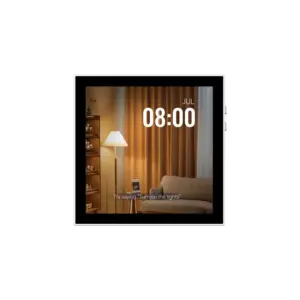
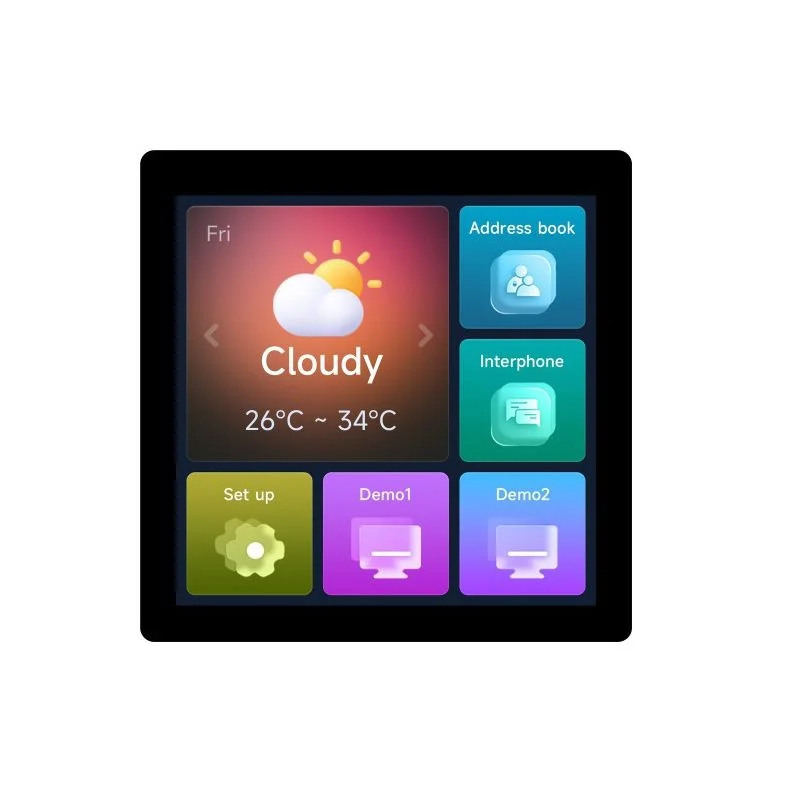
This Waveshare development board integrates an ESP32-S3 dual-core processor with a 4-inch capacitive touch IPS display, offering Wi-Fi, Bluetooth 5, and extensive I/O like CAN and RS485 for creating advanced GUI-based IoT control panels and industrial HMIs.

Features

  • High-resolution 4-inch IPS capacitive touchscreen with 480×480 resolution and 5-point touch via I2C for responsive GUI applications.
  • Powered by Espressif ESP32-S3 dual-core LX7 processor (up to 240MHz) with 16MB Flash and 8MB PSRAM for complex LVGL projects.
  • Integrated 2.4GHz Wi-Fi (802.11 b/g/n) and Bluetooth 5 (LE) with onboard antenna for wireless IoT connectivity.
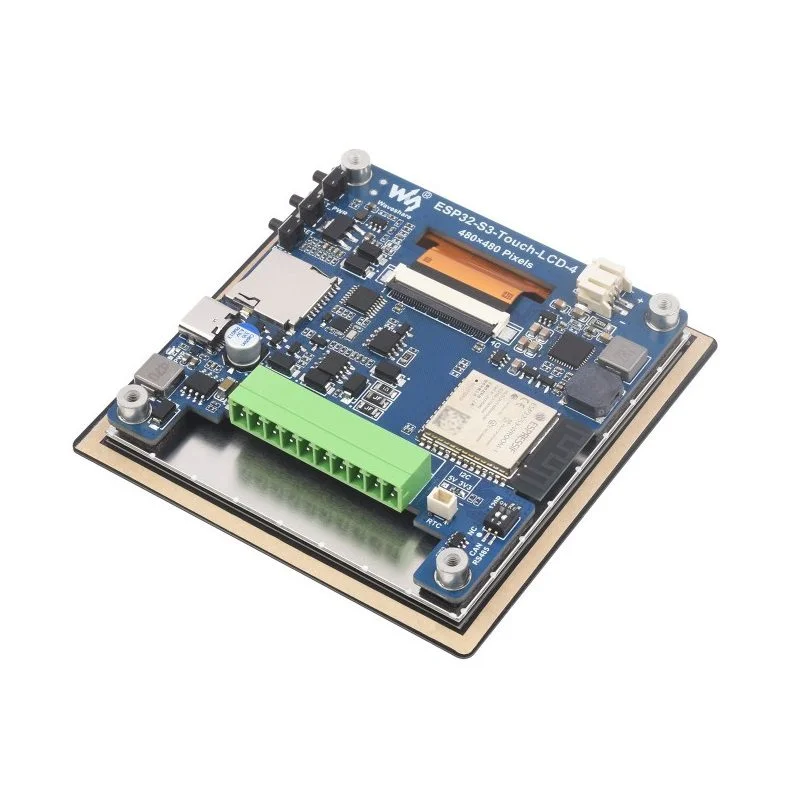
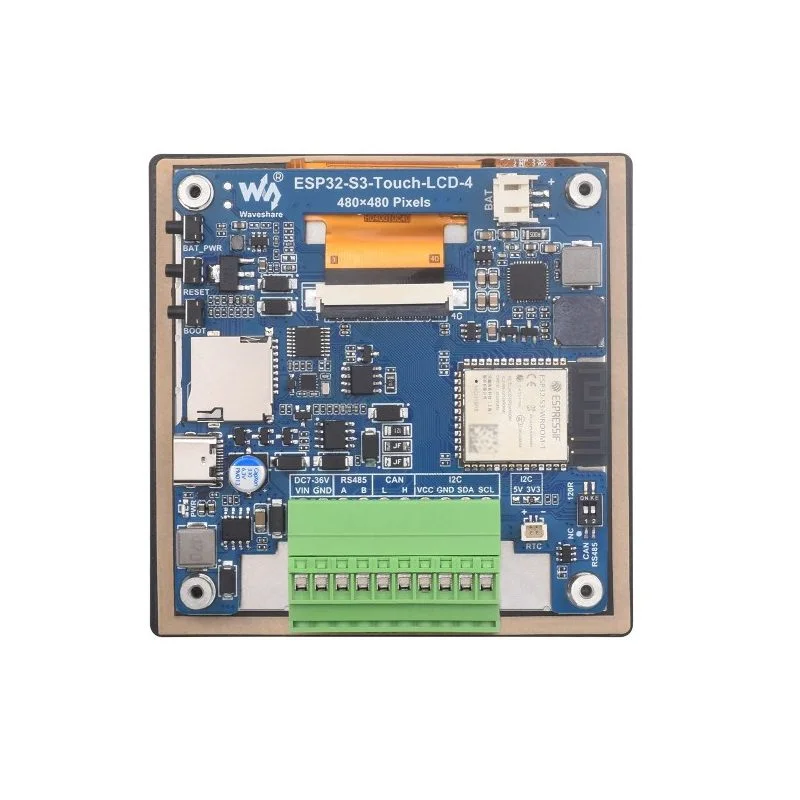
  • Comprehensive industrial interfaces including onboard CAN and RS485 transceivers, plus I2C, USB, and a TF card slot.
  • Flexible power input via USB Type-C (5V) or wide-range DC jack (7-36V) with battery management support for portable deployments.

Out of stock

Description

The Waveshare ESP32-S3 4-Inch Capacitive Touch Display Development Board is engineered for developers building sophisticated human-machine interfaces (HMIs) and smart control panels. It combines the wireless and processing power of the Espressif ESP32-S3 with a high-quality 4-inch IPS touchscreen, providing a robust hardware platform for GUI frameworks like LVGL.

Its architecture supports dual-core processing at up to 240MHz, coupled with substantial 16MB Flash and 8MB PSRAM, enabling smooth rendering of graphical elements and handling of multiple tasks. The inclusion of industrial-grade communication interfaces such as CAN and RS485 directly on the board makes it uniquely suited for integration into automation, telemetry, and control systems beyond typical maker projects.

Key Features

  • High-performance ESP32-S3 dual-core microcontroller with integrated 2.4GHz Wi-Fi and Bluetooth 5 LE for wireless IoT applications.
  • Vivid 4-inch IPS capacitive touch display with 480x480 resolution and 65K colors, supporting 5-point multi-touch input.
  • Ample memory configuration with 16MB Flash and 8MB PSRAM to handle complex graphical user interfaces and data logging.
  • Onboard industrial communication transceivers for CAN bus and RS485 (Modbus) protocols, enabling direct PLC and sensor network integration.
  • Flexible connectivity options including I2C for touch controller, USB Type-C for power/programming, and a microSD (TF) card slot for storage expansion.
  • Versatile power management supporting 5V USB input or a wide 7V to 36V DC supply, with provisions for battery operation and deep sleep modes.
  • Dual pluggable terminal blocks (bottom and back wiring) for clean integration into enclosures and industrial control panels.

Applications

  • Smart Home Control Panels and Automation Hubs with local GUI.
  • Industrial Human-Machine Interfaces (HMIs) for PLCs and monitoring systems.
  • Interactive Kiosks, Point-of-Sale (POS) terminals, and Information Displays.
  • IoT Gateway Devices with local display for sensor data visualization.
  • Prototyping advanced GUI applications using LVGL with Arduino IDE or ESP-IDF.

Technical Specifications

Microcontroller/SoCEspressif ESP32-S3 (Xtensa 32-bit LX7 dual-core, up to 240MHz)
Wireless Protocols2.4GHz Wi-Fi (802.11 b/g/n), Bluetooth 5.0 LE
Memory16MB Flash, 8MB PSRAM, 512KB SRAM, 384KB ROM
Display4-inch IPS Capacitive Touch, 480 x 480 resolution, 65K colors
Touch Support5-point capacitive touch (I2C interface)
InterfacesCAN, RS485, I2C, USB Type-C, TF Card Slot
Power SupplyUSB Type-C (5V) or DC Jack (7V - 36V)
Operating Temperature0°C to 65°C
DimensionsApprox. 120mm x 170mm (Board with display)

Frequently Asked Questions

What software frameworks are supported for programming this board?

The board is fully programmable using the Arduino IDE with the ESP32 board package or the official Espressif IoT Development Framework (ESP-IDF). For the touchscreen GUI, the Light and Versatile Graphics Library (LVGL) is highly recommended and works seamlessly with the provided memory resources. You can develop in C or C++, and MicroPython is also an option for rapid prototyping, though native performance is best with ESP-IDF.

How do I connect external sensors or actuators to the CAN and RS485 interfaces?

The onboard CAN (Controller Area Network) and RS485 interfaces are brought out to the pluggable terminal blocks. For CAN, connect the CAN_H and CAN_L wires to your bus, ensuring proper termination. For RS485, connect the A (positive) and B (negative) differential lines. You must configure the correct GPIO pins in your firmware (using libraries like ESP32-CAN or Modbus) and set the appropriate baud rate (e.g., 125kbps for CAN, 9600bps for Modbus) for communication with your industrial devices.

What is the power consumption in active and sleep modes?

Active power consumption depends on Wi-Fi/BLE usage and screen brightness, typically ranging from 200mA to 500mA at 5V. The ESP32-S3 supports deep sleep modes where most peripherals, including the display, are powered down, reducing current to microamps (μA). You can enable deep sleep via firmware to wake on timer or external trigger, making the board suitable for battery-powered applications when the display is not constantly active.

Package Includes

  • 1 x ESP32-S3-Touch-LCD-4 Development Board
  • 1 x Back Wiring 3.5mm Pitch 10-Pin Pluggable Terminal Block
  • 1 x Bottom Wiring 3.5mm Pitch 10-Pin Pluggable Terminal Block

Additional Information

Weight 0.13 kg
Dimensions 17 × 12 × 3 cm