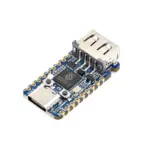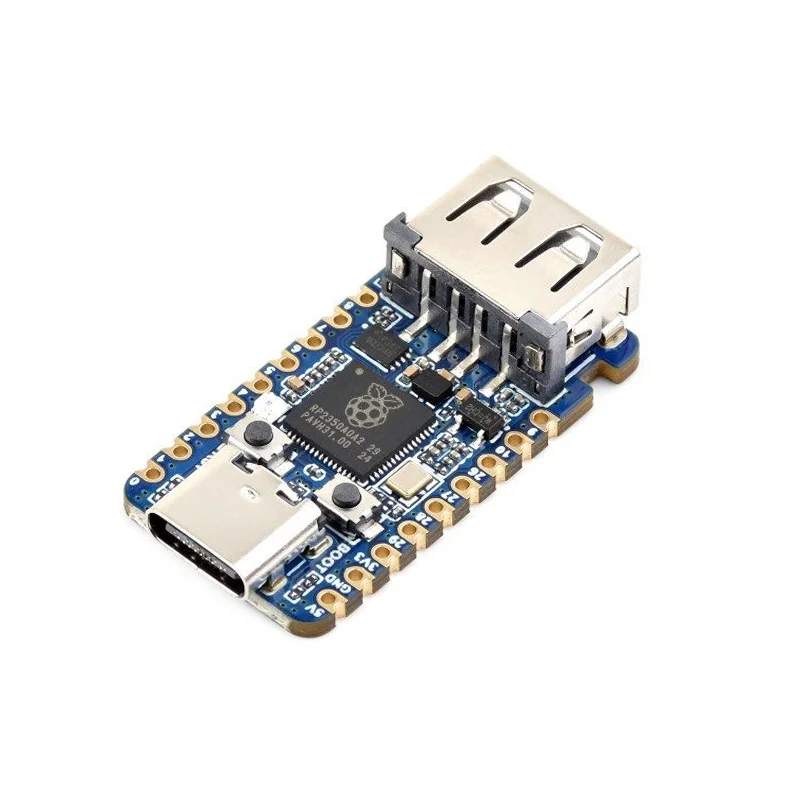
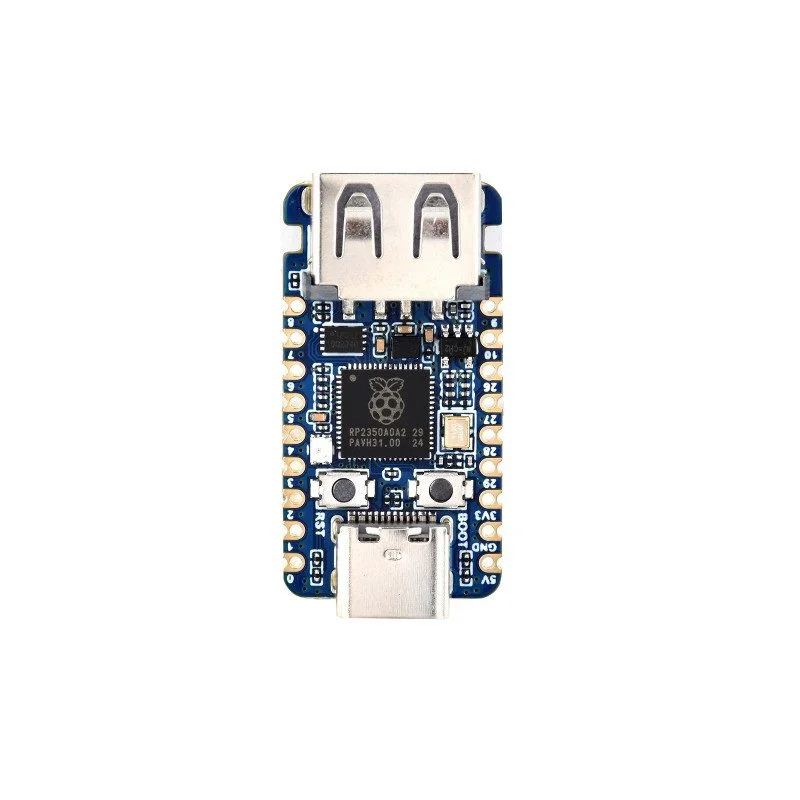
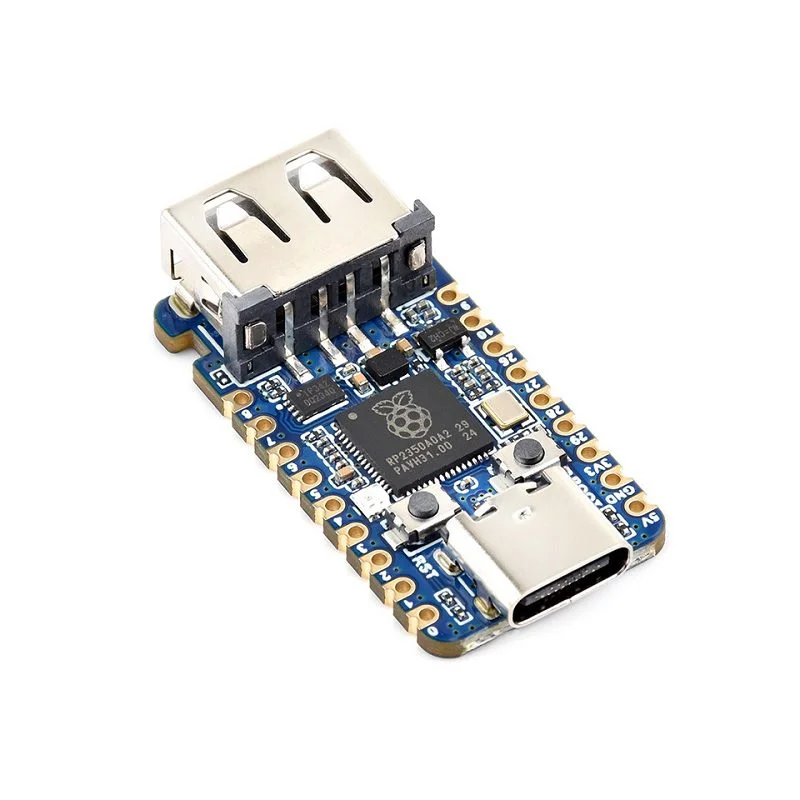
Waveshare RP2350A USB Mini Dev Board, Raspberry Pi Dual-Core MCU
The Waveshare RP2350A USB Mini Development Board is a compact, dual-core MCU platform based on the Raspberry Pi RP2350A, featuring a unique Arm Cortex-M33 and RISC-V core architecture. It supports drag-and-drop USB programming and is ideal for embedded projects requiring flexible I/O and low-power operation.
Features
- Dual-Core, Dual-Architecture MCU: Features a Raspberry Pi RP2350A with dual Arm Cortex-M33 and dual RISC-V cores for flexible, parallel task execution.
- High-Performance & Memory: Operates at 150MHz with 520KB SRAM and 2MB onboard Flash for demanding embedded applications.
- Versatile Connectivity & I/O: Includes USB-C for power/programming, a USB host port, 15 multi-function GPIOs, SPI, I2C, UART, ADC, PWM, and 12 programmable PIO state machines.
- Developer-Friendly Workflow: Supports drag-and-drop programming via USB mass storage, eliminating the need for dedicated programmers or debuggers.
- Compact & Integrable Form Factor: Castellated module edges allow direct soldering onto carrier boards for space-constrained, custom PCB designs.
Out of stock
The Waveshare RP2350A USB Mini Development Board provides a powerful and accessible entry point into embedded systems development using Raspberry Pi’s innovative microcontroller silicon. At its heart is the RP2350A, which combines a dual-core Arm Cortex-M33 processor cluster with a dual-core Hazard3 RISC-V processor, enabling developers to partition tasks across different instruction set architectures for optimized performance and power efficiency.
With a flexible clock speed up to 150MHz, substantial 520KB of SRAM, and 2MB of integrated Flash memory, this board handles complex logic, data buffering, and firmware storage with ease. Its comprehensive peripheral set includes multiple serial interfaces, high-resolution ADCs, precise PWM channels, and the unique Programmable I/O (PIO) blocks that allow for the creation of custom, bit-banged communication protocols without CPU overhead. The integrated USB 1.1 interface with device and host support, coupled with a modern USB-C connector, simplifies both connectivity to peripherals and the firmware update process.
Designed for low-power applications, the board supports sleep and dormant modes, making it suitable for battery-powered IoT nodes. The castellated module design facilitates direct integration into final products, bridging the gap between prototyping and production. This board is engineered for developers, makers, and professionals seeking a capable, small-form-factor platform for sensor interfacing, motor control, custom USB devices, and other embedded computing tasks.
Additional Information
| Weight | 0.007 kg |
|---|---|
| Dimensions | 3 × 5 × 2 cm |