SKU: IOWC-0691
📋 GST Invoice Available

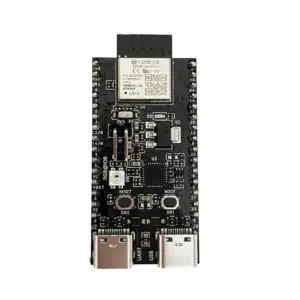
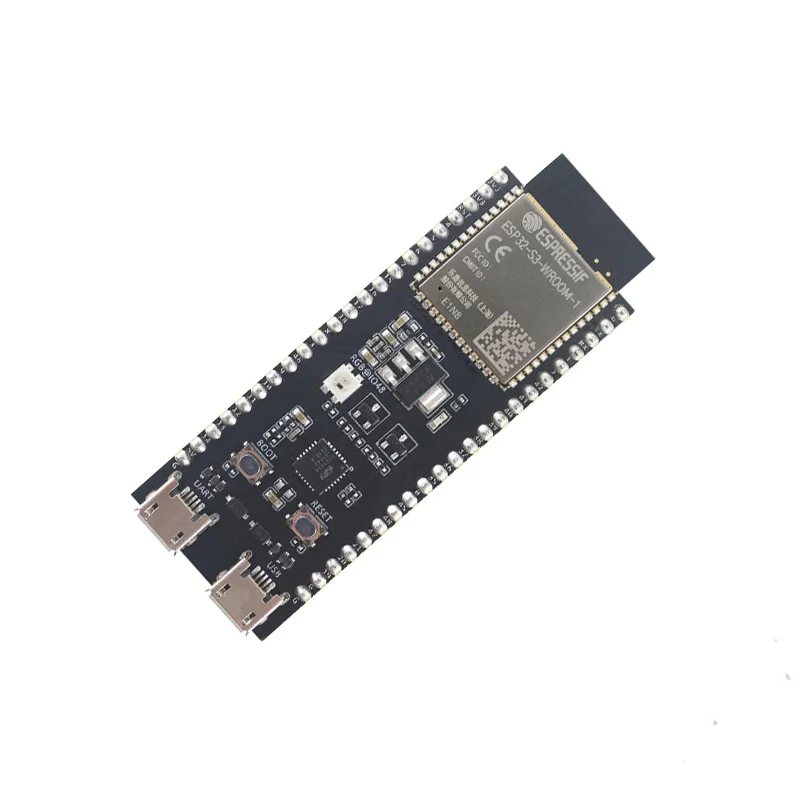
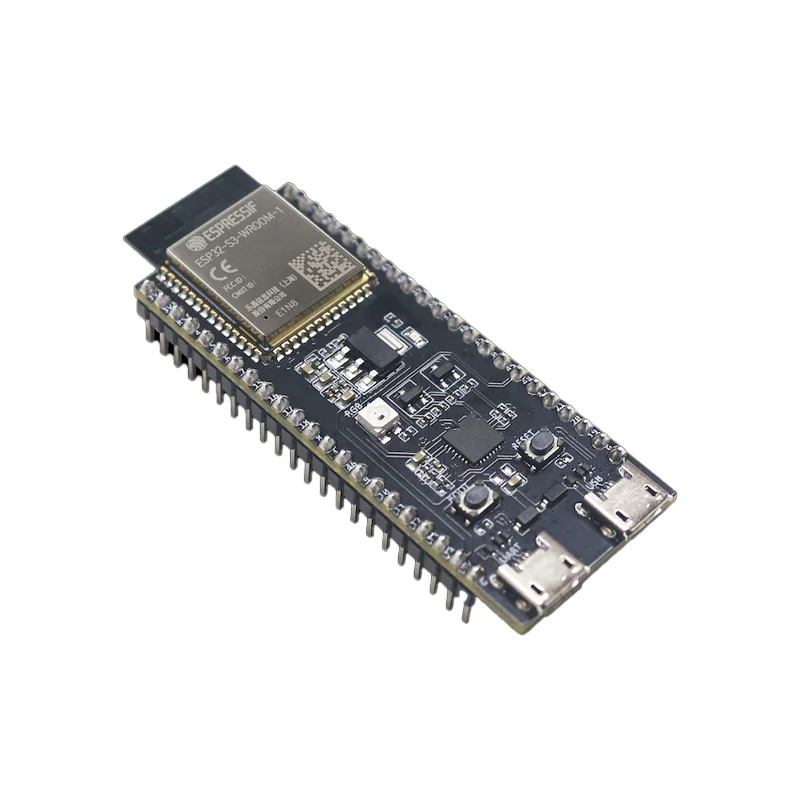
Espressif ESP32-S3-DevKitC-1-N8R8 Development Board

₹1,839.00 (Inclusive of all taxes)
Out of Stock

The Espressif ESP32-S3-DevKitC-1-N8R8 is a versatile AIoT development board powered by the ESP32-S3 SoC, featuring dual-core LX7 processing, 8MB PSRAM, 8MB Flash, and integrated Wi-Fi 6 & Bluetooth 5.0 LE connectivity for rapid IoT and edge computing prototyping.

Features

  • ESP32-S3 SoC with dual-core Xtensa LX7 processor for enhanced AIoT and edge computing performance.
  • Integrated Wi-Fi 6 (802.11ax) and Bluetooth 5.0 LE for robust, low-power wireless connectivity.
  • 8MB PSRAM and 8MB Flash memory for handling complex applications and data buffering.
  • Comprehensive peripheral interfaces: GPIO, SPI, I2C, I2S, UART, PWM, ADC, and DAC pins exposed.
  • Onboard USB-to-UART bridge and JTAG interface for simplified programming, debugging, and firmware updates.

Out of stock

Description

The Espressif ESP32-S3-DevKitC-1-N8R8 is a compact, high-performance development platform centered on the ESP32-S3 system-on-chip. It combines a dual-core Xtensa LX7 processor with integrated Wi-Fi 6 and Bluetooth 5.0 LE radios, providing a solid foundation for demanding IoT, smart home, and AI acceleration projects. The inclusion of 8MB PSRAM significantly boosts performance for memory-intensive tasks like voice recognition and image processing.

Engineered for low-power operation, the board supports multiple sleep modes, making it suitable for battery-powered edge devices. Its extensive I/O breakout includes standard communication protocols (SPI, I2C, I2S, UART) and analog interfaces (ADC, DAC), offering maximum flexibility for sensor integration and peripheral control. The onboard USB-to-UART bridge and accessible JTAG signals streamline the development workflow, from initial code upload to in-depth hardware debugging.

Key Features

  • Powered by the ESP32-S3 SoC with dual-core Xtensa LX7 processor for high computational throughput.
  • Integrated Wi-Fi 6 (802.11ax) ensures high-speed, reliable wireless data transfer with improved network efficiency.
  • Bluetooth 5.0 Low Energy (LE) enables energy-efficient short-range communication for sensor networks and wearables.
  • Hardware support for Zigbee and Thread (IEEE 802.15.4) protocols via the 2.4 GHz radio, enabling multiprotocol IoT gateways.
  • 8MB of external PSRAM provides ample memory for AI model inference, graphics buffers, and complex data processing.
  • 8MB of Flash memory offers substantial storage for application code, filesystems, and OTA updates.
  • Comprehensive GPIO and peripheral access simplifies interfacing with displays, sensors, actuators, and communication modules.
  • Advanced power management with multiple low-power modes (including deep sleep) maximizes battery life in field deployments.

Applications

  • AIoT and Edge Computing: Local AI inference for voice control, image recognition, and predictive maintenance.
  • Smart Home Automation: Multiprotocol hubs controlling Zigbee, Thread, BLE, and Wi-Fi devices.
  • Industrial IoT (IIoT): Wireless sensor nodes for telemetry, condition monitoring, and process control.
  • Wearable Tech: Low-power fitness trackers, smart watches, and health monitoring devices.
  • Rapid Prototyping: General-purpose development platform for embedded systems and IoT proof-of-concepts.

Technical Specifications

Microcontroller/SoCESP32-S3 (ESP32-S3-WROOM-1-N8R8)
ProcessorDual-core Xtensa LX7
Wireless ProtocolsWi-Fi 6 (802.11ax), Bluetooth 5.0 LE, Zigbee/Thread (IEEE 802.15.4)
Flash Memory8 MB
PSRAM8 MB
InterfacesGPIO, SPI, I2C, I2S, UART, PWM, ADC, DAC, JTAG
Programming InterfaceUSB-C (USB-to-UART bridge)
Operating Voltage5V via USB, 3.3V I/O
Dimensions (Shipping)10 x 6 x 3 cm
Weight (Shipping)0.05 kg

Frequently Asked Questions

What development frameworks are supported for programming the ESP32-S3-DevKitC-1-N8R8?

The board is fully supported by Espressif's official ESP-IDF framework for advanced feature access and low-level control. It is also compatible with the Arduino Core for ESP32 via the Arduino IDE for quicker prototyping, and MicroPython for scripting. PlatformIO offers a versatile environment supporting both IDF and Arduino cores. You typically connect via the onboard USB-C port, select the correct COM port, and flash using the esptool.py utility included with these frameworks. (46 words)

How do I enable and use the Zigbee or Thread protocol support on this board?

Zigbee and Thread support is provided via the integrated IEEE 802.15.4 radio in the ESP32-S3. You must use the ESP-IDF v5.0 or later and install the esp-zigbee-sdk or esp-thread-sdk from Espressif's GitHub. Development involves configuring the network coordinator or end-device roles, compiling the example projects, and flashing the firmware. The board can act as a multiprotocol gateway, concurrently managing Wi-Fi/BLE and a Zigbee or Thread network. (50 words)

What is the purpose of the 8MB PSRAM, and how do I utilize it in my application?

The 8MB PSRAM (Pseudo Static RAM) serves as external, high-speed volatile memory for data-intensive tasks. It is essential for buffering camera frames, storing audio samples, holding large graphics buffers for displays, or loading machine learning model weights. In ESP-IDF, you enable it via menuconfig (`Component config > ESP32S3 Specific > Support for external, SPI-connected RAM`). The memory is then automatically allocated for certain functions or can be manually managed using `heap_caps_malloc()`. (50 words)

What are the power supply requirements and how low can the sleep current go?

The board is primarily powered via the USB-C port at 5V, which is regulated down to 3.3V for the core and I/O. For battery operation, you can supply 3.3V directly to the appropriate pins, bypassing the onboard regulator. The ESP32-S3 SoC itself supports ultra-low-power sleep modes. In deep sleep, with the UART and radios disabled, current consumption can drop to the microamp range (typically 5-10 µA), allowing for months of operation on a single charge. (50 words)

Package Includes

  • 1 x Espressif ESP32-S3-DevKitC-1-N8R8 Development Board

Additional Information

Weight 0.05 kg
Dimensions 6 × 10 × 3 cm