SKU: IOWC-1640
📋 GST Invoice Available

XY-MK-5V RF Transmitter Receiver Module 433MHz Wireless Link Kit

₹98.00 (Inclusive of all taxes)
Out of Stock

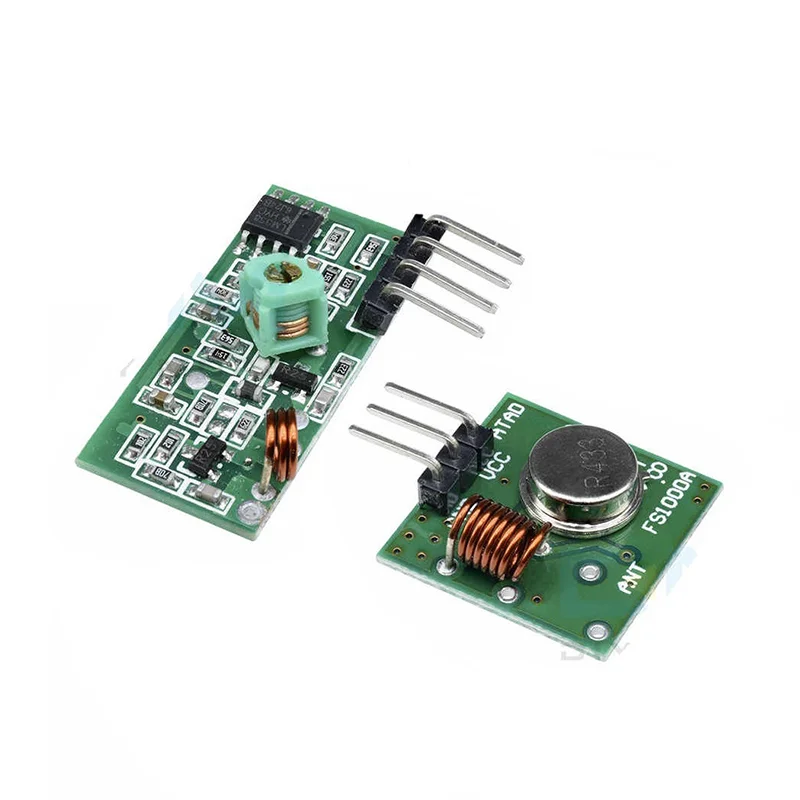
This 433MHz RF transmitter and receiver kit provides a simple one-way wireless data link for Arduino, Raspberry Pi, and other microcontrollers, operating at 5V with a range up to 200 meters.

Features

  • Operates on the global 433MHz ISM band for reliable, license-free wireless communication.
  • Receiver features high sensitivity of -105 dB for stable long-range links up to 200 meters.
  • Low quiescent current of 4mA on the receiver enables power-efficient remote sensing applications.
  • Transmitter supports a wide 3.5V to 12V input range, allowing flexible integration with 3.3V or 5V logic systems.
  • Compact modules are breadboard-friendly for rapid prototyping and simple serial data control.

Out of stock

Description

This 433MHz RF link kit consists of a matched transmitter and receiver pair designed for straightforward wireless serial communication between microcontrollers. The system employs Amplitude Modulation (AM) at a data rate of 4 KB/s, suitable for transmitting sensor readings, remote control signals, or telemetry data. The receiver module operates at a stable 5V supply with low standby current, making it ideal for battery-powered nodes, while the transmitter’s flexible voltage input accommodates various power sources.

The link is optimized for one-way communication, requiring a second pair on a different frequency for full duplex operation. An external wire antenna can be attached to the transmitter to extend the operational range, which varies from 20 to 200 meters depending on environmental conditions and supply voltage. This kit is a fundamental building block for DIY IoT projects, remote controls, and simple wireless sensor networks.

Key Features

  • License-free 433MHz operation for global deployment in IoT and remote control projects.
  • High-receiver sensitivity (-105 dB) ensures reliable data reception at extended ranges.
  • Low-power receiver design with 4mA quiescent current for energy-conscious applications.
  • Wide transmitter voltage range (3.5V-12V) supports compatibility with 3.3V and 5V logic families.
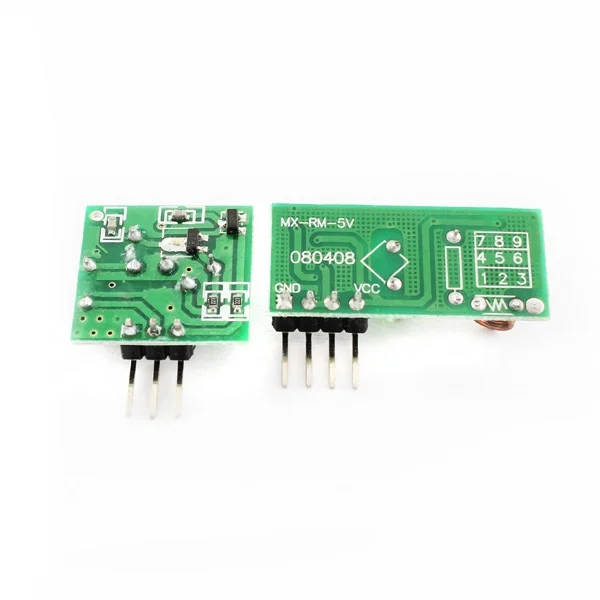
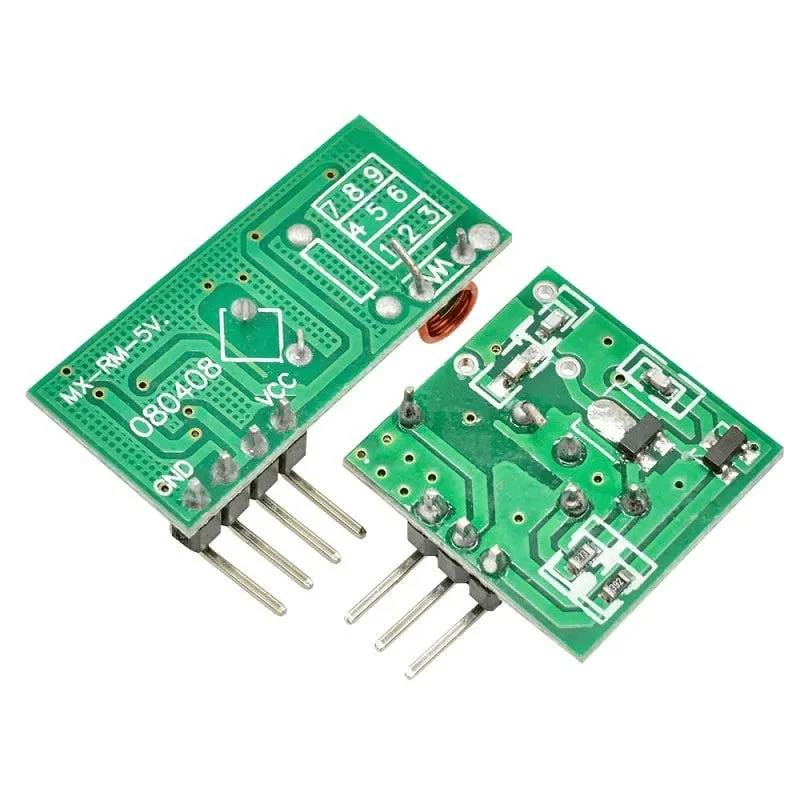
  • Simple three-pin interface (VCC, GND, DATA) for easy integration with Arduino, Raspberry Pi, and other MCUs.
  • Compact, breadboard-friendly form factor enables rapid prototyping and testing.
  • Supports Amplitude Modulation (AM) for robust data transmission in various environments.

Applications

  • Simple wireless sensor nodes for temperature, humidity, or door/window status.
  • Remote control systems for garage doors, lighting, or DIY robotics.
  • Basic telemetry links for RC planes, drones, or model vehicles.
  • One-way data transmission from remote field sensors to a central gateway.
  • Educational projects demonstrating fundamental RF communication principles.

Technical Specifications

Wireless ProtocolAM (Amplitude Modulation)
Frequency Range433 MHz
RF Transmit Power10 mW
Receiver Sensitivity-105 dB
Data Rate4 KB/s
Transmitter Supply Voltage3.5V - 12V
Receiver Supply Voltage5V
Receiver Quiescent Current4 mA
Communication Range20 - 200 meters
Transmitter Dimensions19 x 19 mm
Receiver Dimensions30 x 14 x 7 mm
AntennaExternal wire (approx. 25cm)

Frequently Asked Questions

How do I connect this 433MHz RF kit to an Arduino Uno for basic transmission?

Connect the transmitter module's VCC pin to Arduino's 5V, GND to GND, and DATA to a digital pin (e.g., D12). For the receiver, connect its VCC to 5V, GND to GND, and DATA to another digital pin (e.g., D11). Use the VirtualWire or RCSwitch library to encode and decode data. Ensure you use a common ground between all devices and consider adding a decoupling capacitor near the module's power pins for stable operation. The transmitter can run on voltages from 3.5V to 12V, affecting range.

What is the effective communication range, and how can I improve it?

The rated range is 20 to 200 meters, heavily dependent on environment, obstructions, antenna, and supply voltage. To maximize range, power the transmitter at its maximum 12V, use a proper 1/4 wavelength (approx. 17.3cm) wire antenna soldered to the ANT pad, and ensure a clear line of sight. Elevate both modules, avoid sources of electrical noise like motors or switching power supplies, and orient antennas vertically. The receiver's high -105 dB sensitivity helps, but interference from other 433MHz devices (e.g., car key fobs) can reduce reliability.

Can I use this module for two-way communication between two Arduinos?

No, this specific kit provides only one-way communication as it includes one transmitter and one receiver tuned to 433MHz. For bidirectional communication, you need two kits with the transmitter and receiver pairs operating on two distinct frequencies (e.g., 433MHz and 315MHz). Alternatively, you can use a true transceiver module. For this kit, one Arduino can only send, and the other can only receive. You would need to implement a protocol to alternate control if using two frequencies for simple duplex.

What libraries or code examples are compatible with this 433MHz RF module?

For Arduino, the most common libraries are VirtualWire and RCSwitch. VirtualWire provides robust data encoding with CRC checks, while RCSwitch is tailored for simulating remote controls. In your sketch, initialize the library with the correct data pin numbers, set the transmission speed (typically 2000 bits/s for reliable operation with these modules), and use the send() and receive() functions. For Raspberry Pi, you can use the `433Utils` suite or Python libraries like `Raspberry Pi-rf`. Remember these modules use AM, not digital packet radio, so error checking is not inherent.

Package Includes

  • 1 x RF Transmitter Module (433MHz)
  • 1 x RF Receiver Module (433MHz)

Additional Information

Weight 0.085 kg
Dimensions 4 × 4 × 3 cm