SKU: IOWC-1406
📋 GST Invoice Available

Sony Spresense Main Board CXD5602 IoT Development Board

₹6,859.00 (Inclusive of all taxes)
Out of Stock

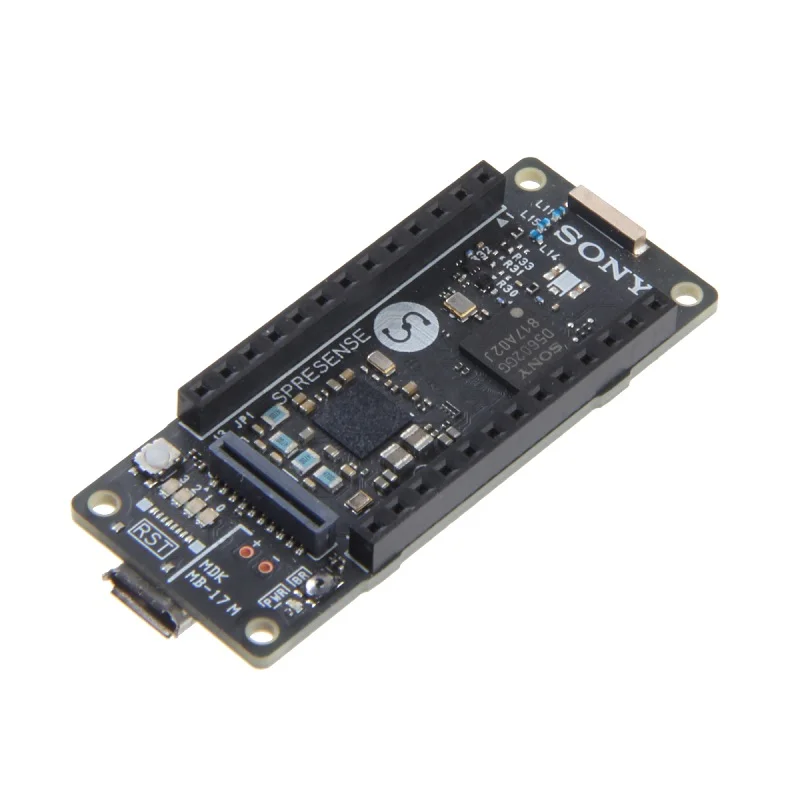
The Sony Spresense Main Board is a compact, low-power IoT development platform centered on the CXD5602 hexa-core ARM Cortex-M4F microcontroller, featuring integrated GNSS (GPS/GLONASS) and a high-resolution audio codec. It is programmable via the Arduino IDE or the NuttX-based SDK for advanced audio, location, and sensor applications.

Features

  • Hexa-Core Processing Power: Features Sony’s CXD5602 microcontroller with six ARM Cortex-M4F cores running at 156 MHz, delivering extensive computing performance for complex IoT tasks.
  • Integrated Multi-GNSS Receiver: Onboard GNSS supports GPS, GLONASS, Galileo, BeiDou, and QZSS, enabling high-precision, low-power positioning for tracking applications.
  • High-Resolution Audio Codec: Includes a 192kHz/24-bit audio codec and digital amplifier, supporting stereo output and up to 8 digital microphone inputs for advanced audio processing.
  • Rich Connectivity & Expansion: Offers GPIO, SPI, I2C, UART, PWM, I2S interfaces, a dedicated camera connector, and a 100-pin expansion header for add-ons like LTE, Wi-Fi, and sensors.
  • Developer-Friendly Platform: Supported by both the Arduino IDE for rapid prototyping and the NuttX-based Spresense SDK for deeper, real-time OS development.

Out of stock

Description

The Sony Spresense Main Board is a sophisticated IoT development platform engineered around Sony’s power-efficient CXD5602 microcontroller. Built on FD-SOI technology, its six ARM Cortex-M4F cores provide substantial processing headroom for data-intensive applications like audio analysis, sensor fusion, and real-time location tracking, all while maintaining ultra-low power consumption critical for battery-operated devices.

This board uniquely combines high-fidelity audio capabilities with precise global navigation. The integrated GNSS receiver supports multiple satellite constellations, offering reliable positioning for asset trackers, drones, or environmental monitors. Simultaneously, the high-resolution audio subsystem enables development of voice-controlled interfaces, acoustic sensing, and digital audio recording projects. The platform’s extensible design, via its camera interface and expansion connector, allows seamless integration with Sony’s add-on boards for cellular, wireless, and vision-based functionalities.

Key Features

  • Sony CXD5602 Hexa-Core MCU: Six ARM Cortex-M4F cores at 156 MHz provide high computational performance for multitasking IoT applications.
  • Integrated Multi-GNSS Positioning: On-chip GNSS supports GPS, GLONASS, Galileo, BeiDou, and QZSS for accurate, global location tracking with low power draw.
  • High-Resolution Audio Processing: 192kHz/24-bit audio codec and ADC with support for 8-channel digital microphone input and stereo BTL amplifier output.
  • Comprehensive Development Support: Programmable via the familiar Arduino IDE or the advanced, NuttX-based Spresense SDK for full RTOS capabilities.
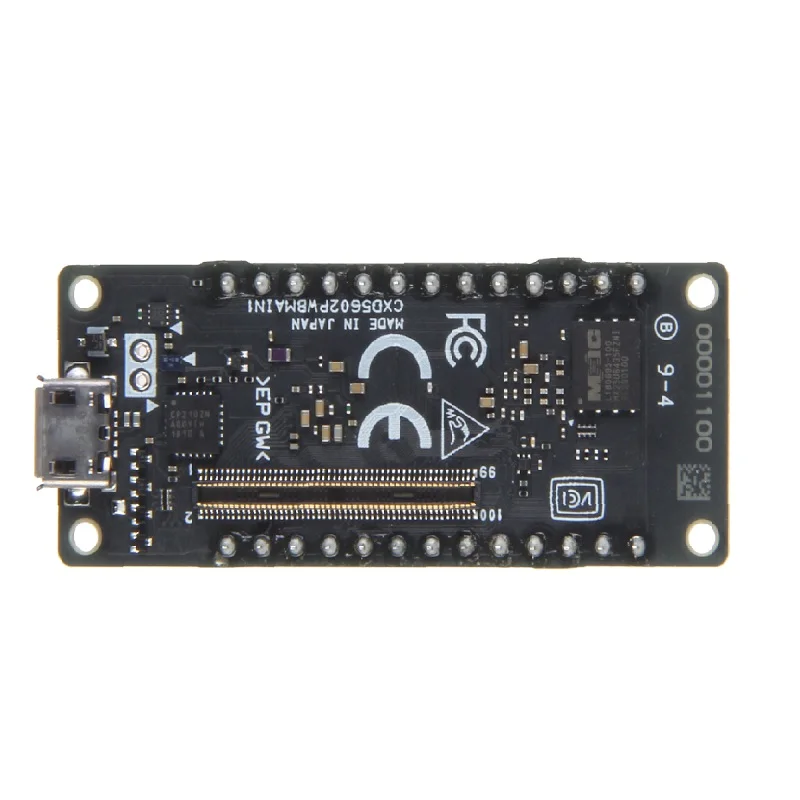
  • Extensive I/O and Expansion: Features GPIO, SPI, I2C, UART, PWM, I2S, 2x ADC channels, a camera interface (CN5), and a 100-pin expansion header (CN4) for modular add-ons.
  • Compact and Feature-Packed Design: Small PCB footprint includes a micro-USB debug interface, 4 user LEDs, a reset button, and an onboard GNSS antenna.

Applications

  • Precision Asset & Fleet Tracking: Develop low-power GPS/GNSS trackers for logistics, wildlife monitoring, or vehicle telemetry.
  • Smart Audio Devices: Build voice-activated assistants, multi-channel audio recorders, or acoustic environmental sensors.
  • Drone & Robotics Navigation: Implement real-time positioning and sensor fusion for autonomous navigation systems.
  • IoT Sensor Hubs: Create central nodes that collect data from multiple sensors (via I2C/SPI), process it on-board, and transmit via add-on cellular or Wi-Fi modules.
  • Camera-Enabled Edge AI: Utilize the camera interface for vision-based projects like object detection, time-lapse photography, or security systems.

Technical Specifications

Microcontroller / SoCSony CXD5602GG (ARM Cortex-M4F x 6 cores)
Max Clock Frequency156 MHz
Flash Memory8 MB
SRAM1.5 MB
Wireless / PositioningIntegrated GNSS (GPS, GLONASS, Galileo, BeiDou, QZSS)
Audio Codec192 kHz / 24-bit, 8-ch Digital Mic Input, Stereo Output
Digital InterfacesGPIO, SPI, I2C, UART, PWM, I2S
Analog Inputs2 channels (0.7V range)
Expansion Connectors100-pin header (CN4), Camera connector (CN5)
Debug InterfaceMicro USB Type-B
User Indicators4x Green User LEDs, 1x Blue Power LED
ButtonsReset, Boot Recovery
Dimensions (approx.)8 cm x 6 cm

Frequently Asked Questions

How do I start programming the Sony Spresense board?

You can begin development using the Arduino IDE by installing the Spresense board package from the Board Manager. For more advanced features and real-time OS control, download and install the Spresense SDK, which is based on the NuttX RTOS. Connect the board via the micro-USB port for both power and serial communication. The SDK provides examples for GNSS, audio, and camera functionalities to jumpstart your project.

What is the power consumption of the Spresense main board during operation?

The Spresense board is designed for low-power IoT applications. Exact current draw depends on active cores and peripherals like the GNSS receiver. Utilizing the FD-SOI technology of the CXD5602 and its deep sleep modes can significantly reduce power for battery-powered deployments. For precise measurements, refer to the current consumption graphs in the Sony Spresense technical documentation for different operational states.

Can I connect an external antenna to the onboard GNSS receiver?

The main board includes an integrated GNSS patch antenna. For applications requiring improved signal reception or specific placement, you can solder an external antenna connector. Consult the Spresense hardware guide for the pinout and impedance matching requirements (typically 50 ohms) for an external passive antenna to maintain GPS/GNSS sensitivity and accuracy in your final design.

What types of cameras are compatible with the Spresense camera interface?

The dedicated camera connector (CN5) supports Sony's compatible add-on camera boards. You cannot directly connect a standard Raspberry Pi or Arduino camera module. You must use the officially supported Spresense camera extension board, which interfaces with the main board's parallel camera bus. This allows for streaming image data to the hexa-core processor for computer vision or recording applications.

Package Includes

  • 1 x Sony Spresense Main Board (CXD5602)

Additional Information

Weight 0.019 kg
Dimensions 6 × 8 × 2.5 cm