SKU: IOWC-1127
📋 GST Invoice Available

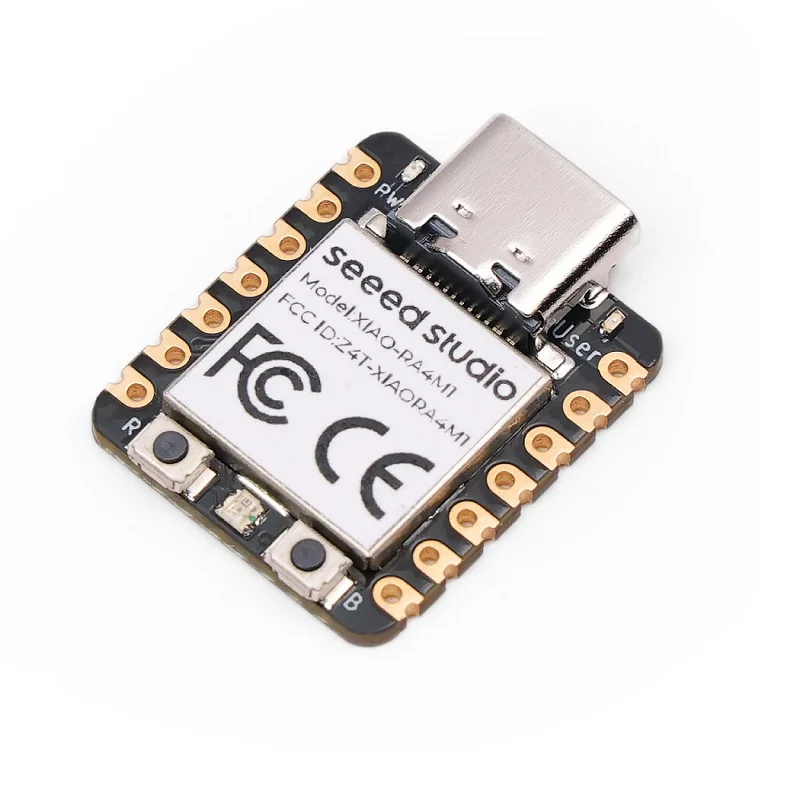
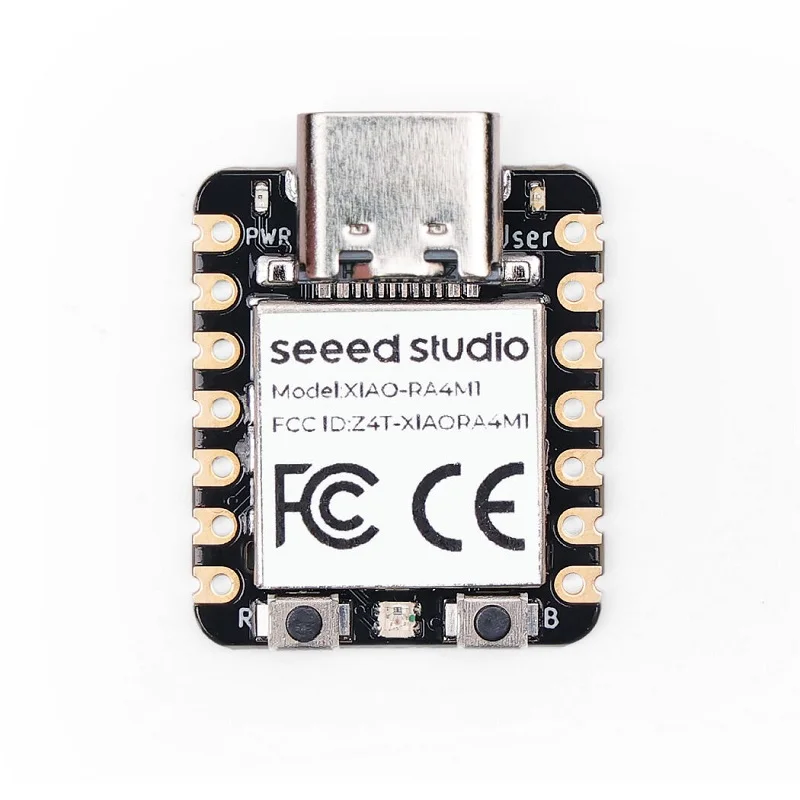
Seeed Studio Studio XIAO RA4M1 Dev Board - Renesas RA4M1 Cortex-M4

₹999.00 (Inclusive of all taxes)
Out of Stock

The Seeed Studio Studio XIAO RA4M1 is a thumb-sized development board powered by a Renesas RA4M1 32-bit ARM Cortex-M4 MCU at 48 MHz. Fully compatible with the Arduino IDE, it features 256KB Flash, 32KB SRAM, and hardware security for embedded IoT prototyping.

Features

  • Renesas RA4M1 32-bit ARM Cortex-M4 MCU running at 48 MHz with 256 KB Flash and 32 KB SRAM.
  • Compact thumb-sized design measuring just 21 x 17.8 mm, ideal for space-constrained wearable and portable applications.
  • Enhanced I/O with 19 total GPIOs, including 14-bit ADC, 12-bit DAC, CAN BUS, USB 2.0, and an onboard RGB LED.
  • Built-in hardware security features including AES-128/256 encryption, secure boot, and secure key storage.
  • Low-power operation with deep sleep current as low as 45μA and integrated lithium battery charge management.

Out of stock

Description

The Seeed Studio Studio XIAO RA4M1 is a production-ready, ultra-compact development board built around the Renesas RA4M1 microcontroller. This 32-bit ARM Cortex-M4 core operates at 48 MHz and includes a floating-point unit (FPU), 256 KB of Flash memory, and 32 KB of SRAM, providing a robust platform for embedded applications requiring both performance and security.

Designed with system integration in mind, the board features a comprehensive set of peripherals including a 14-bit ADC, 12-bit DAC, CAN BUS, and USB 2.0 Full-Speed interface. Its power architecture supports multiple low-power modes, achieving a deep sleep current of just 45μA, and includes a battery management circuit for portable, battery-operated IoT nodes. The classic XIAO form factor and SMD design with stamp holes facilitate easy embedding into final products.

Key Features

  • Powered by the Renesas RA4M1 (R7FA4M1AB3CFM), a 48 MHz ARM Cortex-M4 MCU with FPU.
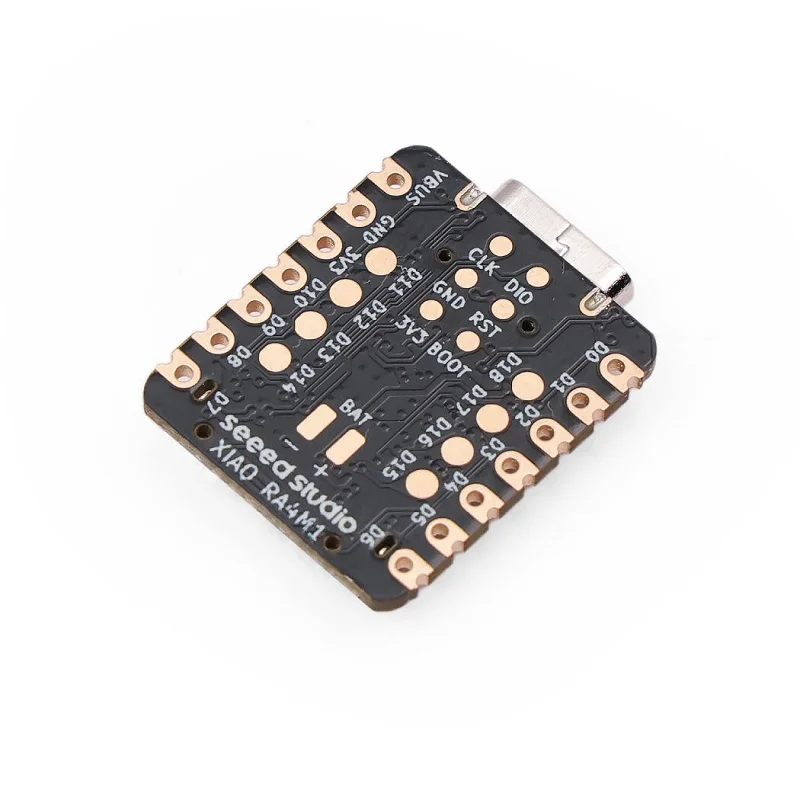
  • Expanded I/O with 19 total GPIOs, including 8 additional pins on the board's reverse side.
  • Integrated hardware security engine supporting AES-128/256 encryption and secure boot functionality.
  • Comprehensive peripheral set: 14-bit ADC, 12-bit DAC, CAN 2.0B controller, USB 2.0 FS, and two each of I2C, UART, and SPI interfaces.
  • Ultra-low power consumption with four operating modes, including a deep sleep mode drawing only 45μA.
  • Onboard user-addressable RGB LED, reset button, and boot mode selector button.
  • Lithium battery charge management circuit for portable power solutions.
  • Surface-mount device (SMD) design with all components on one side and production-friendly stamp holes.

Applications

  • Smart home automation controllers and sensor hubs.
  • Educational platforms for embedded systems and microcontroller programming.
  • Robotics and motor control systems utilizing CAN bus communication.
  • Wearable electronics and portable health monitoring devices.
  • Industrial IoT (IIoT) telemetry nodes with security requirements.

Technical Specifications

Microcontroller/SoCRenesas RA4M1 (R7FA4M1AB3CFM), 48 MHz ARM Cortex-M4 with FPU
Flash Memory256 KB
SRAM32 KB
Digital I/O Pins19
Analog Inputs14 (14-bit ADC)
Digital-to-Analog Converter12-bit DAC
Communication InterfacesUSB 2.0 FS, CAN 2.0B, 2x I2C, 2x UART, 2x SPI
SecurityAES-128/256 Hardware Encryption, Secure Boot
Supply Voltage3.3V (via USB or external source)
Operating Current (Deep Sleep)45 μA
Operating Temperature-20°C to +70°C
Dimensions21 mm x 17.8 mm

Frequently Asked Questions

How do I program the XIAO RA4M1 using the Arduino IDE?

First, install the Seeed Studio Studio XIAO board package via the Arduino Boards Manager. Connect the board via USB, select 'Seeed Studio Studio XIAO RA4M1' as your target board, and choose the correct COM port. You can then upload sketches using the standard Arduino IDE upload procedure, utilizing the built-in USB bootloader for firmware deployment.

What are the power supply options and how do I connect a battery?

The board is powered via its USB Type-C connector at 5V, which is regulated to 3.3V internally. For battery operation, connect a single-cell Li-Po/Li-Ion battery (3.7V nominal) to the 'BAT+' and 'GND' test points on the board. The integrated charging circuit manages charging when USB is connected. Ensure the battery voltage does not exceed 4.2V.

How do I utilize the hardware security features like AES encryption?

The RA4M1 MCU includes a hardware cryptographic engine. In the Arduino environment, you will need to use specific libraries provided by Renesas or Seeed Studio Studio that expose low-level HAL functions for AES-128/256 operations, key storage, and secure boot configuration. Refer to the official GitHub repository for example code and API documentation.

Can I use the CAN bus interface, and what additional hardware is required?

Yes, the RA4M1 integrates a CAN 2.0B controller. To use it, you need an external CAN transceiver chip (like SN65HVD230) to convert the controller's logic-level signals to the differential CAN bus standard. Wire the transceiver to the designated CAN_TX and CAN_RX pins (check the pinout diagram) and provide 5V/3.3V power and 120-ohm termination resistors on the bus lines.

Package Includes

  • 1 x Seeed Studio Studio XIAO RA4M1 Development Board
  • 2 x 7-pin Header (for soldering)

Additional Information

Weight 0.014 kg
Dimensions 6 × 6 × 2 cm