SKU: IOWC-1746
📋 GST Invoice Available

RFM98 LoRa Radio Node v1.0 ATmega328P 868MHz

₹1,236.00 (Inclusive of all taxes)
Out of Stock

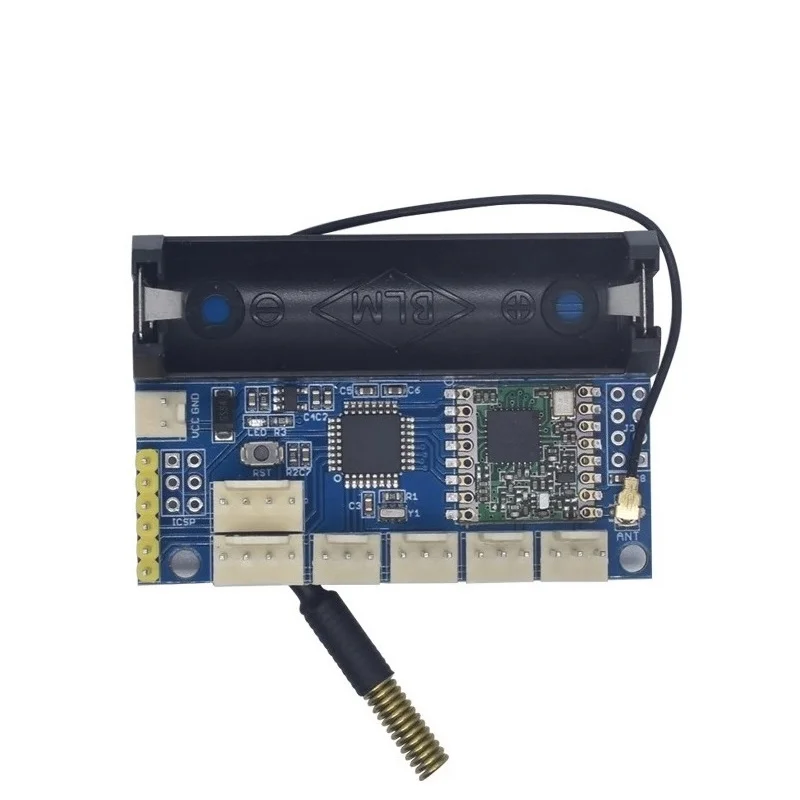
This LoRa Radio Node v1.0 integrates an ATmega328P microcontroller with an RFM95-based 868MHz LoRa transceiver, designed for long-range, low-power IoT data transmission. It runs on a 3.7V LiPo battery and is compatible with the Arduino Pro Mini 8MHz 3.3V bootloader for easy firmware development.

Features

  • ATmega328P microcontroller (8MHz, 3.3V) with Arduino Pro Mini compatibility for straightforward programming.
  • RFM95-based 868MHz LoRa radio module for sub-GHz long-range communication, ideal for sensor telemetry.
  • On-board 14500 LiPo battery holder and 3.3V regulator (500mA peak) for portable, field-deployable operation.
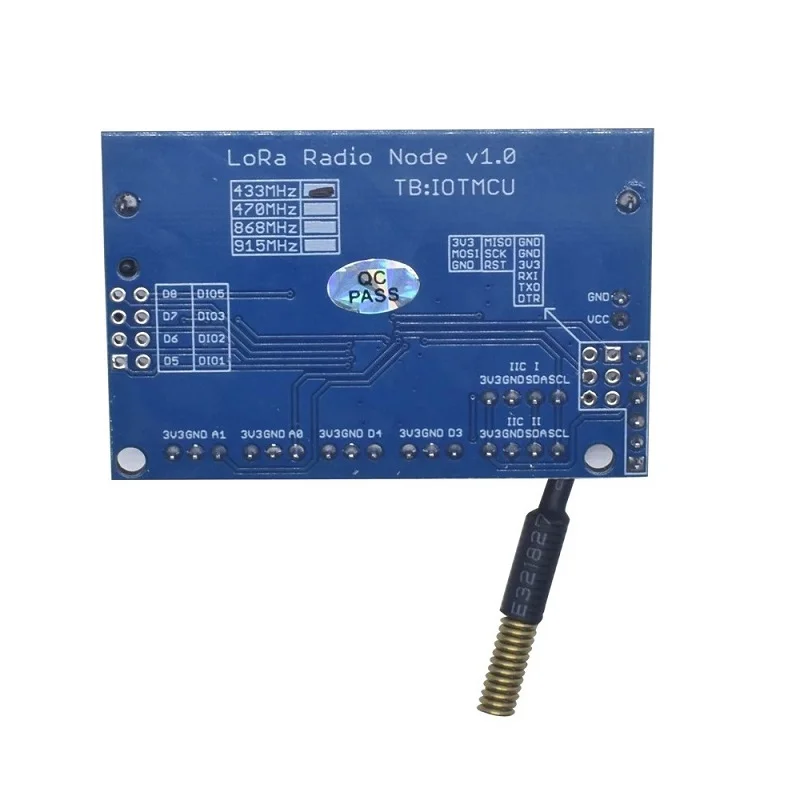
  • Breaks out essential I/O: hardware I2C (x2), analog inputs (A0, A1), digital pins (D3, D4), and hardware SPI.
  • Compact 40mm x 60mm form factor with mounting holes for robust integration into IoT enclosures.

Out of stock

Description

The LoRa Radio Node v1.0 is a purpose-built development board combining an 8-bit ATmega328P microcontroller with a Semtech SX1278-based RFM95 LoRa transceiver, optimized for the 868MHz ISM band. Its architecture provides a balance of processing capability and ultra-long-range, low-data-rate wireless connectivity, making it suitable for remote monitoring applications where Wi-Fi or Bluetooth range is insufficient. The board operates at 3.3V logic, powered either by the integrated 14500 LiPo cell or an external 3.7V to 12V DC source, with an efficient onboard regulator ensuring stable power for both the MCU and RF module.

Designed for system integrators and makers, the node exposes critical interfaces including dual I2C ports, analog inputs, digital GPIOs, and dedicated SPI lines for the radio, facilitating seamless connection with sensors, displays, and peripherals. The use of the standard Arduino Pro Mini 8MHz bootloader simplifies firmware development within the Arduino IDE, allowing developers to leverage extensive community libraries for LoRa communication (e.g., RadioHead, LoRa) and sensor integration. This board is engineered for reliable, battery-operated deployments in IoT networks, smart agriculture, environmental sensing, and asset tracking scenarios.

Key Features

  • Integrated LoRa transceiver (RFM95/SX1278) for robust, long-distance communication in the 868MHz frequency band.
  • ATmega328P microcontroller pre-loaded with Arduino Pro Mini 8MHz 3.3V bootloader for rapid prototyping.
  • On-board 14500 LiPo battery holder enables portable, untethered operation for field deployments.
  • 3.3V voltage regulator with 500mA peak output ensures stable power for the MCU and connected peripherals.
  • Comprehensive I/O breakout: Two I2C ports, two analog inputs (A0, A1), digital pins (D3, D4), and hardware SPI.
  • Includes a reset button, a user-controllable LED on pin 13, and mounting holes for secure installation.
  • Optimized for small, intermittent data packet transmission, maximizing battery life in LPWAN applications.

Applications

  • Remote environmental monitoring (temperature, humidity, air quality sensors).
  • Smart agriculture and irrigation system telemetry.
  • Asset tracking and logistics management over long ranges.
  • Industrial IoT (IIoT) for machine condition monitoring and alerting.
  • Building automation and decentralized sensor networks.

Technical Specifications

Microcontroller / SoCATmega328P (8MHz, 3.3V Logic)
Wireless ProtocolLoRa (Semtech SX1278)
Frequency Range868 MHz
RF Transmit PowerUp to +20 dBm (Typical for RFM95)
Supply Voltage3.7V (LiPo) or 3.7V - 12V DC Input
Regulator Output3.3V, 500mA Peak
InterfacesHardware UART, I2C (x2), SPI, Analog Inputs (x2), Digital GPIO
Antenna ConnectorIntegrated (868MHz Antenna Included)
Dimensions40 mm x 60 mm

Frequently Asked Questions

How do I program this LoRa Radio Node?

The board uses an ATmega328P pre-loaded with the Arduino Pro Mini 8MHz 3.3V bootloader. Connect an FTDI programmer to the serial header pins (RX, TX, VCC, GND), select 'Arduino Pro or Pro Mini' as the board in the Arduino IDE, choose 'ATmega328P (3.3V, 8MHz)' as the processor, and set the programmer to 'USBasp' or 'AVRISP mkII'. You can then upload sketches that utilize LoRa libraries like RadioHead or Sandeep Mistry's LoRa library.

What is the power consumption and how long will a battery last?

Current consumption depends heavily on the LoRa transmission mode and MCU sleep state. The RFM95 module can draw ~120mA during transmission at +20 dBm but drops to microamps in deep sleep. The ATmega328P also supports sleep modes. Using aggressive sleep scheduling and transmitting small packets infrequently, a standard 14500 LiPo (e.g., 800mAh) can last for several months. Always measure your specific application's duty cycle to estimate precise battery life.

Can I change the operating frequency from 868MHz to 915MHz?

The hardware is configured for the 868MHz ISM band, as indicated by the included antenna. While the underlying RFM95/SX1278 chip supports multiple frequency bands, switching to 915MHz requires modifying the center frequency in your LoRa library initialization code and, critically, replacing the antenna with a 915MHz-tuned model for proper impedance matching and regulatory compliance. The board's RF matching network may also be optimized for 868MHz.

What sensors can I connect to the available I/O pins?

The broken-out I2C ports allow connection of a wide range of sensors (temperature, humidity, pressure, VOC). The analog inputs (A0, A1) are suitable for reading voltage outputs from sensors like soil moisture probes or light-dependent resistors. Digital pins D3 (PWM-capable) and D4 can control relays, read switches, or interface with digital sensors. Ensure any connected peripheral is 3.3V logic compatible, as the board's I/O is not 5V tolerant.

Package Includes

  • 1 x LoRa Radio Node v1.0 Board with 14500 Battery Holder
  • 1 x 868MHz LoRa Antenna

Additional Information

Weight 0.05 kg
Dimensions 8 × 6 × 3 cm