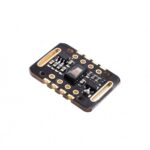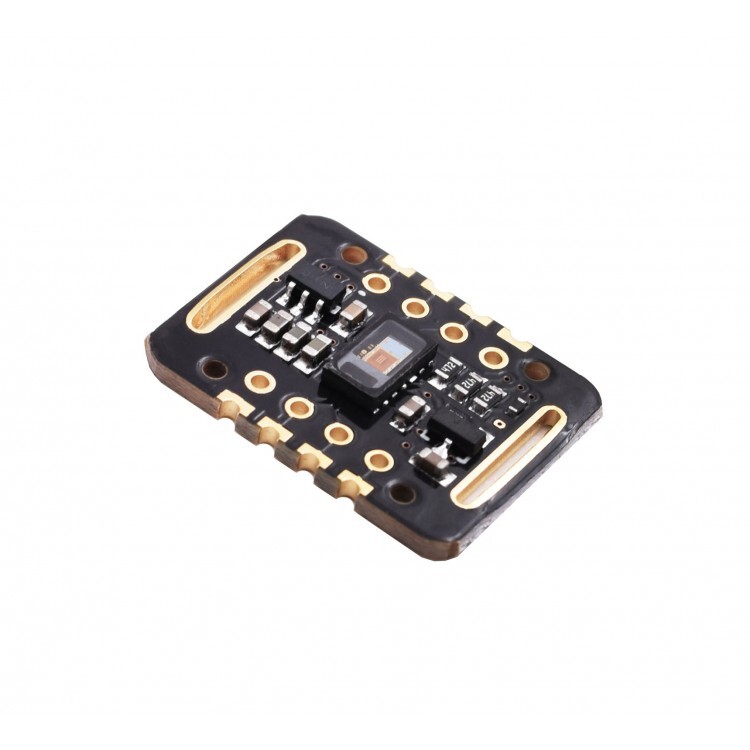
MAX30102 Heart Rate and Pulse Oximeter Sensor Module (Black) - I2C Interface
The MAX30102 is an integrated biosensor module for non-invasive heart rate (HR) and pulse oximetry (SpO2) monitoring, compatible with 3.3V/5V microcontrollers like Arduino, ESP32, and STM32 via a standard I2C digital interface.
Features
- Integrated PPG sensor with 660nm (red) and 880nm (infrared) LEDs for HR and SpO2 measurement.
- Standard I2C digital interface for easy connection to Arduino, Raspberry Pi, ESP32, and other MCUs.
- Low-noise optical front-end with ambient light suppression and integrated glass cover for signal integrity.
- Dual power supply: 1.8V for core logic and 3.3V to 5.0V for LED driver, enabling low-power wearable designs.
- Software shutdown mode with near-zero standby current for battery-powered portable applications.
Out of stock
The MAX30102 sensor module is a complete photoplethysmography (PPG) solution integrating red and infrared LEDs, a photodetector, optical components, and low-noise analog signal conditioning. It operates on the principle of reflective pulse oximetry, measuring the absorption of light by blood to calculate heart rate and blood oxygen saturation (SpO2). The module features advanced ambient light cancellation and a protective glass cover to minimize optical interference, ensuring reliable data acquisition from fingertips, earlobes, or wrists.
Designed for seamless integration into portable and wearable systems, the module communicates via an I2C interface, transmitting raw PPG data to a host microcontroller for algorithm processing. Its dual-voltage architecture separates the sensitive analog core (1.8V) from the higher-power LED driver (3.3-5V), optimizing both signal fidelity and power efficiency for continuous monitoring applications.
Additional Information
| Weight | 0.005 kg |
|---|---|
| Dimensions | 0.85 × 0.6 × 0.1 cm |