SKU: IOWC-1751
📋 GST Invoice Available

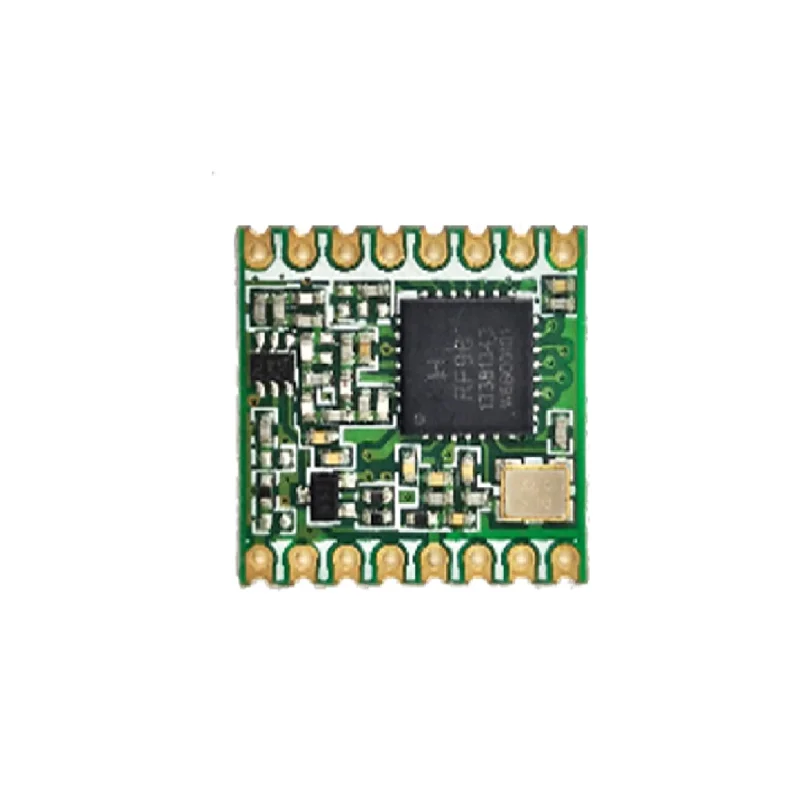
HopeRF RFM95W-868S2R LoRa Module (868MHz)

₹819.00 (Inclusive of all taxes)
Out of Stock

The HopeRF RFM95W-868S2R is a 868MHz LoRa transceiver module featuring Semtech’s long-range spread spectrum modem, ideal for low-power, long-range IoT sensor networks compatible with Arduino and Raspberry Pi platforms.

Features

  • LoRa Spread Spectrum Modem for superior range and interference immunity compared to FSK/OOK systems.
  • High sensitivity down to -144 dBm with a maximum link budget of 164 dB for robust long-range communication.
  • Ultra-low power operation with 10.3 mA RX current and 200 nA register retention sleep current.
  • Supports multiple modulations: LoRa, FSK, GFSK, MSK, GMSK for compatibility with various standards.
  • Compact 16x16mm form factor with integrated synthesizer, temperature sensor, and packet engine.

Out of stock

Description

The HopeRF RFM95W-868S2R module integrates Semtech’s LoRa spread spectrum modem, enabling significantly longer communication range and improved sensitivity over traditional FSK modulation. Its orthogonal spreading factors allow multiple signals to coexist on the same channel, facilitating scalable network deployments. The module operates on the 868MHz UHF band, offering programmable bandwidth and spreading factor for flexible data rate vs. range trade-offs.

Engineered for low-power IoT applications, it features a robust RF front end with excellent blocking immunity and an automatic Channel Activity Detection (CAD) system for efficient duty cycling. The built-in temperature sensor and 256-byte packet engine with CRC simplify system design for remote monitoring and telemetry. Its 3.3V supply and SPI interface make it directly compatible with popular microcontrollers like ESP32, STM32, and Arduino boards.

Key Features

  • Semtech LoRa modem for long-range, low-power spread spectrum communication.
  • Programmable RF parameters: Bandwidth (125-500 kHz), Spreading Factor (6-12), and Error Correction.
  • High dynamic range RSSI (127 dB) and excellent blocking immunity for reliable operation in noisy RF environments.
  • Ultra-low sleep current (200 nA) and efficient RX mode (10.3 mA) for battery-powered sensor nodes.
  • Integrated packet engine with 256-byte FIFO, CRC, and preamble detection for simplified data handling.
  • Supports FSK, GFSK, MSK, GMSK modulation for backward compatibility with systems like wireless M-Bus.
  • Built-in temperature sensor and low-battery indicator for enhanced system monitoring.
  • Fully integrated frequency synthesizer with 61 Hz resolution for precise channel control.

Applications

  • Automated Meter Reading (AMR) for water, gas, and electricity utilities.
  • Home and Building Automation for wireless sensor and control networks.
  • Industrial Monitoring and Control (IIoT) for telemetry and remote diagnostics.
  • Wireless Alarm and Security Systems requiring long-range, low-power links.
  • Agricultural and Environmental Sensor Networks for soil moisture, weather, and asset tracking.

Technical Specifications

Wireless ProtocolLoRa, FSK, GFSK, MSK, GMSK
Frequency Range868 MHz (RFM95W)
RF Output PowerUp to +20 dBm (typical)
Receiver SensitivityDown to -144 dBm (LoRa)
Maximum Link Budget164 dB
Supply Voltage3.3V
Operating Current (RX)10.3 mA
Sleep Current (Register Retention)200 nA
InterfaceSPI
Data Rate (Programmable)Up to 300 kbps
Package Size16 x 16 mm

Frequently Asked Questions

What microcontroller interfaces does the RFM95W-868S2R module support?

The module communicates via a standard SPI interface, making it compatible with most microcontrollers like Arduino (using libraries like RadioHead or LoRa), ESP32, STM32, and Raspberry Pi. You'll need to connect the MISO, MOSI, SCK, and NSS (chip select) pins, along with power (3.3V) and ground. The DIO0-DIO5 pins provide interrupt and control signals for packet handling and CAD mode.

How do I configure the spreading factor and bandwidth for my LoRa network?

You configure the LoRa modulation parameters (spreading factor SF, bandwidth BW, coding rate CR) by writing to the module's internal registers via SPI commands. Using an Arduino library like RadioHead or Sandeep Mistry's LoRa library, you can set these values in your setup() function. A higher spreading factor (e.g., SF12) increases range and sensitivity but reduces data rate, while a wider bandwidth (e.g., 125 kHz) increases data rate at the cost of some sensitivity.

What is the typical real-world range I can expect with this module?

In an urban environment with line-of-sight, expect ranges of 2-5 km. In rural or open areas with clear line-of-sight, ranges can extend to 10-15 km or more, depending on antenna gain (a 3dBi external antenna is recommended), height, and spreading factor settings. The maximum 164 dB link budget and -144 dBm sensitivity enable robust communication, but obstacles, interference, and antenna placement are critical factors for achieving maximum range.

Can this module be used in a LoRaWAN network with a gateway?

Yes, the RFM95W is a physical layer (PHY) transceiver that implements the LoRa modulation. To participate in a LoRaWAN network, you must implement the LoRaWAN MAC layer protocol stack in your microcontroller firmware (using libraries like MCCI LoRaWAN or Semtech's LoRaMac-node). The module handles the radio communication, while your code manages the join procedure, adaptive data rate (ADR), and encryption required by the LoRaWAN specification.

Package Includes

  • 1 x HopeRF RFM95W-868S2R LoRa Module

Additional Information

Weight 0.01 kg
Dimensions 1.6 × 1.6 cm