
Generic 1 Channel 12V Relay Module | Optocoupler Isolation | High Current Control
₹149.00₹250.00 (price_including_tax) (-40%)
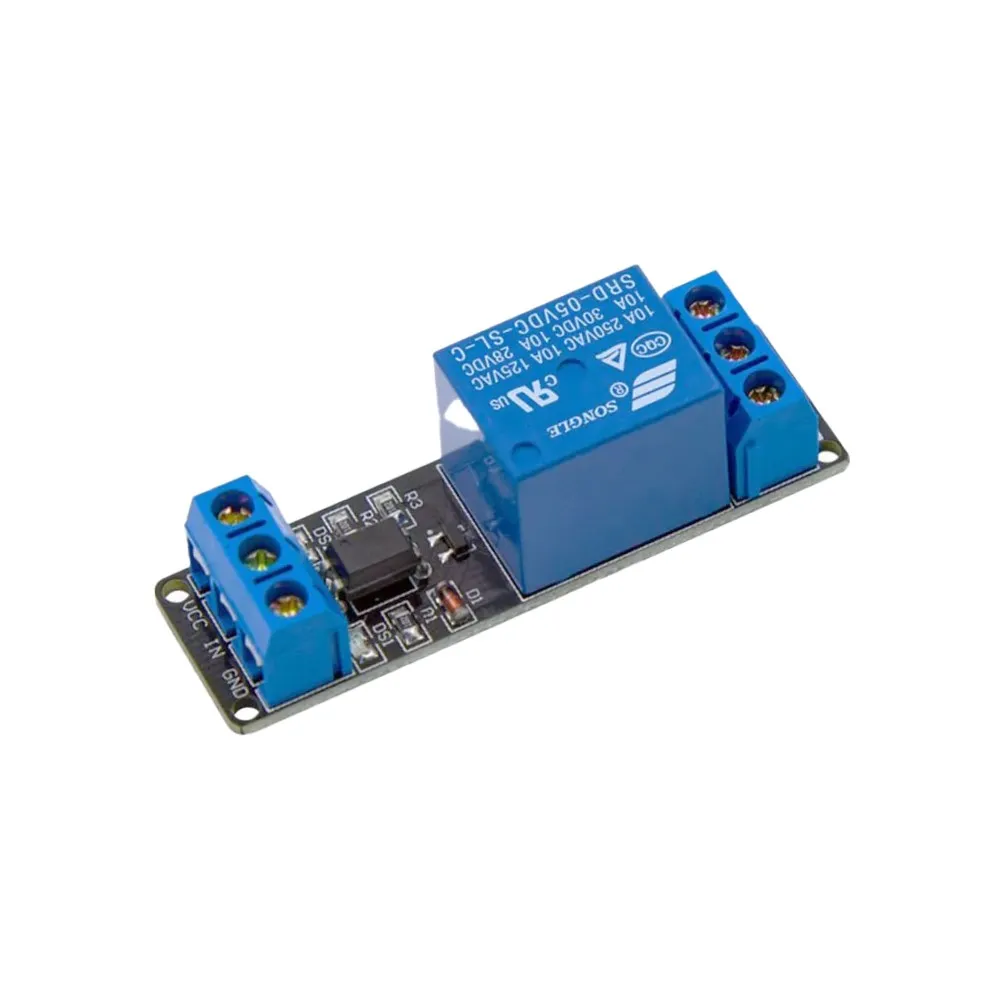
Achieve safe, isolated high-current control for your projects. This module seamlessly interfaces microcontrollers with higher voltage/current loads. Engineered for durability and secure switching in demanding environments.
This robust 12V relay module with optocoupler isolation delivers reliable, safe control for diverse embedded projects.
Shields microcontrollers from high voltage transients, ensuring robust and safe operational integrity.
Effortlessly controls substantial electrical loads, expanding project capabilities beyond low-power limits.
Adaptable active-high/low input simplifies integration with diverse microcontroller platforms and designs.
The Engineering Behind 1 Channel 12V Relay Module
The 1 Channel 12V Relay Module provides an essential interface for low-voltage microcontrollers to switch high-voltage or high-current loads safely. At its core, it features a Songle SRD-12VDC-SL-C type single-pole, double-throw (SPDT) relay, rated for switching up to 10A at 250VAC or 30VDC. The module integrates an optocoupler, typically a PC817, which provides galvanic isolation between the control circuit (microcontroller) and the load circuit, preventing noise propagation and protecting the sensitive microcontroller from voltage spikes or ground loops.
Constructed on a high-quality FR-4 PCB, the module incorporates robust screw terminals for secure load connections (NC, COM, NO) and standard 2.54mm header pins for input signals (VCC, GND, IN). Power is derived from a 12V DC source, typically via the VCC pin, energizing the relay coil. The module’s design emphasizes both signal integrity and mechanical stability, ensuring long-term operational reliability in diverse prototyping and industrial applications.
Optocoupler Isolation for Enhanced Circuit Protection
The integrated optocoupler, a critical safety feature, uses light to transmit a signal across an electrical barrier. This design ensures complete electrical separation between the low-voltage control side (e.g., 5V from an Arduino) and the high-voltage load side (e.g., 12V or 220V AC). This galvanic isolation effectively mitigates common ground loop issues, protects the microcontroller from destructive voltage transients, and enhances overall system robustness and safety, particularly in noisy industrial environments or when controlling inductive loads.
Flexible Control and Inductive Load Management
This module supports both active-high and active-low trigger configurations via an onboard jumper, offering design flexibility for various microcontroller logic levels. The relay coil is driven by a transistor (e.g., S8050) and includes a flyback diode to suppress voltage spikes generated by the inductive coil during de-energization, protecting the driving transistor and the power supply. This robust drive circuit ensures stable and reliable switching performance, even with demanding inductive loads like motors or solenoids.
Optimized for Performance & Integration
- Channels: 1
- Operating Voltage: 12V DC
- Trigger Voltage (IN): 3.3V-5V DC (configurable active-high/low)
- Relay Contact Rating: 10A @ 250VAC / 10A @ 30VDC
- Isolation: Optocoupler (PC817 equivalent)
- Indicator LEDs: Power, Status
- Terminals: Screw terminals for load, Pin headers for control
- Dimensions: Compact PCB design
Features & Benefits
- Optocoupler Isolation: Ensures galvanic separation between control and load circuits, protecting sensitive electronics from high voltage spikes and noise.
- High Load Capacity: Switches up to 10A at 250VAC or 30VDC, suitable for controlling a wide range of motors, lights, and appliances.
- 12V DC Operation: Standard operating voltage for compatibility with various power supplies and embedded systems.
- Configurable Trigger: Onboard jumper allows selection of active-high or active-low control signals, adapting to different microcontroller logic.
- Robust PCB Construction: Designed for durability and reliable long-term performance in prototyping and industrial applications.
- Clear Status Indicators: LED indicators for power and relay status provide immediate visual feedback on operation.
Pro-Grade Advantages
- Offers excellent electrical isolation, protecting sensitive control circuitry effectively.
- Capable of reliably switching significant AC and DC loads with high current ratings.
- Integrated status LEDs provide immediate visual feedback for troubleshooting and operation.
- Compact module design facilitates easy integration into space-constrained projects and enclosures.
Technical Considerations
- Requires a dedicated 12V DC power supply for optimal relay coil energization.
- Single channel limits simultaneous control to one independent load per module instance.
What is the purpose of the optocoupler in this relay module?
The optocoupler provides galvanic isolation, using light to transmit the control signal without direct electrical connection, thereby protecting the microcontroller from high voltage spikes, noise, and ground loop issues from the load circuit.
Can this relay module be controlled by a 3.3V microcontroller like a Raspberry Pi?
Yes, this module typically supports 3.3V to 5V logic level inputs for its ‘IN’ pin. An onboard jumper often allows configuration for active-high or active-low triggering to match the microcontroller’s output.
What are the maximum voltage and current ratings for the relay contacts?
The common relay used in these modules (e.g., Songle SRD-12VDC-SL-C) is rated for switching up to 10A at 250VAC or 10A at 30VDC. Always verify the specific relay’s datasheet for exact specifications.
How do I connect the load to this 1-channel relay module?
The load should be connected to the screw terminals labeled NC (Normally Closed), COM (Common), and NO (Normally Open). Connect your power source to COM and your load to either NO (for normally open operation) or NC (for normally closed operation).
Does this module require a separate 12V power supply, or can it be powered by the microcontroller?
The relay coil itself requires a 12V DC power supply, which is typically supplied to the VCC and GND pins of the module. While the control signal (IN) can come from a 3.3V/5V microcontroller, the main operating power for the relay coil must be 12V.
| Specification | Value |
|---|---|
| Number of Channels | 1 |
| Operating Voltage | 12V DC |
| Control Signal Voltage | 3.3V – 5V DC |
| Relay Type | SPDT (Single Pole Double Throw) |
| Coil Current | ~15-20mA @ 12V |
| Max Load (AC) | 10A @ 250V AC |
| Max Load (DC) | 10A @ 30V DC |
| Isolation Method | Optocoupler |
| Onboard Indicators | Power LED, Status LED |
| Trigger Logic | Jumper selectable (Active-High/Low) |
| Dimensions | Approx. 50mm x 26mm x 18.5mm |
| Mounting Holes | Yes |
Additional information
| Weight | 0.02 kg |
|---|---|
| Dimensions | 5 × 2.6 × 1.85 cm |
| Brand | Generic |
| Operating Voltage | 12V DC |
| Max Current | ~20mA (control), 10A (Load) |
| Channels | 1 |
| Control Voltage | 3.3V-5V DC |
| Technology | Electromechanical Relay with Optocoupler |
| Load Capacity | 250VAC/10A, 30VDC/10A |

Reviews
There are no reviews yet.