SKU: IOWC-0688
📋 GST Invoice Available

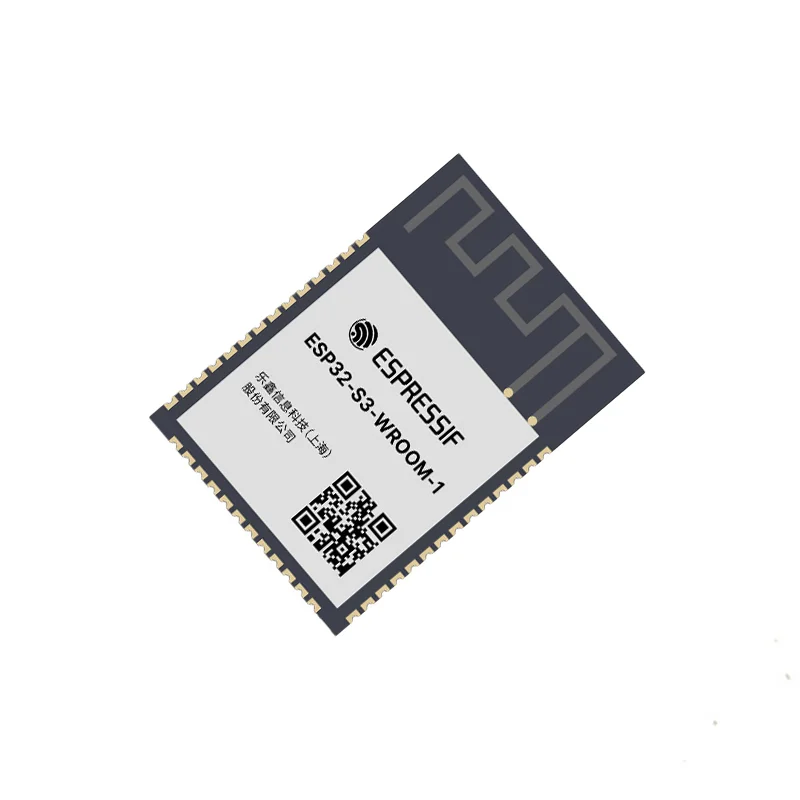
Espressif ESP32-S3-WROOM-1-N8R8 Wi-Fi & BLE 5.0 AIoT Module

₹409.00 (Inclusive of all taxes)
Out of Stock

The Espressif ESP32-S3-WROOM-1-N8R8 is a compact, high-performance AIoT module integrating dual-core Xtensa LX7 MCU, 2.4 GHz Wi-Fi 4, and Bluetooth 5.0 BLE, ideal for advanced embedded projects using ESP-IDF, Arduino, or MicroPython.

Features

  • High-performance AIoT core with dual-core Xtensa LX7 processor and 8MB PSRAM (N8R8) for demanding edge computing tasks.
  • Integrated 2.4 GHz Wi-Fi 802.11 b/g/n and Bluetooth 5.0 LE with 20.5 dBm output power for robust, long-range wireless connectivity.
  • Rich peripheral set including USB OTG, multiple UART, SPI, I2C, I2S, PWM, and capacitive touch GPIOs for versatile sensor and actuator integration.
  • Ultra-low-power design with multiple deep sleep modes, operating from a 3.0V to 3.6V supply, ideal for battery-powered IoT endpoints.
  • Compact 25.5 x 18 x 3.1 mm form factor with an integrated PCB antenna, simplifying RF design and reducing final product footprint.

Out of stock

Description

The ESP32-S3-WROOM-1-N8R8 module is Espressif’s flagship solution for AI-enhanced IoT applications, built around a powerful dual-core Xtensa LX7 microprocessor. It combines high-speed 2.4 GHz Wi-Fi and Bluetooth 5.0 Low Energy radios with 8MB of octal SPI PSRAM, enabling complex machine learning inference, voice recognition, and graphics rendering directly on the edge device.

Engineered for reliable operation in industrial and consumer environments, the module features an integrated PCB antenna, advanced power management for extended battery life, and a wide operating temperature range. Its comprehensive suite of serial interfaces and GPIOs allows seamless connection to sensors, displays, and other peripherals, forming the core of smart home automation, wearable tech, and industrial monitoring systems.

Key Features

  • AI-accelerated dual-core Xtensa LX7 processor with vector instructions for efficient neural network operations.
  • Integrated 8MB octal SPI PSRAM (N8R8 variant) for handling large data buffers and complex application code.
  • Robust 2.4 GHz Wi-Fi 4 (802.11 b/g/n) and Bluetooth 5.0 LE stack with support for simultaneous connections.
  • High RF output power of 20.5 dBm ensures stable wireless links in challenging environments.
  • Comprehensive development support via ESP-IDF, Arduino Core, MicroPython, and PlatformIO ecosystems.
  • Advanced security features including secure boot, flash encryption, and cryptographic hardware acceleration.
  • Multiple low-power sleep modes with ultra-low standby current for years of operation on coin-cell batteries.
  • Direct USB OTG support enables device/host functionality without external PHY chips.

Applications

  • AI-powered smart home devices (voice assistants, smart displays, security cameras).
  • Wearable technology and health monitoring gadgets with BLE connectivity.
  • Industrial IoT (IIoT) sensors and wireless telemetry gateways.
  • Edge computing nodes for computer vision and TinyML applications.
  • Prototyping and product development for connected consumer electronics.

Technical Specifications

Microcontroller / SoCEspressif ESP32-S3 Dual-Core Xtensa LX7
Wireless ProtocolsWi-Fi 802.11 b/g/n (2.4 GHz), Bluetooth 5.0 LE
Frequency Range2.4 GHz ISM Band
RF Transmit PowerUp to 20.5 dBm
Supply Voltage3.0 V to 3.6 V
Operating CurrentVaries with mode; typical active current ~40-80 mA
InterfacesUSB OTG, UART, SPI, I2C, I2S, PWM, GPIO, ADC, Touch Sensor
Antenna ConnectorIntegrated PCB Antenna
Operating Temperature-40°C to +65°C
Dimensions (L x W x H)25.5 mm x 18 mm x 3.1 mm

Frequently Asked Questions

What is the key difference between the ESP32-S3-WROOM-1-N8 and the N8R8 variant?

The 'N8R8' suffix specifically denotes the inclusion of 8 Megabytes of Octal SPI PSRAM (Pseudo Static RAM). This is in addition to the standard flash memory. The N8 variant lacks this PSRAM. The extra high-speed RAM is crucial for buffering camera frames, audio data, or running complex machine learning models directly on the ESP32-S3, significantly boosting performance for AIoT applications without external memory chips.

How do I power and program the ESP32-S3-WROOM-1 module on a custom PCB?

Supply a clean 3.3V (within 3.0V to 3.6V range) to the VDD (3V3) pin, ensuring adequate decoupling capacitors are placed nearby. For programming, connect the module's UART0 pins (GPIO43 as TXD, GPIO44 as RXD) to a USB-to-serial adapter. The EN (enable) and BOOT pins must be accessible to enter download mode: pull BOOT low, pulse EN low, then release BOOT to flash firmware via esptool.py or the Arduino IDE. The integrated USB OTG pins (D+/D-) can also be used for direct programming and communication if routed to a USB connector.

Can I use an external antenna with the ESP32-S3-WROOM-1-N8R8 module?

The ESP32-S3-WROOM-1-N8R8 module comes with a pre-certified integrated PCB antenna soldered on-board and is not designed for an external antenna connection. For projects requiring an external antenna, you must select the 'U' variant (e.g., ESP32-S3-WROOM-1U-N8R8), which features an IPEX connector for connecting external antennas like a 2.4GHz dipole or monopole. Swapping antennas on the WROOM-1 module would require component-level rework and would invalidate its regulatory certifications.

What development frameworks are supported for the ESP32-S3?

Espressif's official IoT Development Framework (ESP-IDF) provides the most comprehensive support, including all advanced features like PSRAM management, Bluetooth stack, and Wi-Fi provisioning. The Arduino-ESP32 core offers a familiar Arduino IDE environment with broad library compatibility. MicroPython and Rust are also supported for rapid prototyping. For AI workloads, Espressif's ESP-DL and TensorFlow Lite Micro frameworks leverage the LX7's vector instructions for accelerated neural network inference on the edge.

Package Includes

  • 1 x Espressif ESP32-S3-WROOM-1-N8R8 Module

Additional Information

Weight 0.03 kg
Dimensions 5 × 5 × 1 cm