SKU: IOWC-1641
📋 GST Invoice Available

RFM69HCW 915MHz Sub-1GHz RF Transceiver Module

₹359.00 (Inclusive of all taxes)
Out of Stock

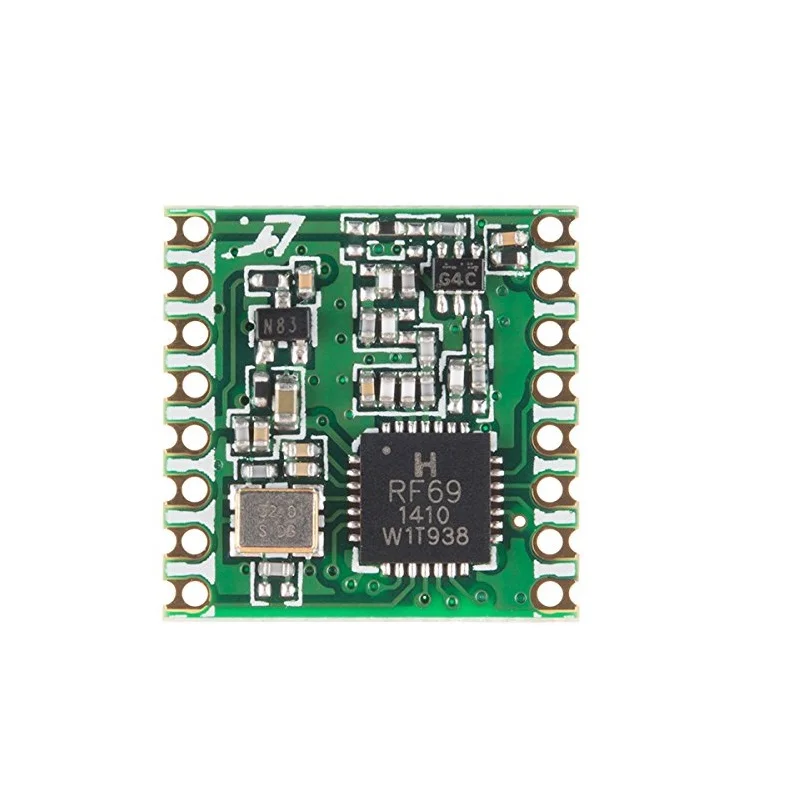
The RFM69HCW is a high-performance, low-power FSK transceiver module operating in the 915 MHz ISM band, ideal for building robust, long-range wireless sensor networks and industrial telemetry systems with Arduino, Raspberry Pi, or other microcontrollers.

Features

  • 915 MHz ISM band operation for long-range, license-free wireless communication in applicable regions.
  • High RF output power up to +20 dBm (100 mW) and excellent sensitivity down to -120 dBm for reliable links over 500+ meters.
  • Configurable data rates from 1.2 kbps to 300 kbps, allowing optimization for range or power consumption.
  • Built-in AES encryption engine for secure, private data transmission across your network.
  • Supports large-scale mesh networks with up to 256 networks and 255 nodes per network.

Out of stock

Description

The RFM69HCW wireless module is a versatile FSK transceiver designed for demanding IoT and M2M applications requiring robust, low-power communication. Its architecture enables stable performance across varying environmental conditions, making it suitable for both consumer electronics and industrial control systems.

Operating from a 1.8V to 3.6V supply, the module is optimized for battery-powered deployments, with configurable transmit power and data rates to balance range against energy consumption. The integrated 16-tap FIR channel filter provides strong selectivity against interference, ensuring reliable packet delivery in crowded RF environments. Its SPI interface allows for straightforward integration with popular microcontrollers for rapid prototyping and deployment.

Key Features

  • Operates in the global 915 MHz ISM band for license-free use in applicable regions.
  • High-power RF output (+20 dBm / 100 mW) coupled with high sensitivity (-120 dBm) maximizes communication range.
  • Fully configurable FSK modulation with bit rates programmable from 1.2 kbps to 300 kbps.
  • On-chip AES 128-bit encryption for secure data packet transmission.
  • Advanced network addressing supports large, scalable networks of up to 65,280 nodes.
  • Excellent adjacent channel rejection provided by a digital 16-tap FIR channel filter.
  • Low-voltage operation (1.8V–3.6V) ideal for battery-powered, portable sensor nodes.
  • Compact 16x16mm footprint with a standard 2mm pin pitch for easy integration.

Applications

  • Industrial wireless sensor networks for telemetry, monitoring, and control (IIoT).
  • Low-power telemetry systems for environmental sensing (temperature, humidity, soil moisture).
  • Asset tracking, logistics, and electronic tag systems in warehouses.
  • Secure access control, attendance, and surveillance systems.
  • Consumer electronics requiring robust, medium-range wireless links.
  • Medical device connectivity and remote control applications.

Technical Specifications

Transceiver ICRFM69HCW
Wireless ProtocolFSK
Frequency Range915 MHz
RF Transmit PowerUp to +20 dBm (100 mW)
Receiver Sensitivity-120 dBm @ 1.2 kbps
Supply Voltage1.8 VDC to 3.6 VDC
Data Rate (FSK)1.2 kbps to 300 kbps
InterfaceSPI
Antenna ConnectorPin / solder pad for wire antenna
Selectivity16-tap FIR Channel Filter
Dimensions (LxWxH)16 mm x 16 mm x 21 mm
Weight13.5 g

Frequently Asked Questions

How do I connect the RFM69HCW module to an Arduino or microcontroller?

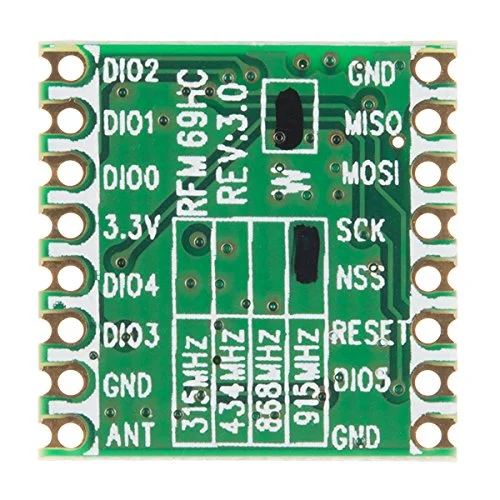
Connect the module via SPI: SCK to SCK, MOSI to MOSI, MISO to MISO. Connect NSS (Slave Select) to any digital GPIO pin, and connect the RESET and DIO0/2 pins to other digital pins for interrupt-driven operation. Ensure you provide a stable 3.3V power supply and a common ground. Popular libraries like RadioHead or LowPowerLab's RFM69 greatly simplify initialization and packet handling.

What is the typical range of the RFM69HCW module, and how can I extend it?

With a simple wire antenna, expect ranges of 500+ meters in open air and reliable penetration through several interior walls. To maximize range, configure the module for its highest transmit power (+20 dBm) and lowest data rate (1.2 kbps). Using an external, properly tuned antenna (e.g., a 1/4 wave whip) with an appropriate matching circuit will significantly improve performance. Always ensure your antenna is resonant at 915 MHz for optimal efficiency.

How do I configure the RFM69HCW's data rate and transmit power?

Configuration is done via SPI registers. Using a library like RadioHead, you typically set the frequency, power level, and modem configuration during initialization. For example, to set max power, you would call a function like 'rf69.setTxPower(20, true)'. The data rate is configured by setting the frequency deviation and bit rate registers; lower rates like 1.2kbps increase range but reduce throughput. Always refer to the RFM69 datasheet for specific register values.

Does the RFM69HCW support mesh networking or addressing multiple nodes?

Yes, the module's packet engine supports addressing. Libraries implement network layers allowing you to assign a unique node ID (1-255) and network ID (1-256). This enables simple star or mesh topologies where a gateway can talk to many sensor nodes. For advanced mesh networking with dynamic routing, you would need to implement a protocol like MESH or use a library that adds this layer on top of the basic RFM69 driver.

What is the power consumption of the RFM69HCW during transmission and sleep?

At full +20 dBm output, the transmit current can reach approximately 130 mA. In receive mode, current consumption is around 16 mA. The module supports low-power sleep modes where consumption drops to under 1 µA, making it ideal for battery-powered sensor nodes that wake up periodically to send data. Effective power management involves putting the module to sleep between transmission cycles and using a microcontroller's deep sleep mode.

Package Includes

  • 1 x RFM69HCW Wireless Transceiver Module (915 MHz)

Additional Information

Weight 0.0135 kg
Dimensions 1.6 × 1.6 × 2.1 cm