SKU: IOWC-1639
📋 GST Invoice Available

HC-11 CC1101 433MHz RF Serial UART Transceiver Module

₹419.00 (Inclusive of all taxes)
Out of Stock

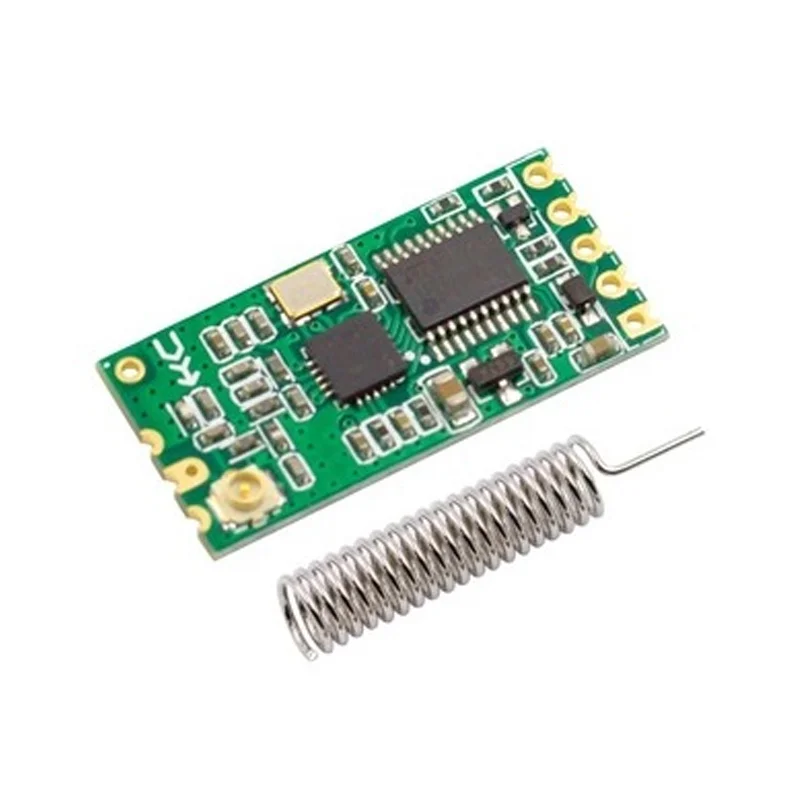
The HC-11 is a 433MHz FSK wireless transceiver module based on the TI CC1101 chip, providing a simple UART/TTL serial pass-through interface for point-to-point or mesh data links. It operates from 3.3V to 5V and is configurable via AT commands for baud rate, RF power, and channel settings.

Features

  • 433MHz FSK transceiver with TI CC1101 RF IC for reliable sub-1GHz communication.
  • Configurable UART/TTL interface with baud rates from 1.2Kbps to 115.2Kbps for easy serial cable replacement.
  • Ultra-low power operation with sleep current as low as 80μA and selectable active modes (3.5mA or 22mA).
  • Adjustable RF output power up to 10dBm and high receiver sensitivity (-112dBm) for robust outdoor/indoor range.
  • Compact PCB footprint (28mm x 14mm) with integrated spring antenna for quick prototyping and deployment.

Out of stock

Description

The HC-11 module implements a transparent serial wireless link, converting UART data streams directly into 433MHz FSK radio packets. Its architecture centers on the proven TI CC1101 transceiver, offering stable frequency generation and configurable RF parameters including frequency deviation and receiver bandwidth. The module supports half-duplex communication, requiring a paired unit for bidirectional data transfer.

Power management is a key feature, with software-selectable modes balancing current draw against responsiveness. Engineers can fine-tune the module for battery-operated telemetry applications using AT commands, which permanently store settings in non-volatile memory. The integrated spring antenna provides adequate gain for typical indoor/urban ranges, while the module’s -40°C to +90°C operating temperature ensures reliability in industrial environments.

Key Features

  • Transparent serial data transmission mode for seamless UART-to-RF conversion.
  • AT command configurability for UART baud rate, RF frequency, output power, and data rate.
  • Ultra-low power sleep mode (80μA) for battery-powered sensor nodes and remote monitoring.
  • High RF sensitivity (-112dBm) and adjustable transmit power (up to 10dBm) for extended range.
  • Wide operating voltage range (3.3V to 5V) compatible with 3.3V and 5V microcontroller systems.
  • Compact form factor with integrated antenna for space-constrained embedded designs.
  • Settings retention during power cycles via internal EEPROM storage.
  • Robust operating temperature range suitable for outdoor and industrial IoT deployments.

Applications

  • Wireless serial cable replacement for industrial equipment and POS systems.
  • Low-power telemetry for environmental sensors (temperature, humidity, soil moisture).
  • Simple remote control and data links for DIY robotics and RC models.
  • Home automation networks for sensor data aggregation and actuator control.
  • Basic wireless mesh networks for educational and prototyping projects.

Technical Specifications

RF Transceiver ICTI CC1101
Operating Frequency433MHz / 434MHz
Wireless ProtocolFSK (Frequency-Shift Keying)
RF Output Power-30dBm to 10dBm (Configurable)
Receiver Sensitivity-112dBm to -95dBm
Supply Voltage3.3V to 5V DC
Operating Current3.5mA or 22mA (Mode Dependent)
Sleep Current80μA
InterfaceUART/TTL (Half-Duplex)
UART Baud Rate1.2Kbps to 115.2Kbps
Antenna ConnectorIntegrated Spring Antenna
Operating Temperature-40°C to +90°C
Dimensions (L x W)28mm x 14mm

Frequently Asked Questions

How do I configure the HC-11 module's RF parameters like frequency and power?

Configure the HC-11 using AT commands sent via its UART interface. Connect the module's TX/RX pins to a USB-to-serial adapter or microcontroller UART. Use commands like AT+FUx to set frequency and AT+Px to adjust transmit power. All settings are saved to non-volatile memory and persist after power cycling. Ensure both communicating modules are set to the same baud rate, channel, and air data rate for a stable link.

What is the difference between the HC-11 and HC-12 wireless serial modules?

The HC-11 operates on the 433MHz band using the TI CC1101 transceiver, while the HC-12 typically uses a different RF chip and supports a wider frequency range (433-473MHz). They are not firmware compatible. The HC-11 offers lower sleep current (80μA) and a simpler command set. For a new design, ensure all nodes in your network use the same module model and are configured with identical communication parameters to establish a successful wireless link.

What power supply and wiring connections are required for the HC-11 module?

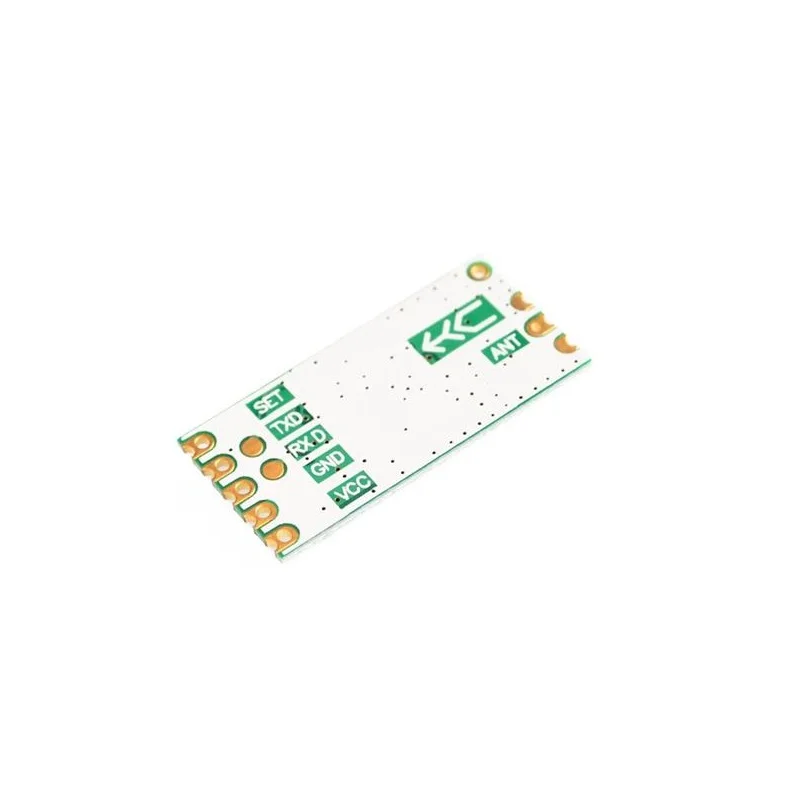
Supply 3.3V to 5V DC to the VCC and GND pins. Connect the module's TXD pin to your microcontroller's RXD, and its RXD pin to your microcontroller's TXD for UART communication. The SET pin is used for entering command mode; typically, you pull it low before power-up. The integrated spring antenna provides adequate performance; for extended range, ensure the antenna is fully extended and modules have a clear line of sight, minimizing obstructions and RF interference sources.

Can I use the HC-11 for battery-powered projects, and how do I minimize current draw?

Yes, the HC-11 is suitable for battery projects due to its configurable low-power modes. Use the AT+SLEEP command to put the module into its 80μA sleep state when not transmitting. Design your firmware to wake the module, send data quickly, and return to sleep. Power the module from a regulated 3.3V source to minimize current. For longest battery life, use the lowest effective transmit power setting and the highest supported data rate to reduce on-air time.

Package Includes

  • 1 x HC-11 CC1101 RF Module
  • 1 x Spring Antenna

Additional Information

Weight 0.07 kg
Dimensions 4 × 4 × 1 cm