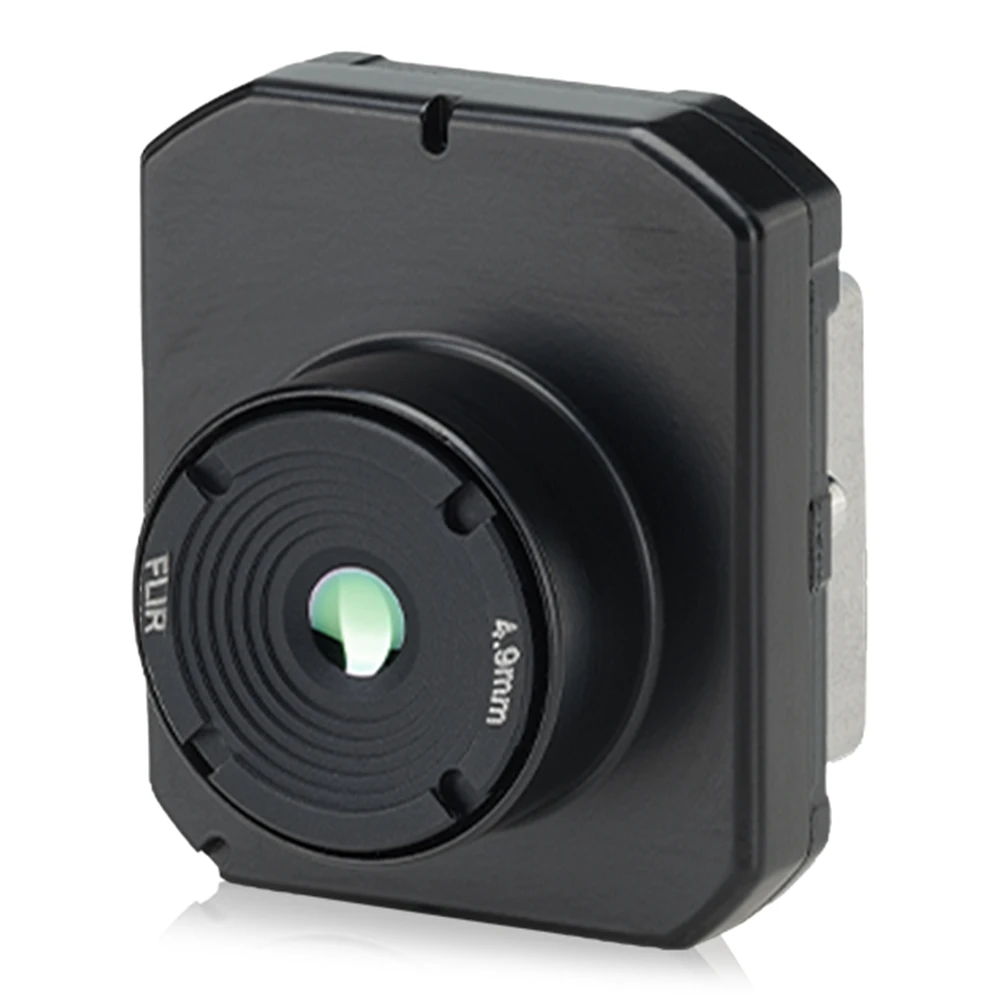
Teledyne Teledyne FLIR Boson+ 640×512 LWIR Thermal Camera Module, 95° HFOV, 4.9mm Lens
The Teledyne Teledyne FLIR Boson+ 22640AS95-6PAAX is a high-performance longwave infrared (LWIR) thermal imaging core module, featuring a 640×512 resolution sensor with ≤20 mK sensitivity and a 95° HFOV 4.9mm lens. Designed for OEM integration, it provides low-latency, 60Hz video output via USB, MIPI, or CMOS interfaces for real-time thermal vision applications in drones, robotics, and surveillance systems.
Features
- High-Resolution Thermal Imaging: 640×512 pixel LWIR sensor delivers detailed thermal maps with exceptional ≤20 mK (NEdT) thermal sensitivity for detecting minute temperature differences.
- Wide-Angle Field of View: Integrated 4.9mm f/1.0 lens provides a 95° horizontal field of view (HFOV), ideal for broad-area surveillance and inspection.
- Real-Time Performance: Operates at a 60Hz frame rate with ultra-low latency output, enabling responsive tracking and analysis for dynamic applications.
- Flexible OEM Integration: Supports multiple video (CMOS, MIPI, USB) and control (UART, I2C, USB) interfaces for seamless embedding into custom hardware platforms.
- Compact & Low Power: Ultra-compact 21x21x11 mm core module weighs just 7.5g and consumes from ~1000 mW, suitable for portable and airborne systems.
Out of stock
The Boson+ 640 thermal camera module represents a significant advancement in accessible, high-performance LWIR imaging cores for OEMs and system integrators. Its 12µm pixel pitch sensor operates in the 8–14 µm spectral range, capturing detailed thermal data even in low-contrast environments. Advanced on-board image processing, including automatic gain control (AGC) and dynamic detail enhancement (DDE+), ensures output imagery maintains sharpness and clarity for improved machine vision algorithms or operator interpretation.
Engineered for harsh operational conditions, the module functions reliably across an extended temperature range of -40°C to 80°C. Its compact, lightweight form factor and versatile digital interfaces allow for straightforward integration into drones for aerial thermography, robotic platforms for autonomous navigation, handheld devices for predictive maintenance, and fixed surveillance systems for perimeter monitoring. The module’s design prioritizes low power draw and minimal thermal footprint, making it a practical choice for battery-powered and space-constrained applications requiring persistent thermal awareness.
Additional Information
| Weight | 0.015 kg |
|---|---|
| Dimensions | 5 × 5 × 2 cm |