SKU: SENS-0206
📋 GST Invoice Available

Pulse Sensor Amped Heart Rate Monitor for Arduino - Module Only

₹149.00 (Inclusive of all taxes)
Out of Stock

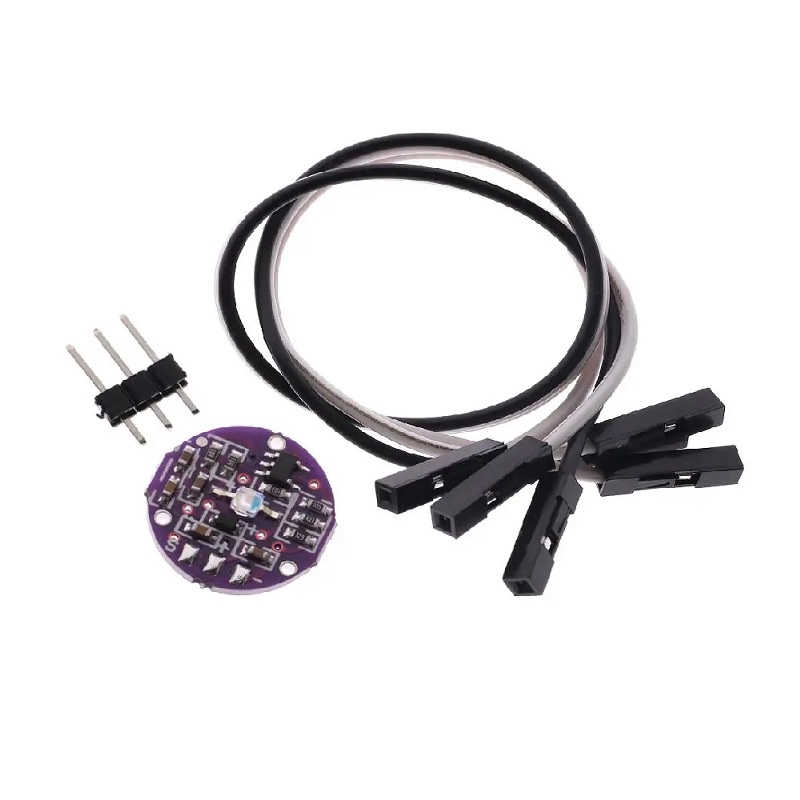
The Pulse Sensor Amped is a plug-and-play heart-rate sensor module compatible with 3.3V and 5V Arduino boards, Raspberry Pi, ESP32, and other microcontrollers. It outputs a clean analog signal representing the photoplethysmogram (PPG) waveform for real-time heart rate monitoring.

Features

  • Integrated amplification and ambient light noise cancellation circuitry for stable, reliable pulse readings.
  • Simple 3-pin interface (VCC, GND, Signal) for direct connection to microcontroller analog input pins.
  • Compact 15mm diameter PCB with mounting holes for easy integration into wearables and prototypes.
  • Compatible with Arduino IDE and Processing visualization software for immediate data plotting and debugging.
  • Operates from 3V to 5V DC, making it suitable for a wide range of development boards and battery-powered projects.

Out of stock

Description

The Pulse Sensor Amped is a photoplethysmography (PPG) sensor designed to simplify the acquisition of heart rate data. It uses a green LED paired with a photodetector to sense changes in blood volume at the skin’s surface, which correspond to the cardiac pulse. The onboard analog front-end amplifies the weak signal and filters out ambient light interference, delivering a clean, readable waveform to a microcontroller’s ADC.

This module is engineered for rapid prototyping and integration into health-monitoring systems, interactive art installations, fitness devices, and educational projects. Its straightforward analog output eliminates the complexity of raw signal conditioning, allowing developers to focus on application logic and data visualization.

Key Features

  • Optimized PPG Front-End: Onboard amplification and noise filtering provide a robust analog signal, minimizing the need for external circuitry.
  • Broad Voltage Compatibility: Supports 3V to 5V DC power supplies, ensuring compatibility with Arduino Uno, Nano, ESP32, and other 3.3V/5V logic systems.
  • Prototype-Friendly Design: Compact 15mm circular PCB features three peripheral mounting holes for secure attachment to fabrics, enclosures, or wearables.
  • Developer Ecosystem: Supported by open-source Arduino libraries and Processing-based visualization software for instant waveform display and heart rate calculation.
  • High-Value Build: Delivers reliable performance for biometric sensing applications at an optimized performance-to-cost ratio.

Applications

  • Wearable fitness and heart rate monitoring devices for athletes and health tracking.
  • Biometric feedback systems in interactive art, music, or game controller projects.
  • Prototyping medical and wellness devices for remote patient monitoring and vital sign data acquisition.
  • Educational demonstrations of human physiology, signal processing, and data visualization with microcontrollers.
  • Integrating live physiological data into VR/AR experiences and human-computer interaction research.

Technical Specifications

Item TypeHeart Rate Sensor Module
Model NamePulse Sensor Amped
PCB Diameter15 mm
PCB Thickness1.5 mm
Sensing PrinciplePhotoplethysmography (PPG)
Output SignalAnalog Voltage (0-VCC)
Supply Voltage3V to 5V DC
Interface3-pin (VCC, GND, Signal)
Primary CompatibilityArduino, Raspberry Pi, ESP32, STM32

Frequently Asked Questions

What is the operating voltage range for the Pulse Sensor Amped?

The Pulse Sensor Amped is designed to operate from a 3V to 5V DC power supply. This range makes it directly compatible with most 5V Arduino boards (like Uno) and 3.3V logic systems (like ESP32 or Raspberry Pi) without requiring a level shifter. Simply connect the red wire to your board's VCC (3V/5V) and the black wire to GND.

How do I connect and read data from this sensor with an Arduino?

Connection is straightforward: connect the sensor's red wire to Arduino 5V, black wire to GND, and purple (signal) wire to an analog input pin (e.g., A0). In your Arduino sketch, use the `analogRead()` function on the chosen pin to acquire the raw PPG waveform. For heart rate calculation and visualization, utilize the open-source PulseSensor Playground library and accompanying Processing application.

Does the sensor require any calibration or specific mounting?

The sensor does not require user calibration for basic waveform acquisition. For optimal signal quality, ensure the green LED side is in firm, consistent contact with skin (typically on a fingertip or earlobe). The three small holes on the PCB allow for sewing or mounting the module onto straps, clothing, or enclosures to maintain proper skin contact during movement.

Package Includes

  • 1 x Pulse Sensor Amped Heart Rate Sensor Module

Additional Information

Weight 0.04 kg
Dimensions 6 × 8 × 2 cm