SKU: IOWC-1107
📋 GST Invoice Available

LilyGO T7-C6 ESP32-C6 Wi-Fi 6 & BLE 5 Dev Board

₹1,059.00 (Inclusive of all taxes)
Out of Stock

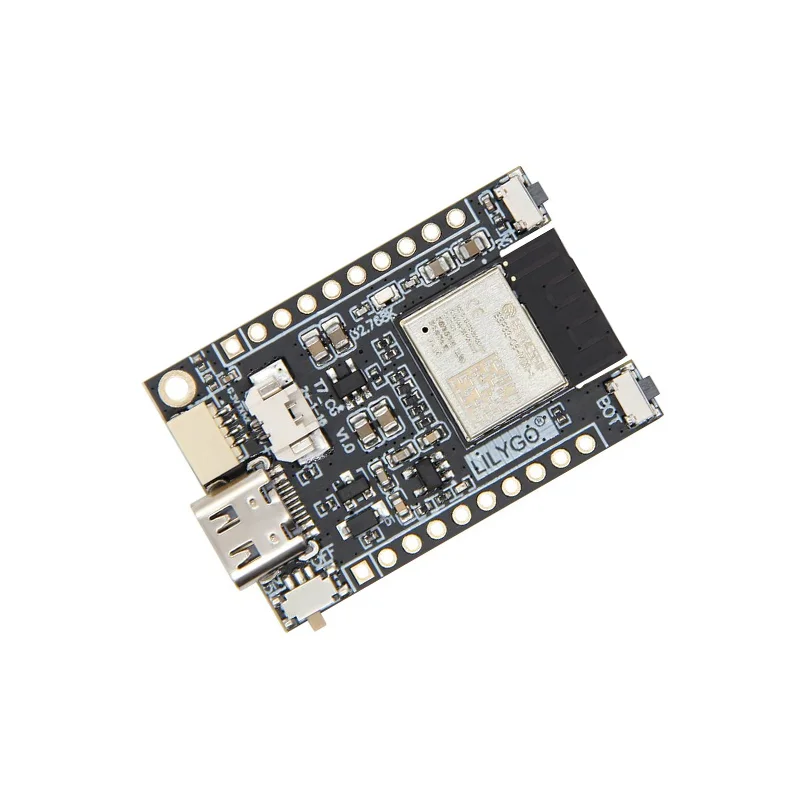
The LilyGO T7-C6 is a compact IoT development board powered by the ESP32-C6-MINI-1 RISC-V processor, supporting 2.4GHz Wi-Fi 6, Bluetooth 5 LE, and 802.15.4 protocols. It is programmable via Arduino IDE, ESP-IDF, or MicroPython for rapid IoT prototyping.

Features

  • ESP32-C6-MINI-1 RISC-V core delivers up to 160 MHz processing for efficient IoT edge computing.
  • Integrated 2.4GHz Wi-Fi 6 and Bluetooth 5 LE enables fast, reliable, and low-power wireless connectivity.
  • 4MB Flash and 400KB SRAM provide ample memory for application code and data buffering.
  • Qwiic 4-pin STEMMA QT connector allows for rapid, solderless integration of I2C sensors and modules.
  • Available in two variants: N1 with external antenna connector and N4 with a built-in PCB antenna.

Out of stock

Description

The LilyGO T7-C6 development board integrates the Espressif ESP32-C6-MINI-1 module, a single-core RISC-V microcontroller optimized for low-power IoT applications. Operating at 3.3V, it provides a robust wireless suite including 2.4GHz Wi-Fi 6 (802.11ax) for higher throughput and efficiency, Bluetooth 5 Low Energy for peripheral connectivity, and native support for the 802.15.4 standard, forming a foundation for Zigbee and Thread mesh networking protocols.

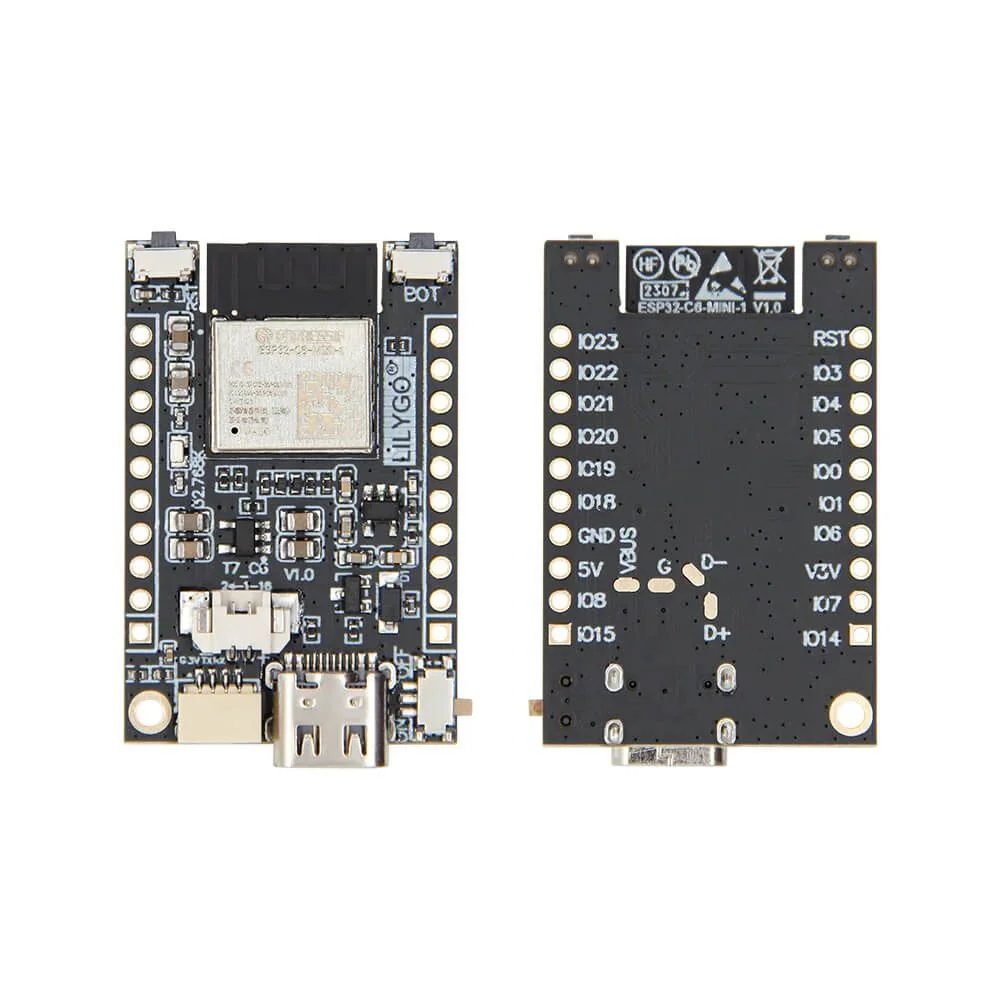
With 4MB of onboard flash memory and 400KB of SRAM, the board accommodates complex firmware developed in C/C++ via ESP-IDF or Arduino IDE, as well as scripting with MicroPython and Lua. The inclusion of dedicated BOOT and Reset buttons simplifies the firmware flashing and debugging workflow. Its compact form factor and Qwiic/STEMMA QT connector enable rapid prototyping by daisy-chaining I2C sensors without soldering, making it an ideal platform for smart home automation, environmental monitoring, and wireless sensor node development.

Key Features

  • Powered by the ESP32-C6-MINI-1, a RISC-V based SoC running at up to 160 MHz for efficient processing.
  • Comprehensive wireless support: 2.4GHz Wi-Fi 6 (802.11ax), Bluetooth 5 Low Energy, and IEEE 802.15.4 (Zigbee/Thread).
  • 4MB of flash memory provides sufficient space for application code, filesystem, and OTA updates.
  • Qwiic/STEMMA QT 4-pin I2C connector enables plug-and-play expansion with a vast ecosystem of sensors.
  • Low-power operation with typical current draw between 100-200 mA, suitable for battery-powered nodes.
  • Wide operating temperature range of -40°C to 85°C ensures reliability in industrial and outdoor environments.
  • Dual antenna options: external u.FL/IPEX connector (N1 variant) or integrated PCB antenna (N4 variant) for flexible deployment.
  • Fully compatible with Arduino IDE, ESP-IDF, VS Code with PlatformIO, MicroPython, and Lua for versatile development.

Applications

  • Smart home automation hubs and wireless sensor nodes for temperature, humidity, and motion.
  • Industrial IoT (IIoT) telemetry systems for equipment monitoring and predictive maintenance.
  • Prototyping for Zigbee or Thread mesh network coordinators and end-devices.
  • Battery-powered environmental sensors leveraging Wi-Fi 6's power efficiency.
  • Educational platforms for learning RISC-V architecture, wireless protocols, and embedded C/MicroPython.

Technical Specifications

Microcontroller / SoCESP32-C6-MINI-1 (RISC-V, up to 160 MHz)
Wireless ProtocolsWi-Fi 6 (2.4GHz 802.11ax), Bluetooth 5 LE, IEEE 802.15.4
Flash Memory4 MB
SRAM400 KB
Supply Voltage3.3V
Operating Current100-200 mA (typical)
InterfacesQwiic/STEMMA QT (I2C), GPIO, UART, SPI, I2S
Antenna Connectoru.FL/IPEX (N1 variant) or PCB Antenna (N4 variant)
Operating Temperature-40°C to 85°C
DimensionsApprox. 8 x 5 cm (board)

Frequently Asked Questions

How do I program the LilyGO T7-C6 board using the Arduino IDE?

First, install the ESP32 board support via the Arduino Boards Manager. Select 'ESP32-C6 Dev Module' as your target. Connect the board via USB, press the BOOT button, then upload your sketch. The board uses a standard USB-to-UART bridge, so ensure you have the correct CP210x or CH340 drivers installed for your operating system.

What is the difference between the N1 and N4 variants of the T7-C6?

The N1 variant includes a u.FL (IPEX) connector for an external antenna, offering improved range and directionality. The N4 variant uses a printed PCB antenna for a more compact, integrated solution. Choose N1 for applications requiring maximum signal strength or metal enclosures, and N4 for simple, cost-effective designs where space is limited.

Can this board be used as a Zigbee or Thread coordinator?

Yes, the ESP32-C6's native 802.15.4 radio provides the physical layer for Zigbee and Thread protocols. You will need to implement the respective network stack using Espressif's ESP-Zigbee-SDK or ESP-Thread-SDK within the ESP-IDF framework. The board can function as a coordinator, router, or end-device within such low-power mesh networks.

What is the typical power consumption and how can I enable deep sleep?

Active current ranges from 100-200 mA. For battery operation, utilize the ESP32-C6's deep sleep modes. In your code, call `esp_deep_sleep_start()` after configuring a wake-up source (timer, GPIO). In deep sleep, current can drop to microamps, dramatically extending battery life. Ensure your power supply regulator supports ultra-low quiescent current for optimal results.

Package Includes

  • 1 x LilyGO T7-C6 Development Board
  • 1 x Connector Wire
  • 2 x Header Connector (for pin soldering)

Additional Information

Weight 0.027 kg
Dimensions 5 × 8 × 3 cm