
Generic NodeMCU ESP8266 Wireless Development Module | Wi-Fi Connectivity | IoT Prototyping Platform
₹149.00₹250.00 (price_including_tax) (-40%)
Empower your IoT projects with robust wireless capabilities. This module transforms concepts into connected devices, offering seamless integration and rapid prototyping. Engineered for reliability, it provides a stable foundation for smart applications.
Compact, powerful ESP8266 module for rapid IoT development, delivering reliable Wi-Fi and comprehensive GPIO access.
Accelerate your project development with quick Wi-Fi integration and easy programming access.
Connect numerous sensors and peripherals using abundant GPIO pins and standard protocols easily.
Space-saving footprint ensures seamless integration into diverse embedded and portable applications.
The Engineering Behind NodeMCU ESP8266 Wireless Development Module
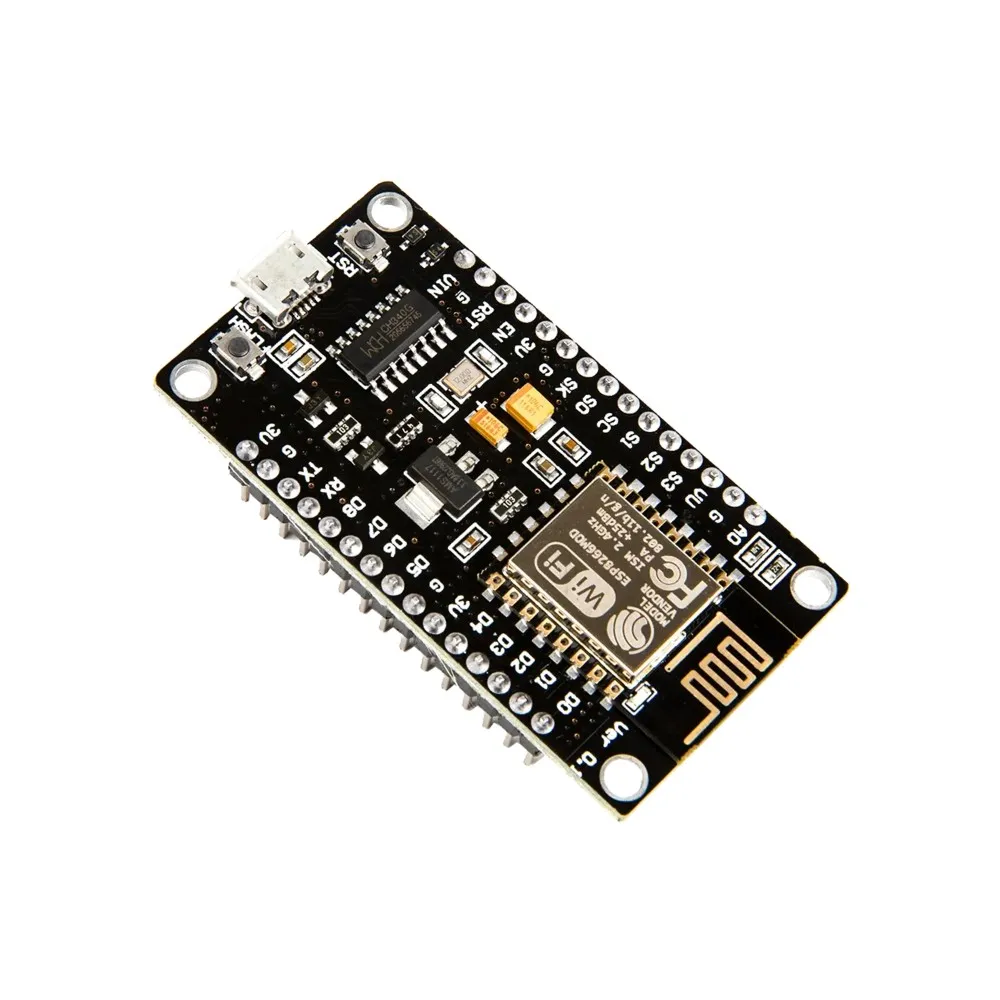
The NodeMCU ESP8266 is an open-source firmware and development kit that helps to prototype your IoT product within a few Lua script lines. It’s built upon the ESP-12E module, which integrates the powerful ESP8266 Wi-Fi enabled System-on-Chip (SoC). This architecture allows for cost-effective, full-stack IoT solutions, providing both Wi-Fi connectivity and microcontroller capabilities on a single board, facilitating robust data acquisition and transmission for various applications.
Designed for ease of use, the NodeMCU board typically includes an integrated USB-to-serial converter (e.g., CP2102 or CH340G), enabling direct programming via a standard Micro-USB cable. Its breadboard-friendly pinout simplifies circuit integration, making it an ideal choice for hobbyists, educators, and professional developers. The board’s components are selected for stable operation, providing consistent performance in diverse embedded environments.
Integrated ESP8266-12E Wi-Fi SoC
At its core, the NodeMCU utilizes the ESP8266-12E module, featuring a Tensilica L106 32-bit RISC processor operating at 80MHz (or up to 160MHz). This SoC boasts 4MB of flash memory for program storage and 96KB of data RAM, coupled with full 802.11 b/g/n Wi-Fi capabilities, including support for WPA/WPA2 security. This powerful integration eliminates the need for external Wi-Fi shields, drastically reducing complexity and board space in IoT designs.
Comprehensive GPIO & Peripheral Access
The NodeMCU board exposes crucial GPIOs (General Purpose Input/Output) from the ESP8266-12E, offering versatile connectivity options for sensors, actuators, and other peripherals. It supports standard communication protocols such as SPI, I2C, and UART, along with PWM and a single 10-bit Analog-to-Digital Converter (ADC) input. This rich set of interfaces allows engineers to implement a wide array of functionalities, from environmental monitoring to motor control, all managed by the onboard Wi-Fi enabled microcontroller.
Optimized for Performance & Integration
- Core Processor: Tensilica L106 32-bit RISC CPU
- Clock Speed: 80MHz (Configurable to 160MHz)
- Flash Memory: 4MB (32Mbit)
- SRAM: 64KB Instruction RAM + 96KB Data RAM
- Wireless Standard: IEEE 802.11 b/g/n Wi-Fi
- Operating Voltage: 3.3V (Logic), 5V (USB Power Input)
- GPIO Pins: 11 (Function-configurable)
- Analog Input: 1 x 10-bit ADC channel
Features & Benefits
- Integrated Wi-Fi Module: Enables seamless connectivity for IoT applications without external components.
- ESP8266-12E Core: Provides powerful processing for complex tasks and efficient network communication.
- Breadboard-Friendly Design: Simplifies prototyping and circuit assembly, saving time and effort.
- Micro-USB Port: Allows for easy programming and power supply using a standard cable.
- Lua/MicroPython Support: Facilitates rapid development with high-level scripting languages for quick iteration.
- Multiple GPIO Pins: Offers versatile connectivity for a wide range of sensors and actuators.
Pro-Grade Advantages
- Cost-effective solution for Wi-Fi enabled embedded systems.
- Integrated USB-to-serial converter for straightforward programming.
- Extensive community support and vast online resources.
- Supports high-level scripting languages like Lua and MicroPython.
Technical Considerations
- Limited number of true analog input pins (one 10-bit ADC).
- All GPIOs operate at 3.3V logic, requiring level shifters for 5V components.
What is the operating voltage of the NodeMCU ESP8266?
The NodeMCU ESP8266 module operates at a core logic voltage of 3.3V. While it can be powered via a 5V Micro-USB input, an onboard regulator steps this down to 3.3V for the ESP8266 chip and its peripherals.
Can I program the NodeMCU using the Arduino IDE?
Yes, the NodeMCU ESP8266 is fully compatible with the Arduino IDE. You can install the ESP8266 board package through the IDE’s Board Manager and write sketches in C++ like a standard Arduino board, leveraging its rich set of libraries.
What wireless standards does the ESP8266 support?
The ESP8266 supports the IEEE 802.11 b/g/n Wi-Fi standard. It can operate in various modes, including Station (STA), Access Point (AP), and a combined AP+STA mode, providing flexible network connectivity for IoT applications.
How much flash memory does the NodeMCU ESP8266 typically have?
Most NodeMCU ESP8266 boards, particularly those using the ESP-12E module, come with 4MB (32Mbit) of flash memory. This ample storage allows for complex firmware, over-the-air (OTA) updates, and data logging.
What are the common applications for the NodeMCU ESP8266?
The NodeMCU ESP8266 is widely used for home automation, smart lighting systems, remote monitoring, sensor networks, web servers, and various other Internet of Things (IoT) projects requiring Wi-Fi connectivity and microcontroller capabilities.
| Specification | Value |
|---|---|
| Wireless Standard | 802.11 b/g/n |
| USB-UART Bridge | CP2102/CH340G (Common) |
| GPIO Pins Available | 11 |
| Analog Input Pins | 1 (10-bit ADC) |
| Clock Speed | 80MHz (up to 160MHz) |
| Security Protocols | WPA/WPA2 |
| Programming Languages | Lua, MicroPython, C++ (Arduino IDE) |
| Onboard LED | User-programmable |
| Input Voltage (USB) | 5V DC |
Additional information
| Weight | 0.007 kg |
|---|---|
| Dimensions | 4.9 × 2.55 × 1.3 cm |
| Brand | Generic |
| Technology | Wi-Fi |
| Processor/SoC | ESP8266-12E |
| RAM/Flash Memory | 4MB Flash, 96KB Data RAM |
| Operating Voltage | 3.3V (Logic) |
| Control Interface | UART (USB-to-Serial) |
Reviews
There are no reviews yet.