
Generic 7 Segment LED Display | High Visibility | Easy Microcontroller Interface
₹2.00₹5.00 (price_including_tax) (-60%)
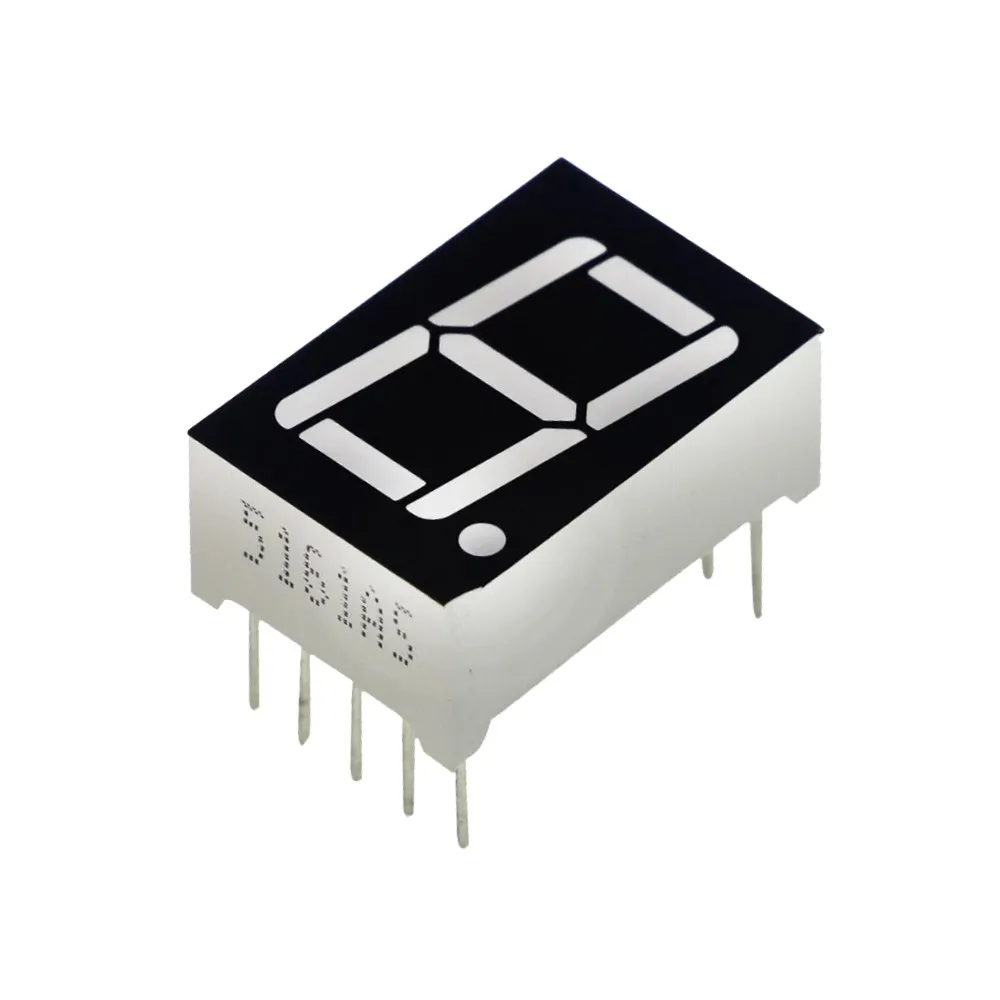
Achieve clear, segmented numerical output for your electronic designs. Simplifies data visualization for embedded systems, clock displays, or counter applications. Offers reliable performance and straightforward interfacing with microcontrollers.
Precision-engineered 7 Segment LED for clear numerical data in embedded systems and educational projects.
Provides instantaneous, easy-to-read numeric data for diverse embedded system applications, enhancing interaction.
Designed for straightforward digital interfacing, simplifying development for all skill levels effectively.
Essential for learning basic digital output and display logic in electronics education quickly.
The Engineering Behind 7 Segment LED Display
The 7 Segment LED Display is a fundamental optoelectronic component designed for the clear and efficient display of numerical data from 0 to 9, along with a few select alphabetical characters and a decimal point. Its architecture comprises seven individual light-emitting diodes (LEDs), plus an optional eighth for the decimal point, arranged in a specific ‘8’ pattern. Operationally, each segment can be independently controlled by a digital signal, allowing microcontrollers to illuminate specific combinations to form desired digits.
Constructed with robust plastic or epoxy packaging, this display utilizes standard LED components known for their longevity and consistent performance. It serves as an excellent pedagogical tool for understanding basic digital output principles, multiplexing, and direct I/O control in electronics education and prototyping environments. Its straightforward design ensures high durability and reliability in various applications.
Direct Segment Control Architecture
The primary technical feature of the 7 Segment LED Display is its direct segment control architecture. Each of the seven segments (and the decimal point) corresponds to an individual pin, enabling direct interfacing with a microcontroller’s General Purpose Input/Output (GPIO) pins. This design simplifies the driver circuitry, allowing for straightforward programming logic to control segment illumination. The practical application benefit is high versatility for displaying digits and a limited set of characters without the need for complex driver ICs in basic setups, making it ideal for learning and simple projects.
Common Anode/Cathode Configurations
These displays typically come in two configurations: common anode or common cathode. In a common anode configuration, all LED anodes are tied to a common positive voltage, and segments are lit by grounding their respective cathodes. Conversely, in a common cathode display, all LED cathodes are tied to a common ground, and segments are lit by applying a positive voltage to their respective anodes. This structural choice resolves traditional operational pain points by allowing engineers to select the display type that best matches their microcontroller’s output capabilities (sourcing or sinking current), thus simplifying wiring and minimizing external component count for efficient circuit design.
Optimized for Performance & Integration
- Display Type: 7-Segment (plus decimal point)
- Operating Voltage: 1.8V – 3.3V per segment (forward voltage)
- Interface: Direct segment control (GPIO)
- Configuration: Common Anode (Typical)
- Pin Count: 10 (8 segments + 2 common)
- Digit Size: 0.56 inches (typical)
- Current per Segment: 10mA – 20mA (typical)
Features & Benefits
- High Visibility: Ensures clear numerical readouts from various viewing angles.
- Direct Drive Compatibility: Seamlessly interfaces with microcontrollers like Arduino or ESP32.
- Robust Construction: Provides long-term reliability in prototyping and finished projects.
- Standard Pinout: Simplifies breadboard integration and custom PCB design processes.
- Energy Efficient LEDs: Minimizes power consumption while maintaining optimal brightness.
Pro-Grade Advantages
- Simple, direct control using GPIO pins for easy implementation.
- Excellent visibility for numerical data in various lighting conditions.
- Low cost and widely available, making it accessible for projects.
- Fundamental component for learning digital electronics principles and practice.
Technical Considerations
- Limited display capabilities, primarily restricted to numbers and a few characters.
- Requires multiple I/O pins for direct driving without a dedicated driver IC.
What is a 7 segment LED display?
A 7 segment LED display is an electronic display device that uses seven individual LEDs (called segments) arranged in a way that allows them to display decimal numerals (0-9) and some basic alphabetical characters. An eighth segment (decimal point) is often included.
How do you interface a 7 segment display with a microcontroller?
Each segment of the display is typically connected to a separate GPIO pin on the microcontroller. By selectively turning these pins high or low, individual segments can be illuminated or extinguished to form the desired digit.
What is the difference between common anode and common cathode?
In a common anode display, all LED anodes are connected to a common positive voltage, and segments are illuminated by grounding their respective cathodes. In a common cathode display, all LED cathodes are connected to a common ground, and segments are illuminated by applying a positive voltage to their respective anodes.
Can a 7 segment display show letters?
While primarily designed for numbers, a 7 segment display can form a limited set of uppercase and lowercase letters (e.g., A, b, C, d, E, F, H, I, L, P, S, U) by creatively combining its segments. Full alphabet display requires more complex matrices.
What is the typical operating voltage and current for these segments?
Each LED segment typically has a forward voltage drop of 1.8V to 3.3V, depending on the LED color. The recommended operating current per segment is usually between 10mA to 20mA, requiring current-limiting resistors.
| Specification | Value |
|---|---|
| Display Type | Single Digit 7-Segment LED |
| Configuration | Common Anode (Typical) |
| Number of Segments | 7 + Decimal Point (DP) |
| Digit Height | 0.56 inch (14.2mm) |
| Emitted Color | Red (Typical) |
| Forward Voltage (Vf) per Segment | 2.0V (Typical) |
| Forward Current (If) per Segment | 10-20mA |
| Pin Count | 10 |
| Package Type | DIP (Dual In-line Package) |
Additional information
| Technology | LED |
|---|---|
| Operating Voltage | 1.8V – 3.3V (per segment) |
| Control Interface | Direct Segment Control |
| Channels | 8 (7 segments + DP) |
| Difficulty Level | Beginner |
Reviews
There are no reviews yet.