
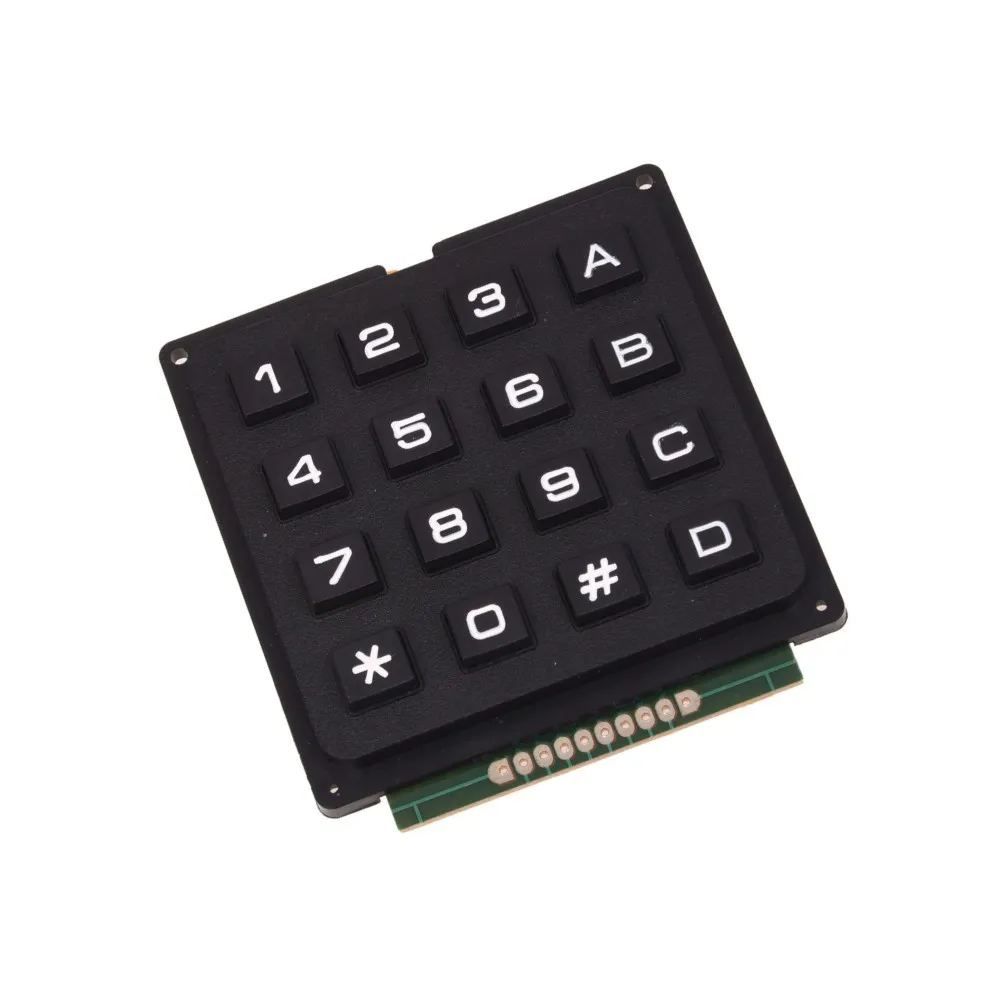
Generic 4×4 Matrix Membrane Keypad Module | 16-Button Input | Microcontroller Interface
₹149.00₹250.00 (price_including_tax) (-40%)
Effortlessly integrate user input into your embedded projects. Transform complex interactions into simple, reliable button presses. Built for robust performance and lasting quality.
This 4×4 matrix keypad provides reliable 16-button input for diverse embedded systems and DIY electronics projects.
Simplifies user interaction for embedded systems with reliable 16-key input functionality.
Minimizes microcontroller I/O pin usage through its intelligent 4×4 matrix design.
Membrane construction ensures long-lasting performance and resilience against environmental factors.
The Engineering Behind 4×4 Matrix Membrane Keypad
The 4×4 Matrix Membrane Keypad is a fundamental human-machine interface (HMI) component, designed for efficient user input in microcontrollers and single-board computers. Its architecture relies on a grid of switches, typically arranged in a row-column matrix (4 rows, 4 columns for a total of 16 keys), reducing the required I/O pins compared to individual key connections. This design leverages internal pull-up resistors or external components on the microcontroller to detect key presses by scanning rows and columns. When a button is pressed, it creates a short circuit between a specific row and column, which the microcontroller reads to determine the activated key.
Constructed from durable membrane switches, this keypad offers a low-profile, spill-resistant interface ideal for various environments, from educational robotics to industrial control panels. The tactile feedback ensures confident key entry, while its sealed design enhances longevity and protects against dust and moisture, making it a reliable choice for prototyping and permanent installations.
Efficient Row-Column Scanning Interface
The core advantage of the 4×4 matrix design lies in its efficient use of I/O pins. Instead of requiring 16 separate pins for 16 buttons, it only needs 8 pins (4 for rows, 4 for columns). This multiplexing technique significantly conserves valuable microcontroller resources, allowing developers to allocate more pins to other sensors, actuators, or communication modules without compromising input functionality. This makes it an ideal solution for resource-constrained embedded systems.
Simple Microcontroller Integration
Designed for seamless integration with popular development boards like Arduino, Raspberry Pi, and ESP32, this keypad features a standard female header connector for straightforward wiring. Its minimal power requirements and direct logic-level compatibility simplify the development process, enabling rapid prototyping and deployment without complex level shifters or external circuitry. This structural choice resolves the pain points of high pin consumption and intricate interfacing often associated with numerous discrete input buttons.
Optimized for Performance & Integration
- Keypad Type: 4×4 Matrix Membrane
- Number of Keys: 16 (0-9, A-D, *, #)
- Interface: 8-pin Header (4 rows, 4 columns)
- Operating Voltage: Typically 3.3V to 5V (logic level dependent)
- Output: Digital (scanned)
- Durability: Over 1 million keystrokes
- Connector: Standard 2.54mm pitch female header
- Included: 4×4 Keypad module with attached ribbon cable
Features & Benefits
- 16-Button Layout: Provides comprehensive numeric and control input options for diverse applications.
- Matrix Scanning Technology: Reduces required I/O pins on microcontrollers, conserving resources for other peripherals.
- Durable Membrane Construction: Ensures long-term reliability and resistance to dust and light splashes.
- Easy Interfacing: Direct connection with Arduino, Raspberry Pi, and other development boards simplifies project setup.
- Tactile Feedback: Offers a satisfying click for positive key press confirmation, enhancing user experience.
- Flexible Application: Ideal for security systems, data entry, custom control panels, and educational robotics.
Pro-Grade Advantages
- Low I/O pin consumption for 16 inputs
- Durable and compact membrane switch design
- Easy to integrate with common microcontrollers
- Cost-effective solution for basic user interfaces
Technical Considerations
- Requires active scanning logic in firmware for key detection
- No direct key status output, requires polling
What is a 4×4 matrix keypad?
A 4×4 matrix keypad is an input device featuring 16 keys arranged in a 4-row by 4-column grid. It uses a multiplexing technique to detect key presses, minimizing the number of I/O pins needed on a microcontroller.
How do I connect the 4×4 keypad to an Arduino?
Connect the 8 pins of the keypad (4 for rows, 4 for columns) to digital I/O pins on your Arduino board. Use a keypad library to simplify reading button presses through scanning.
What are the common applications for this keypad?
Common applications include security keypads, data entry terminals, custom control panels for robotics, home automation systems, and interactive projects in STEM education.
Does this keypad require external pull-up resistors?
Most modern microcontrollers, like Arduino, have internal pull-up resistors that can be enabled. However, external pull-up resistors can also be used for specific designs or improved noise immunity if desired.
What is the typical operating voltage for the keypad?
The keypad itself is a passive component; its operation depends on the logic levels provided by the microcontroller. It is compatible with standard 3.3V and 5V logic systems.
| Specification | Value |
|---|---|
| Keypad Type | Membrane Matrix |
| Key Arrangement | 4 Rows x 4 Columns |
| Total Keys | 16 |
| Interface Pins | 8 (4 row, 4 column) |
| Connector Type | 2.54mm Pitch Female Header |
| Logic Compatibility | 3.3V / 5V |
| Material | PET/FR4 with Conductive Ink |
| Actuation Force | ~2N (200gf) |
| Life Expectancy | >1 Million Cycles |
| Operating Temperature | 0°C to 70°C |
Additional information
| Brand | Generic |
|---|---|
| Control Interface | Digital (Matrix Scan) |
| Channels | 16 (keys) |
| Operating Voltage | 3.3V-5V (Logic Dependent) |
| Piece Count | 1 |
| Difficulty Level | Beginner-Intermediate |

Reviews
There are no reviews yet.