
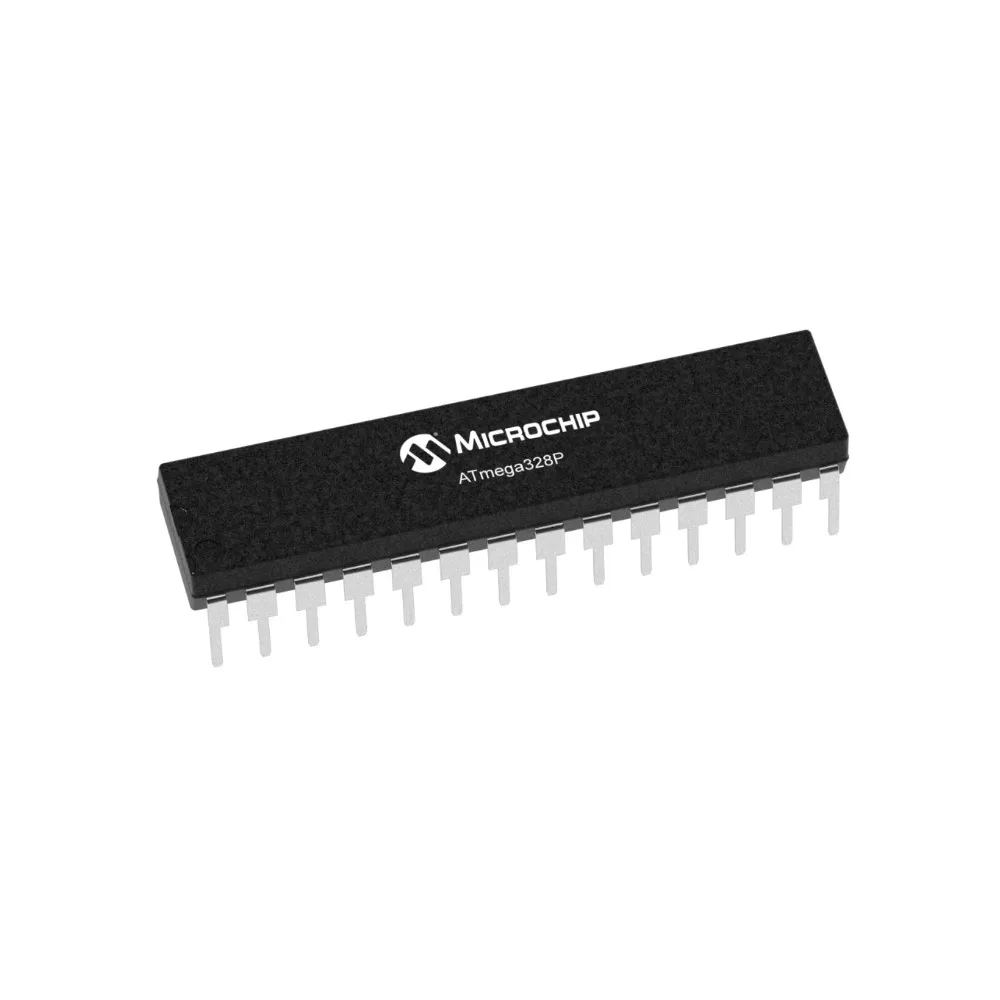
Atmel ATmega328P Microcontroller IC | 8-bit AVR Processor | Arduino Uno Core
₹449.00₹650.00 (price_including_tax) (-31%)
Unlock vast embedded system possibilities with the ATmega328P. This iconic 8-bit AVR microcontroller serves as the brain for countless DIY projects, robotics, and industrial applications. Engineered for stability and widely supported, it ensures reliable operation in demanding environments.
The ATmega328P delivers robust 8-bit performance, ideal for embedded systems and Arduino projects.
This iconic chip is the fundamental brain powering the widely popular Arduino Uno.
Delivers reliable 8-bit processing power for diverse embedded systems efficiently and dependably.
An indispensable component for prototyping, DIY electronics, and educational STEM projects worldwide.
The Engineering Behind ATmega328P Microcontroller
The Atmel ATmega328P is a high-performance, low-power 8-bit AVR RISC-based microcontroller combining 32KB ISP flash memory with read-while-write capabilities, 1KB EEPROM, 2KB SRAM, 23 general purpose I/O lines, 32 general purpose working registers, three flexible timer/counters with compare modes, internal and external interrupts, a serial programmable USART, a byte-oriented 2-wire serial interface (I2C), an SPI serial port, a 6-channel 10-bit A/D converter (8-channels in TQFP and QFN/MLF packages), a programmable watchdog timer with internal oscillator, and five software selectable power saving modes. It operates between 1.8V and 5.5V, making it exceptionally versatile for various embedded applications, from simple sensors to complex automation systems, and is famously the core processor for the Arduino Uno.
Fabricated using Atmel’s high-density non-volatile memory technology, this chip offers superior endurance and reliability. Its advanced RISC architecture executes powerful instructions in a single clock cycle, achieving throughputs approaching 1 MIPS per MHz, balancing power consumption and processing capability. This robust design makes it a foundational component for learning microcontroller programming, rapid prototyping, and developing production-grade electronic devices requiring dependable and efficient control.
High-Performance 8-bit AVR RISC Core
The ATmega328P’s sophisticated 8-bit AVR Reduced Instruction Set Computer (RISC) architecture is optimized for code efficiency and speed. With 32 general-purpose working registers directly connected to the Arithmetic Logic Unit (ALU), instructions can operate on two registers in a single clock cycle. This architectural design significantly enhances execution speed and throughput, enabling designers to implement complex algorithms and time-critical tasks with minimal code and lower clock frequencies, thereby reducing overall system power consumption and extending battery life in portable applications.
Versatile Peripheral Integration
Equipped with a comprehensive set of integrated peripherals, including multiple Timers/Counters, a 10-bit Analog-to-Digital Converter (ADC), Pulse Width Modulation (PWM) channels, and various serial communication interfaces (UART, SPI, I2C/TWI), the ATmega328P drastically simplifies system design. This high level of integration minimizes the need for external components, resolving common real-world pain points such as increased board space, higher Bill of Materials (BOM) costs, and complex inter-component wiring. Developers can leverage these built-in functionalities to directly interface with sensors, control actuators, and communicate with other devices, accelerating development cycles and enhancing project reliability.
Optimized for Performance & Integration
- Architecture: 8-bit AVR RISC
- Flash Memory: 32 KB (ISP)
- SRAM: 2 KB
- EEPROM: 1 KB
- Clock Speed: Up to 20 MHz (External Crystal)
- I/O Pins: 23 General Purpose
- ADC Channels: 6-8 Channels (10-bit)
- Operating Voltage: 1.8V – 5.5V
Features & Benefits
- 8-bit AVR RISC Architecture: Delivers high performance with minimal power consumption for efficient embedded solutions.
- 32KB In-System Programmable Flash: Provides ample program storage for complex sketches and robust firmware updates.
- 1KB EEPROM for Data Storage: Enables non-volatile data retention for configuration settings or persistent state.
- Extensive GPIO Pins (23): Offers flexible interfacing with sensors, actuators, and other peripheral devices.
- Integrated 10-bit ADC & PWM: Simplifies analog signal processing and motor control applications without external circuitry.
- Wide Operating Voltage (1.8V – 5.5V): Ensures compatibility across various power supply configurations and battery types.
Pro-Grade Advantages
- Seamless integration into the vast Arduino ecosystem.
- Excellent balance of performance, power consumption, and cost.
- Extensive documentation and a massive global community support base.
- Robust set of integrated peripherals simplifies system design.
Technical Considerations
- Limited processing power for highly complex, data-intensive computational tasks.
- Smaller memory footprint compared to modern 32-bit microcontrollers requires careful code optimization.
What is the core architecture of the ATmega328P?
The ATmega328P is built around an 8-bit AVR RISC (Reduced Instruction Set Computer) architecture, optimized for high performance and low power consumption.
What are the main memory specifications (Flash, SRAM, EEPROM)?
It features 32 KB of In-System Programmable (ISP) Flash memory for program storage, 2 KB of SRAM for dynamic data, and 1 KB of EEPROM for non-volatile data storage.
What is the maximum clock frequency of the ATmega328P?
The ATmega328P can operate at a maximum clock frequency of 20 MHz when utilizing an external crystal oscillator.
How many general-purpose I/O pins does it have?
The ATmega328P provides 23 general-purpose input/output (GPIO) pins, allowing flexible interfacing with various external components.
What voltage range does the ATmega328P operate within?
It operates within a wide voltage range of 1.8V to 5.5V, making it compatible with various power supply designs and battery applications.
Is the ATmega328P compatible with the Arduino IDE?
Yes, the ATmega328P is the core microcontroller for the popular Arduino Uno board and is fully supported by the Arduino IDE and its extensive libraries.
What are common packages for the ATmega328P?
The most common packages include the 28-pin DIP (Dual In-line Package), 32-lead TQFP (Thin Quad Flat Pack), and 32-pad QFN/MLF (Quad Flat No-lead / Micro Lead Frame) packages.
Does it have built-in analog-to-digital converters?
Yes, the ATmega328P integrates a 10-bit Analog-to-Digital Converter (ADC) with 6 channels (8 channels on TQFP/QFN packages) for reading analog sensor data.
| Specification | Value |
|---|---|
| Architecture | 8-bit AVR RISC |
| Flash Memory | 32 KB (ISP) |
| SRAM | 2 KB |
| EEPROM | 1 KB |
| Clock Speed | Up to 20 MHz |
| GPIO Pins | 23 |
| ADC Channels | 6-8 (10-bit) |
| PWM Channels | 6 |
| Timers/Counters | 2 x 8-bit, 1 x 16-bit |
| Operating Voltage | 1.8V – 5.5V |
| Program Memory Type | Flash |
| Data Retention | 20 years at 85°C / 100 years at 25°C |
Additional information
| Brand | Atmel |
|---|---|
| Processor/SoC | ATmega328P |
| RAM/Flash Memory | 1KB EEPROM, 2KB SRAM, 32KB Flash |
| Operating Voltage | 1.8V – 5.5V |
| Package | DIP-28, QFN/MLF-32, TQFP-32 |


Reviews
There are no reviews yet.