SKU: SBCD-0333
📋 GST Invoice Available

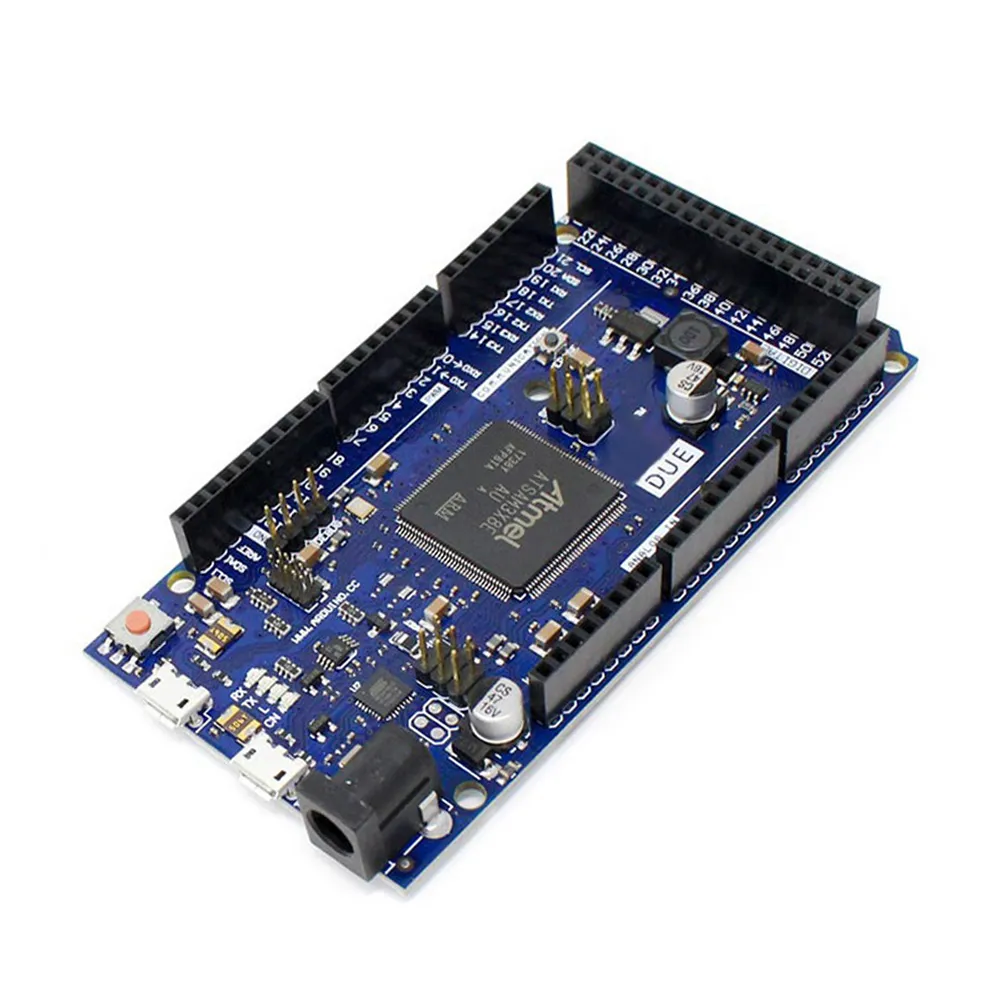
Arduino Due AT91SAM3X8E ARM Cortex-M3 Dev Board w/ USB

₹1,350.36 (Inclusive of all taxes)
Out of Stock

The Arduino Due is a high-performance microcontroller board featuring the Atmel SAM3X8E ARM Cortex-M3 CPU, designed for advanced embedded projects. Operating at 3.3V, it provides a 32-bit core running at 84MHz, 96KB SRAM, and extensive I/O capabilities for complex applications.

Features

  • Features Atmel AT91SAM3X8E ARM Cortex-M3 32-bit Microcontroller.
  • Equipped with an 84MHz CPU clock for high-speed processing.
  • Offers 96KB of SRAM and 512KB of Flash memory for code storage.
  • Provides 54 digital I/O pins (12 with PWM) and 12 analog inputs, plus 2 DAC outputs.
  • Operates at 3.3V and is compatible with Arduino 1.0 pinout shields.

Out of stock

Description

The Arduino Due is a robust microcontroller board built around the Atmel SAM3X8E ARM Cortex-M3 CPU, delivering significantly enhanced processing power compared to traditional 8-bit Arduino boards. It boasts 54 digital input/output pins, including 12 capable of PWM output, along with 12 analog inputs, 4 hardware UARTs, and an 84 MHz clock speed. Connectivity options include a USB OTG capable port, 2 DACs (digital to analog converters), 2 TWI interfaces, an SPI header, and a JTAG header for advanced debugging.

Memory architecture includes 512KB of flash memory for program storage, arranged in two 256KB blocks, and 96KB of SRAM, split into 64KB and 32KB banks. The bootloader is factory pre-burned into a dedicated ROM. A convenient onboard erase button allows for quick clearing of the SAM3X’s flash memory, removing the currently loaded sketch. To erase, simply press and hold the Erase button for a few seconds while the board is powered.

The Due adheres to the Arduino 1.0 pinout, ensuring compatibility with many existing Arduino shields that operate at 3.3V. It incorporates TWI pins (SDA and SCL) near the AREF pin and an IOREF pin, which enables connected shields to adapt to the board’s voltage, supporting both 3.3V (Due) and 5V (AVR-based) boards. Crucially, the Due operates at 3.3V; supplying higher voltages like 5V to any I/O pin can permanently damage the board.

Key Features

  • 32-bit ARM Cortex-M3 core enabling efficient 4-byte wide data operations per CPU clock cycle.
  • High-speed 84MHz CPU clock for demanding computational tasks and real-time applications.
  • Generous 96KBytes of SRAM for ample runtime data storage and complex variable handling.
  • Large 512KBytes of flash memory for extensive program code, accommodating sophisticated projects.
  • Integrated DMA (Direct Memory Access) controller to offload memory-intensive tasks from the CPU, improving overall system efficiency.
  • 54 Digital I/O pins, including 12 with Pulse Width Modulation (PWM) capabilities.
  • 12 Analog Input pins for reading sensor data and continuous signals.
  • 2 Digital-to-Analog Converter (DAC) pins for generating analog voltages.
  • Onboard USB OTG (On-The-Go) capable connection for flexible device connectivity.
  • Four hardware UARTs for robust serial communication.
  • Integrated CAN (Controller Area Network) bus support for industrial and automotive applications.

Applications

  • Advanced embedded control systems requiring higher processing power.
  • High-performance data acquisition and logging applications.
  • Robotics and mechatronics for complex motion control.
  • Real-time signal processing and audio synthesis.
  • Human-machine interface (HMI) development with rich graphics.
  • IoT prototypes requiring enhanced computing capabilities.

Technical Specifications

MicrocontrollerAT91SAM3X8E
Operating Voltage3.3V
Input Voltage (Recommended)7-12V
Input Voltage (Limits)6-16V
Digital I/O Pins54 (12 PWM output)
Analog Input Pins12
Analog Output Pins (DAC)2
CPU Clock Speed84MHz
SRAM96KB
Flash Memory512KB
DC Current per I/O Pin130mA
UART Ports4
TWI (I2C) Ports2
CAN BusYes
USB OTGYes
Dimensions (L x W x H)104 x 53 x 15 mm

Frequently Asked Questions

What is the core difference between Arduino Due and traditional Arduino boards?

The Arduino Due is based on a 32-bit Atmel SAM3X8E ARM Cortex-M3 MCU, unlike 8-bit AVR microcontrollers found in Uno or Mega. It operates at 3.3V and features higher clock speed (84MHz), more flash memory (512KB), and a greater number of I/O pins, enabling more complex applications than AVR-based boards.

What is the operating voltage of the Arduino Due, and what are its implications?

The Arduino Due operates at 3.3V, a critical distinction from 5V AVR-based boards. All I/O pins are 3.3V tolerant. Applying 5V directly to any I/O pin will damage the board. Ensure all connected shields and modules are 3.3V compatible or use appropriate level shifters when interfacing with 5V components.

How does the Arduino Due handle memory and program storage?

It features 512KB of flash memory for program storage and 96KB of SRAM for runtime data. The bootloader is factory pre-burned in a dedicated ROM. Flash memory can be erased via an onboard button, removing the current sketch, facilitating fresh program uploads. This ample memory supports large and complex embedded code.

What programming environments are compatible with the Arduino Due?

The Arduino Due is primarily programmed using the Arduino IDE. Users need to install the 'Arduino SAM Boards (32-bits ARM Cortex-M3)' package through the Boards Manager. It leverages the standard Arduino API, allowing familiar coding practices while utilizing the advanced capabilities of the ARM Cortex-M3 processor for high-performance projects.

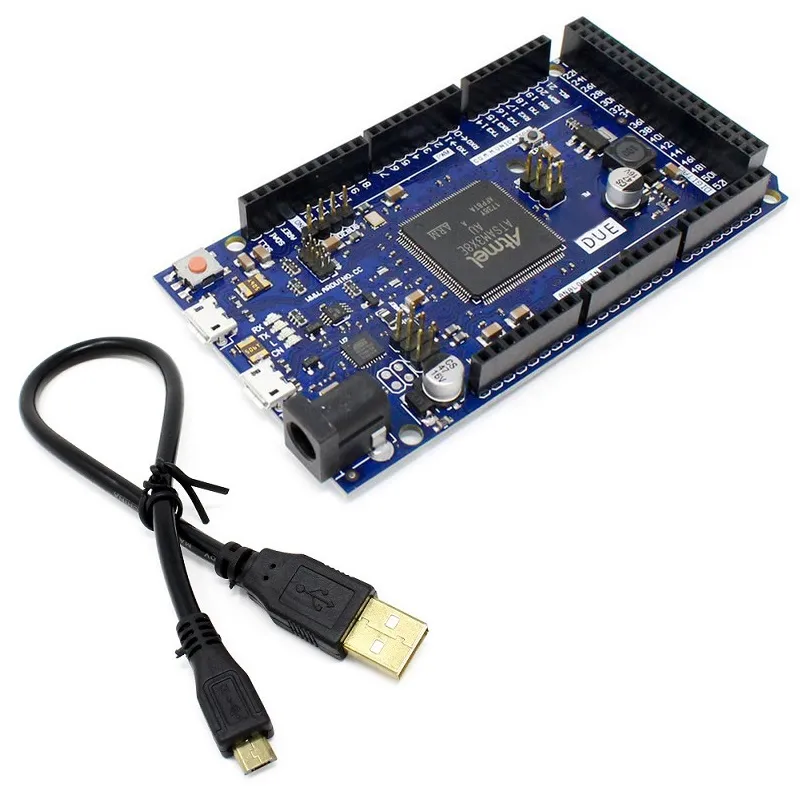
Package Includes

  • 1 x Due, AT91SAM3X8E ARM Cortex-M3 Board
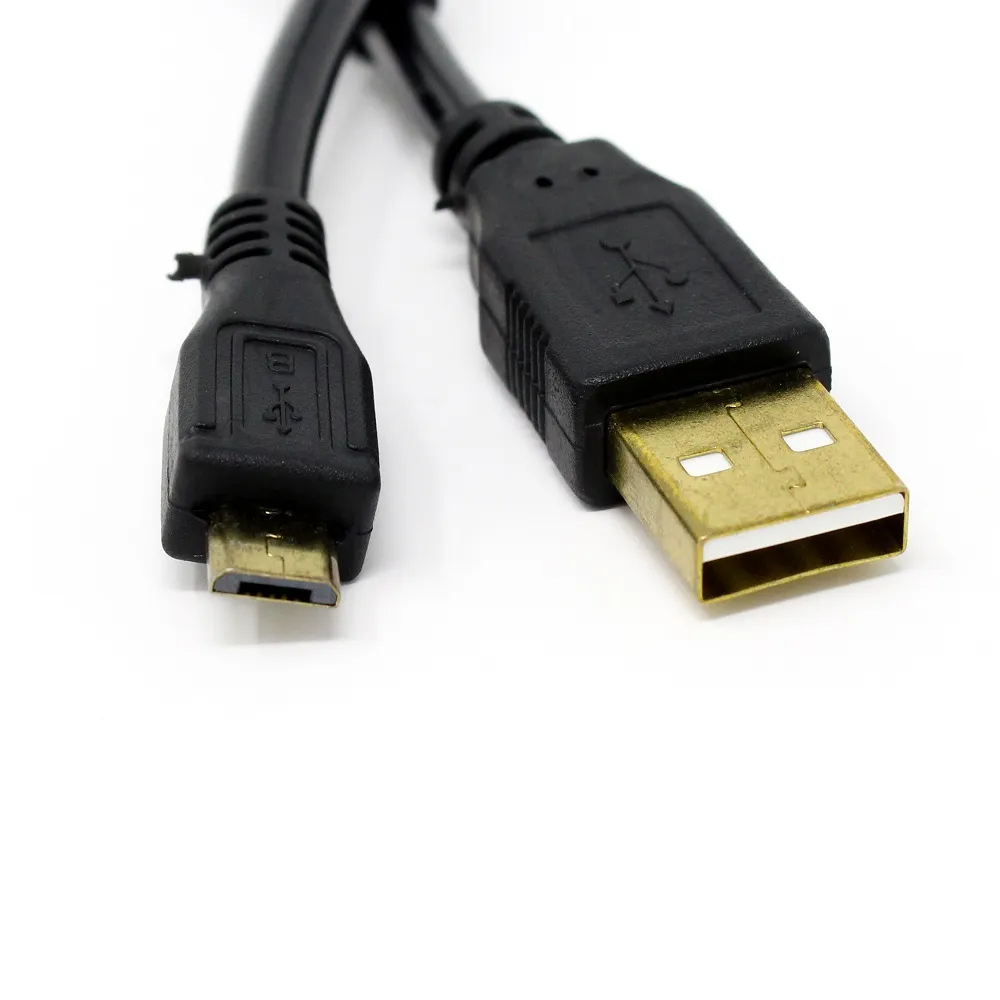
  • 1 x 6 Inch Micro USB Cable – A to Micro B

Additional Information

Weight 0.1 kg
Dimensions 10.4 × 5.3 × 1.5 cm