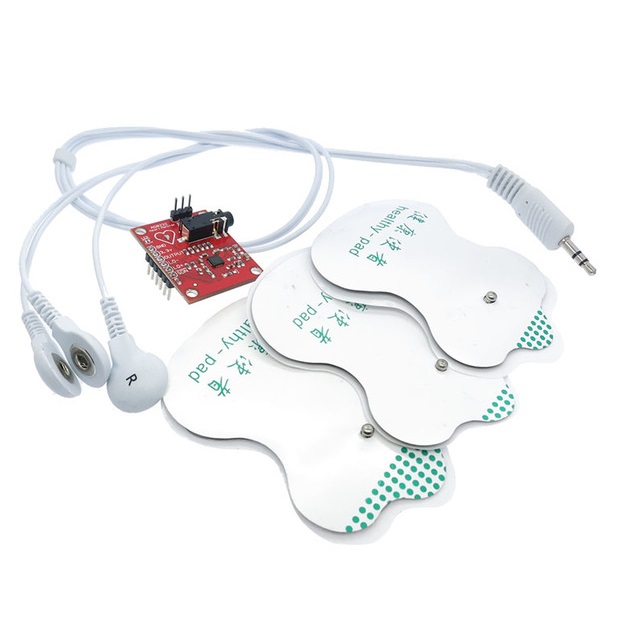
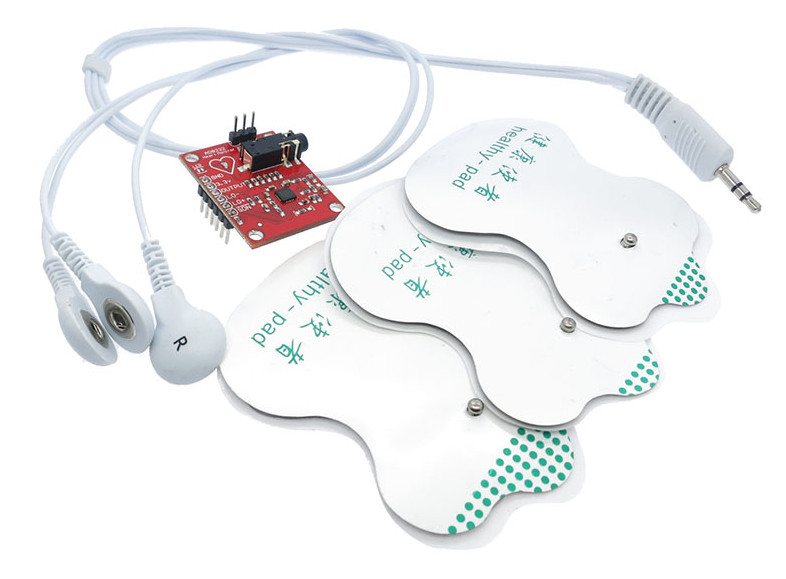

AD8232 ECG Heart Sensor Module for Arduino w/ Electrode Pads & Cable
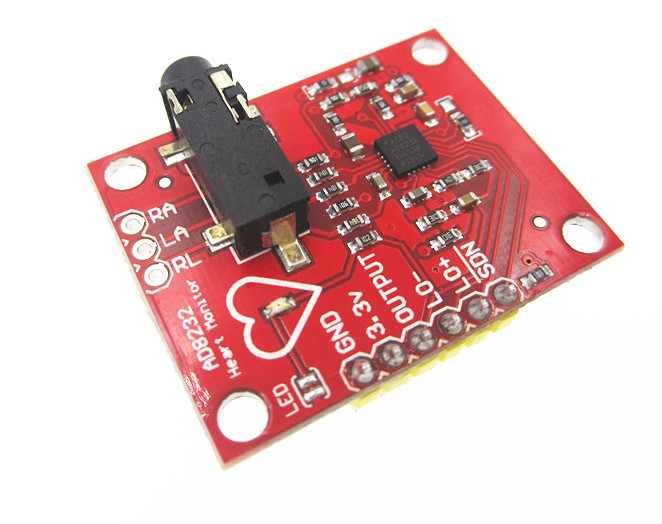
The AD8232 ECG Sensor Module is a dedicated signal conditioning front-end for extracting, amplifying, and filtering biopotential signals, providing a clean analog output compatible with Arduino and other 3.3V/5V microcontroller ADCs for heart rate monitoring and ECG waveform acquisition.
Features
- Integrated AD8232 IC for ECG signal amplification and filtering in noisy conditions.
- Provides analog output for direct connection to microcontroller ADC pins.
- Features Leads-Off Detection (LO+, LO-) to indicate poor electrode contact.
- Includes 3.5mm jack for standard biomedical pads and breakout pins (RA, LA, RL) for custom electrode connections.
- Compact module with shutdown pin for low-power operation and LED heartbeat indicator.
Out of stock
The AD8232 module serves as a complete analog front-end for biopotential measurement, specifically optimized for electrocardiogram (ECG) signals. It employs the AD8232 integrated circuit, which acts as an instrumentation amplifier with built-in filtering to extract the small electrical activity of the heart (typically in the mV range) while suppressing motion artifacts, electrode half-cell potentials, and other common-mode noise. This conditioning enables reliable signal acquisition even with remote or dry electrodes.
The module outputs a single-ended analog voltage proportional to the processed ECG waveform, suitable for sampling by any microcontroller with an ADC, such as Arduino, ESP32, or Raspberry Pi Pico. Key operational features include a shutdown pin for power management, a dedicated LED that pulses with the QRS complex, and leads-off detection pins that go high when an electrode becomes disconnected, ensuring data integrity. It is designed for prototyping, fitness monitoring, and biomedical data acquisition projects.
Additional Information
| Weight | 0.005 kg |
|---|---|
| Dimensions | 3.6 × 3 cm |