SKU: IOWC-1759
📋 GST Invoice Available

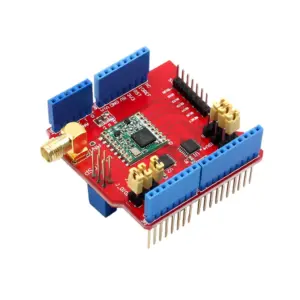
Generic LoRa Shield 433MHz for Arduino (RFM95W/RFM98W)

₹2,159.00 (Inclusive of all taxes)
Out of Stock

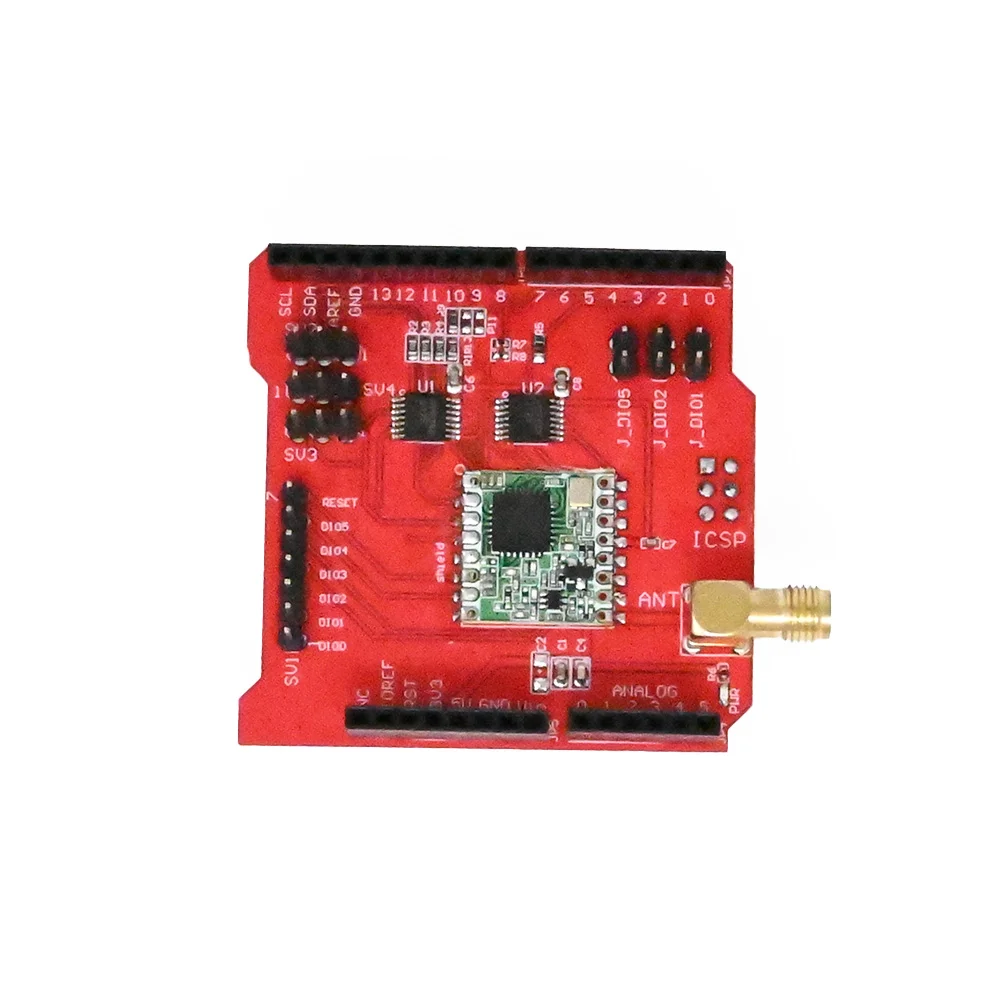
This 433MHz LoRa Shield integrates an RFM95W/RFM98W transceiver onto an Arduino-compatible form factor, enabling long-range, low-power wireless communication for Arduino Leonardo, Uno, Mega2560, and DUE boards via an open-source library.

Features

  • Long-range LoRa transceiver shield based on RFM95W/RFM98W chipset, pre-configured for the 433MHz ISM band.
  • Arduino shield form factor compatible with 3.3V or 5V I/O boards including Leonardo, Uno, Mega2560, and DUE.
  • Ultra-low power operation with a receiver current of only 10.3 mA and a deep sleep register retention of 200 nA.
  • Integrated +20 dBm power amplifier and high sensitivity (over -148dBm) for industry-leading link budget and robust communication.
  • External antenna connectivity via SMA jack for improved range and flexible antenna deployment.

Out of stock

Description

The LoRa Shield is a dedicated wireless transceiver module built on the Arduino shield standard, utilizing the Hope RF RFM95W/RFM98W LoRa chip. It enables developers to implement long-range, spread-spectrum communication with exceptional interference immunity and minimal power draw, ideal for creating robust sensor networks. The shield operates on the 433MHz frequency band and is factory-configured for immediate use with popular Arduino boards.

Based on patented LoRa modulation, the module achieves a sensitivity exceeding -148dBm, which, combined with its integrated +20 dBm power amplifier, provides a superior link budget for challenging environments. It also supports high-performance (G)FSK modes for protocols like WMBus and IEEE 802.15.4g. The built-in packet engine handles frames up to 256 bytes with CRC, while features like automatic Channel Activity Detection (CAD) and a built-in temperature sensor simplify system design and monitoring.

Key Features

  • Long-range, low-power LoRa communication using RFM95W/RFM98W transceiver.
  • Arduino shield form factor for plug-and-play compatibility with Leonardo, Uno, Mega2560, and DUE.
  • Supports multiple modulations: FSK, GFSK, MSK, GMSK, LoRa, and OOK for protocol flexibility.
  • Ultra-low current consumption: 10.3 mA in RX mode and 200 nA for register retention in sleep.
  • Integrated +20 dBm power amplifier and high-receiver sensitivity for maximum range.
  • External antenna connection via SMA jack for customizable RF performance.
  • Built-in packet engine (up to 256 bytes) with CRC, preamble detection, and automatic RF sensing.
  • Onboard temperature sensor and low-battery indicator for system monitoring.

Applications

  • Wireless Sensor Networks (WSN) for environmental monitoring (temperature, humidity, soil moisture).
  • Smart city infrastructure: smart metering, parking sensors, and waste management.
  • Industrial IoT (IIoT): remote telemetry, asset tracking, and building automation.
  • Agricultural automation: irrigation control systems and livestock monitoring.
  • Long-range data links for hobbyist projects and prototyping.

Technical Specifications

Transceiver ICRFM95W / RFM98W
Wireless ProtocolLoRa, (G)FSK, MSK, GMSK, OOK
Frequency Range433 MHz (Factory Pre-configured)
RF Transmit PowerUp to +20 dBm (Integrated PA)
Receiver Sensitivity> -148 dBm (LoRa)
Supply Voltage3.3V or 5V (via Arduino I/O)
Operating Current (RX)10.3 mA
Sleep Current (Retention)200 nA
InterfacesSPI (via Arduino Shield Headers)
Antenna ConnectorSMA Jack (External)
CompatibilityArduino Leonardo, Uno, Mega2560, DUE
Dimensions (Shipping)Approx. 11 x 9 x 2 cm

Frequently Asked Questions

How do I connect and power this LoRa Shield with my Arduino board?

Simply plug the shield directly onto the headers of your compatible Arduino board (Uno, Mega2560, etc.). The shield draws power and communicates via the board's SPI pins. Ensure your Arduino is powered by a stable 7-12V DC supply or USB. The shield itself is compatible with both 3.3V and 5V I/O levels from the host microcontroller. For optimal performance, attach a 433MHz antenna with an SMA connector to the jack on the shield.

What library should I use to program this LoRa Shield, and how do I send data?

Use the popular open-source 'RadioHead' or 'LoRa' library for Arduino. After installing the library via the Arduino IDE Library Manager, include it in your sketch. Initialize the LoRa object with the correct SPI pins (typically D10 for SS, D11 for MOSI, D12 for MISO, D13 for SCK). You can then use functions like `LoRa.begin(433E6)` to start the transceiver, and `LoRa.beginPacket()`, `LoRa.print()`, `LoRa.endPacket()` to send data. Configure matching frequency, spreading factor, and bandwidth on both transmitter and receiver nodes.

What is the actual communication range I can expect with this shield?

Range varies significantly based on environment, antenna, data rate, and obstacles. In open, line-of-sight conditions with a proper antenna, ranges of several kilometers are achievable. Using the LoRa modulation's highest spreading factor (SF12) and lowest bandwidth (125 kHz) maximizes range but reduces data rate. Urban or indoor environments will reduce range due to signal absorption and reflection. The integrated +20 dBm power amplifier and high receiver sensitivity provide a strong link budget for challenging scenarios.

Can I change the operating frequency from 433MHz to 868MHz or 915MHz?

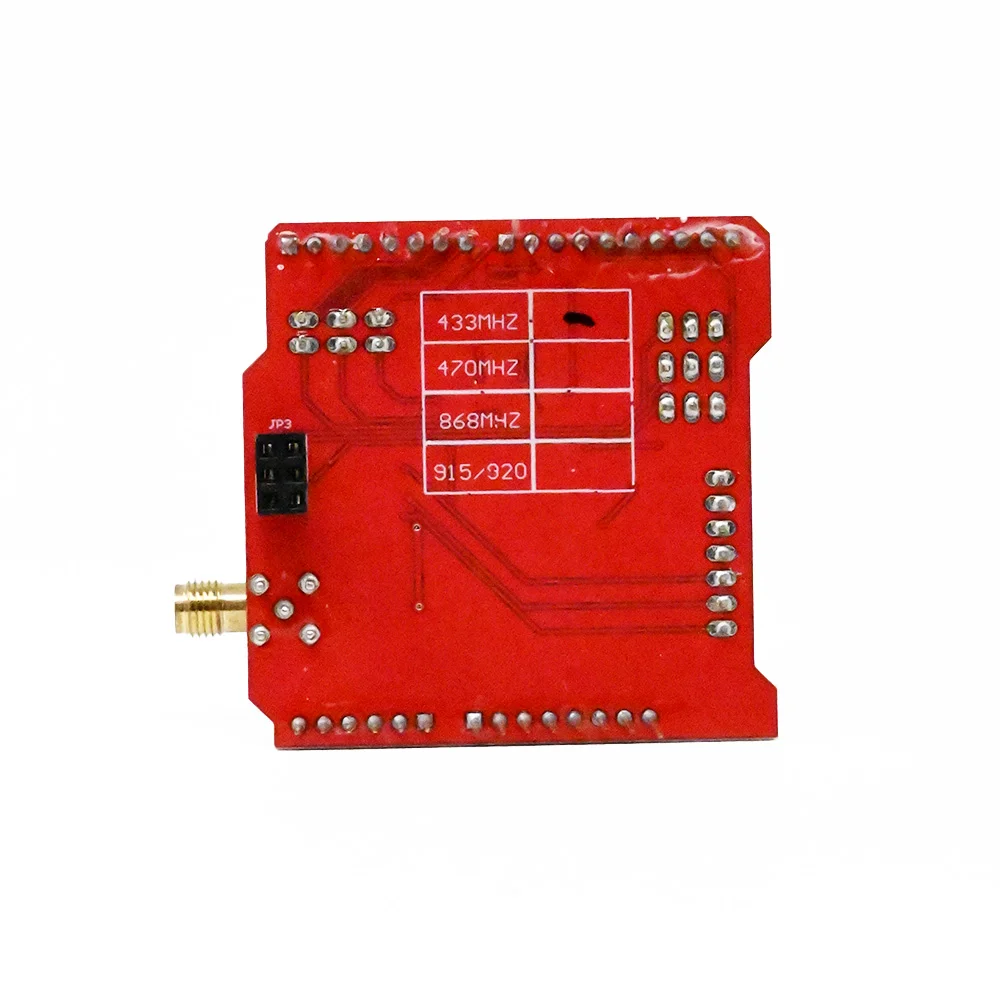
No, this specific shield variant is factory-configured for the 433 MHz ISM band. The RFM95W chip itself is capable of operating on other frequencies, but the shield's matching network and antenna filter are tuned for 433MHz. Attempting to operate on 868MHz or 915MHz would result in degraded performance and potential damage. You would need to source a shield version specifically designed and tuned for your desired frequency band.

How do I minimize power consumption for battery-operated sensor nodes?

Leverage the chip's deep sleep modes between transmissions. After sending data, put the LoRa radio into sleep mode using the library's sleep function, which reduces current to microamps. Put your Arduino microcontroller into a low-power sleep mode as well. Design your application to transmit data infrequently. Use the built-in Channel Activity Detection (CAD) feature before transmitting to listen briefly for a clear channel, avoiding collisions and retransmissions that waste power.

Package Includes

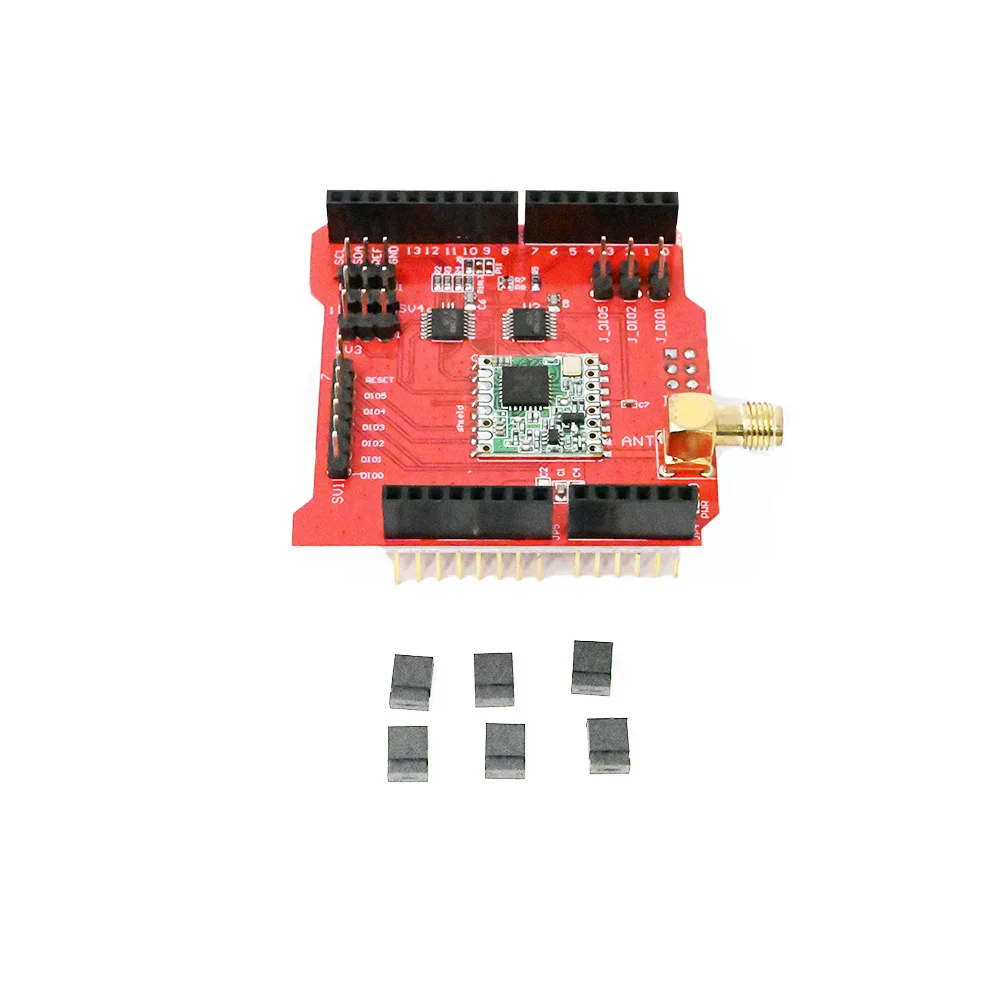
  • 1 x Wireless Transmitter 433MHz (LoRa Shield)

Additional Information

Weight 0.022 kg
Dimensions 9 × 11 × 2 cm