SKU: IOWC-1064
📋 GST Invoice Available

Waveshare RP2350 CAN Development Board w/ XL2515 CAN Controller

₹1,189.00 (Inclusive of all taxes)
Out of Stock

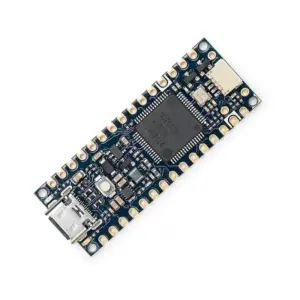
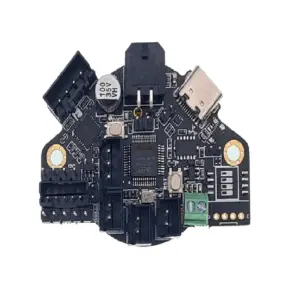
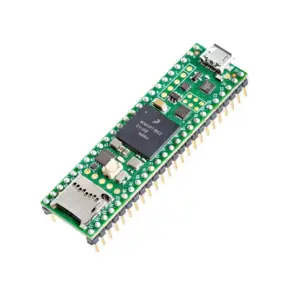
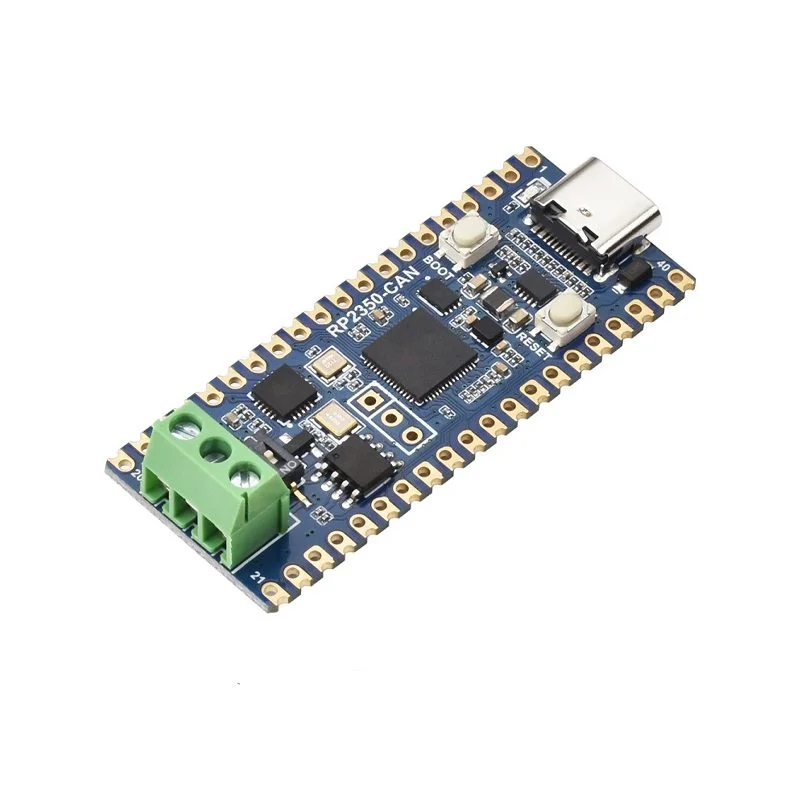
The Waveshare RP2350 CAN Development Board integrates a Raspberry Pi RP2350A microcontroller with an onboard XL2515 CAN controller and transceiver, providing a dedicated hardware platform for prototyping and deploying Controller Area Network (CAN) communication systems compatible with Arduino IDE and MicroPython.

Features

  • RP2350A Dual-Core MCU: Features a dual-core Arm Cortex-M33 and dual-core RISC-V processor running up to 150 MHz for robust processing in automotive and industrial control applications.
  • Integrated CAN Bus Interface: Onboard XL2515 controller supports CAN V2.0B specification with data rates up to 1 Mbps, enabling reliable, fault-tolerant network communication.
  • Rich Peripheral Set: Offers 2x SPI, 2x I2C, 2x UART, 4x 12-bit ADC, 16x PWM channels, and 12x Programmable I/O (PIO) state machines for extensive sensor and actuator integration.
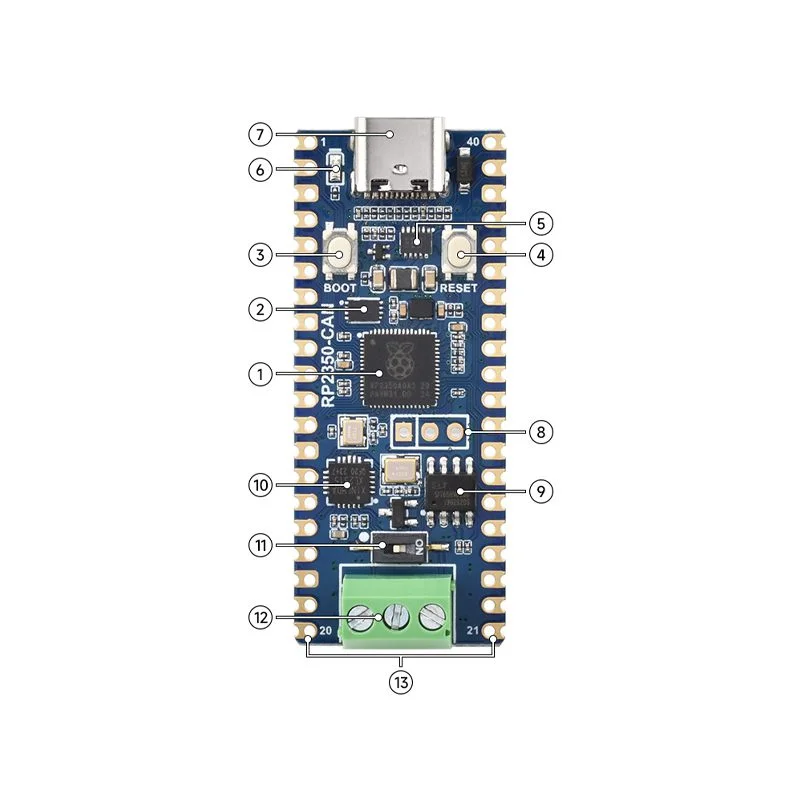
  • Developer-Friendly Design: Includes a USB Type-C connector for power and drag-and-drop programming, castellated edges for direct soldering, and 4MB Flash with 520KB SRAM.

Out of stock

Description

The Waveshare RP2350 CAN Development Board is a compact, feature-rich platform built around the Raspberry Pi RP2350A microcontroller, specifically engineered for CAN bus applications. Its integrated XL2515 CAN controller provides a complete physical layer interface, supporting high-speed communication up to 1 Mbps with excellent noise immunity, making it ideal for harsh electrical environments common in automotive and industrial automation.

Architecturally, the RP2350A combines a dual-core Arm Cortex-M33 with a dual-core RISC-V processor, delivering flexible processing power up to 150 MHz. This is complemented by substantial memory (520KB SRAM, 4MB Flash) and advanced power management features, including low-power sleep modes, enabling efficient operation in battery-powered telemetry nodes. The board’s castellated module design allows for direct integration into custom carrier boards, while the USB Type-C interface simplifies firmware updates via mass storage mode.

Key Features

  • Dual-core Arm Cortex-M33 and dual-core RISC-V processor architecture for parallel task execution.
  • Fully integrated CAN V2.0B controller (XL2515) with onboard transceiver for robust network communication.
  • 12 Programmable I/O (PIO) state machines enable custom peripheral interfaces without taxing the CPU.
  • USB Type-C connector supports both device and host modes for flexible connectivity.
  • Drag-and-drop programming via USB mass storage simplifies firmware deployment.
  • Low-power sleep and dormant modes optimize energy consumption for remote sensing applications.
  • Castellated module edges facilitate direct soldering onto custom PCBs for compact product designs.
  • On-chip temperature sensor and accelerated floating-point libraries aid in real-time data processing.

Applications

  • Automotive ECU prototyping, diagnostics, and in-vehicle network simulation.
  • Industrial automation and machine control using CANopen or J1939 protocols.
  • Building and home automation systems for HVAC and elevator control networks.
  • Remote telemetry and sensor data aggregation in agricultural and environmental monitoring.
  • Robotics and drone control systems requiring robust, multi-node communication.

Technical Specifications

Microcontroller/SoCRaspberry Pi RP2350A (Dual-core Arm Cortex-M33 + Dual-core RISC-V)
Clock FrequencyUp to 150 MHz
Wireless ProtocolsN/A (Wired CAN Bus)
CAN ControllerXL2515 (Supports CAN V2.0B)
CAN Data RateUp to 1 Mbps
Supply Voltage5.0V via USB Type-C
Operating Current~60–100 mA (Typical)
Interfaces2x SPI, 2x I2C, 2x UART, 4x 12-bit ADC, 16x PWM, USB 1.1 Host/Device
Memory520KB SRAM, 4MB Flash
Programmable I/O12x PIO State Machines
Operating Temperature-20°C to +85°C
Dimensions51mm (L) x 21mm (W)
Weight25g

Frequently Asked Questions

How do I program the Waveshare RP2350 CAN Development Board?

The board supports drag-and-drop programming via its USB Type-C port. Connect it to a computer, and it will appear as a mass storage device. Simply copy your UF2 firmware file (compiled in Arduino IDE, MicroPython, or C/C++ using the Raspberry Pi Pico SDK) to the drive. The board will automatically reset and run the new program. For low-level development, you can also use the SWD debug interface available on the castellated pins.

What is the maximum data rate supported by the onboard CAN controller?

The integrated XL2515 CAN controller fully supports the CAN V2.0B specification and can achieve communication rates up to 1 Megabit per second (1 Mbps). The actual stable baud rate depends on your network topology, cable length, and termination. You configure the bit timing parameters in your firmware via the controller's SPI interface, typically using libraries like Arduino-CAN or the Pico SDK's CAN example code.

Can I use this board for automotive OBD-II diagnostics or J1939 applications?

Yes, the RP2350 CAN board is well-suited for automotive protocols like OBD-II (ISO 15765-4) and SAE J1939. Its XL2515 controller handles the physical layer, and the dual-core RP2350A provides ample processing power to manage protocol stacks and data logging. You will need to implement or port the specific protocol library (e.g., an OBD-II decoder) to the board's firmware environment, utilizing the available SPI, UART, and GPIO for connecting displays or wireless modules.

How do I connect external sensors and actuators to this development board?

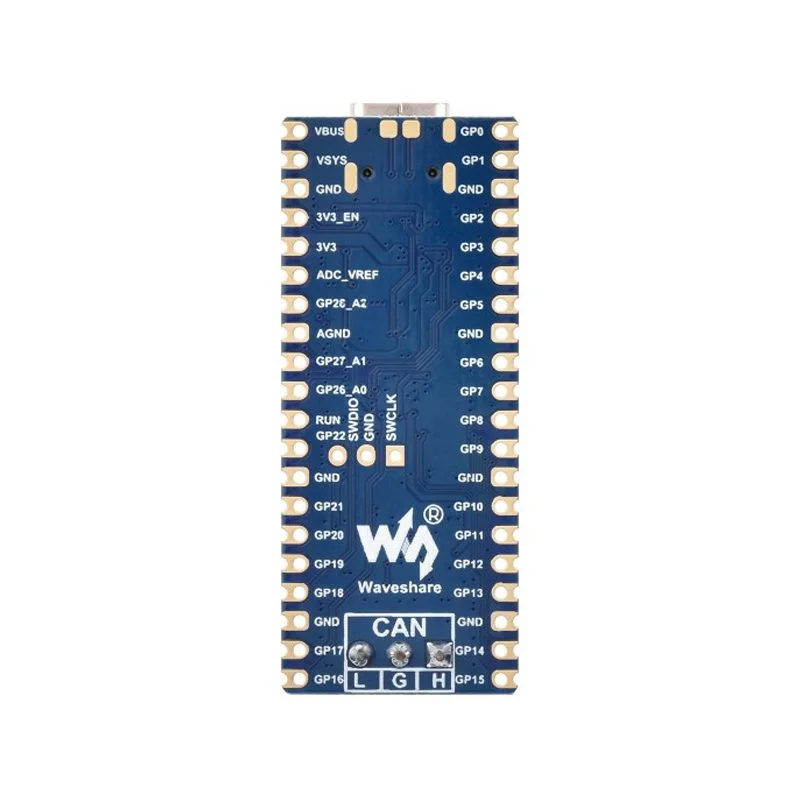
Utilize the board's extensive peripheral set: connect analog sensors via the four 12-bit ADC channels, drive motors or LEDs with the 16 PWM channels, and interface digital sensors using I2C or SPI. For custom communication protocols, the 12 Programmable I/O (PIO) state machines can implement interfaces like DShot, WS2812 LED control, or extra serial ports without CPU overhead. Pinout diagrams are provided in the Waveshare wiki for correct wiring.

Package Includes

  • Waveshare RP2350 CAN Development Board

Additional Information

Weight 0.025 kg
Dimensions 5.1 × 2.1 cm