
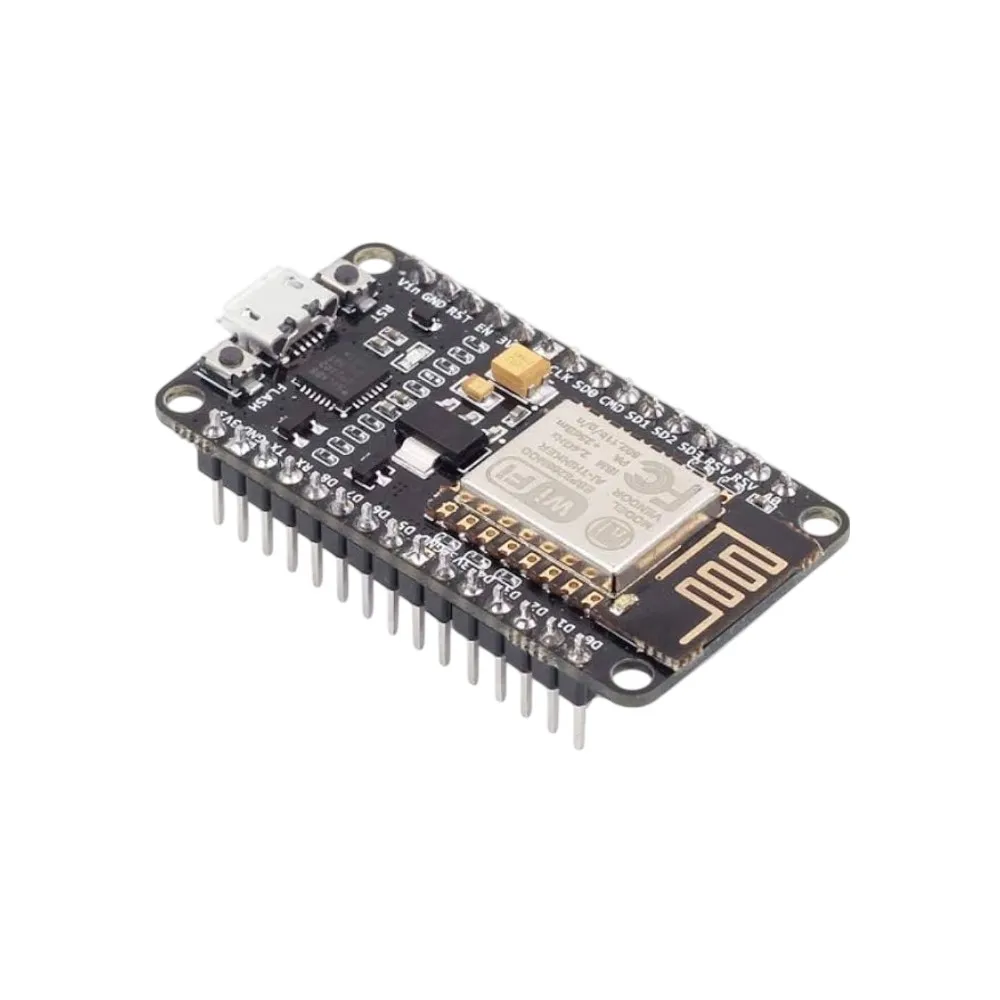
Generic NodeMCU ESP8266 Development Module | Integrated Wi-Fi | USB-UART CP2102
₹149.00₹250.00 (price_including_tax) (-40%)
Accelerate your IoT projects with this versatile ESP8266 NodeMCU development board. Seamlessly integrate Wi-Fi connectivity into smart devices and automation systems. Engineered for dependable performance and extensive community support.
Robust ESP8266 development platform featuring integrated Wi-Fi, streamlined programming via CP2102, for IoT innovation.
Instantly connect your projects to the internet, enabling smart home automation and remote control.
Direct USB programming streamlines code deployment and debugging, saving valuable engineering time.
Empower diverse applications from sensor networks to automation, leveraging a robust microcontroller ecosystem.
The Engineering Behind NodeMCU ESP8266 CP2102
The NodeMCU ESP8266 development module integrates the powerful ESP8266EX Wi-Fi SoC with an on-board CP2102 USB-to-UART bridge, enabling rapid prototyping and deployment of Internet of Things solutions. This architecture provides a self-contained environment for developing network-enabled microcontrollers, leveraging Lua scripting or Arduino IDE compatibility for versatile application development.
Constructed with a robust PCB and clearly labeled pinouts, this module ensures reliable connectivity and ease of integration into breadboards or custom circuit designs. Its compact form factor and low power consumption make it ideal for embedded systems and battery-powered applications, delivering consistent performance for demanding projects.
Integrated ESP8266EX Wi-Fi SoC
At its core, the ESP8266EX SoC delivers a comprehensive Wi-Fi solution, supporting 802.11 b/g/n standards and operating in station, softAP, and station+softAP modes. This integrated radio enables direct cloud communication, local network control, and data logging without the need for additional Wi-Fi modules, significantly reducing BOM and development complexity.
CP2102 USB-to-UART Bridge
The inclusion of the CP2102 USB-to-UART bridge eliminates the need for external serial converters, simplifying the programming and debugging workflow. This direct USB connection facilitates effortless firmware flashing and serial communication, resolving common setup complexities and accelerating the development cycle for engineers and hobbyists alike.
Optimized for Performance & Integration
- Microcontroller: ESP8266EX
- USB-to-UART: Silicon Labs CP2102
- Wireless Protocol: 802.11 b/g/n Wi-Fi
- Operating Voltage: 3.3V (Logic), 5V (USB Power)
- Digital I/O Pins: 11 (all interrupt/PWM/I2C/OneWire capable, except D0)
- Analog Input Pins: 1 (A0, 0-3.3V)
- Flash Memory: 4MB
- Clock Speed: 80MHz/160MHz
Features & Benefits
- Integrated ESP8266EX Wi-Fi: Provides robust 802.11 b/g/n connectivity for seamless IoT device integration and cloud interaction.
- On-board CP2102 USB-UART: Enables direct USB programming and serial debugging, eliminating the need for external converters and simplifying setup.
- Open-Source Firmware & Hardware: Supports diverse development environments including Arduino IDE and Lua scripting, fostering community-driven innovation.
- Compact Footprint & Low Power: Ideal for embedded applications and battery-powered projects, ensuring efficient resource utilization.
- Multiple GPIOs & ADC: Offers versatile digital and analog interfacing capabilities for a wide array of sensors and actuators.
- Breadboard Friendly Design: Facilitates quick prototyping with standard breadboards, accelerating design iteration and testing phases.
Pro-Grade Advantages
- Native Wi-Fi connectivity reduces system complexity and cost for IoT.
- On-board CP2102 USB-UART provides reliable, direct programming interface.
- Extensive community support and open-source resources accelerate development.
- Compact form factor allows integration into space-constrained projects easily.
Technical Considerations
- Limited analog input channels (1 ADC) may restrict certain sensor applications.
- 3.3V logic level requires level shifters when interfacing with 5V components.
What is the primary function of the NodeMCU ESP8266 module?
The NodeMCU ESP8266 module serves as a low-cost, open-source development board for creating Wi-Fi enabled Internet of Things (IoT) applications, integrating a microcontroller with network capabilities.
What is the role of the CP2102 chip on this module?
The CP2102 chip functions as a USB-to-UART bridge, enabling seamless communication between your computer and the ESP8266 for programming, debugging, and serial data exchange via a standard USB cable.
Can this board be programmed using the Arduino IDE?
Yes, the NodeMCU ESP8266 is fully compatible with the Arduino IDE through the ESP8266 core for Arduino, allowing developers to write sketches using the familiar Arduino language and libraries.
What are the typical operating voltage requirements for this module?
The module itself operates on 3.3V logic, but it can be powered via its micro-USB port at 5V, which is then regulated down to 3.3V for the ESP8266 SoC.
How much flash memory does the ESP8266 on this board typically have?
Most NodeMCU ESP8266 boards, including this variant, are equipped with 4MB (32Mbit) of flash memory, providing ample space for firmware, web servers, and data storage.
What types of wireless connectivity does this module support?
The ESP8266EX SoC supports the 802.11 b/g/n Wi-Fi standard, allowing it to connect to 2.4 GHz networks in client (station), access point (softAP), or combined modes.
Is this board suitable for battery-powered projects?
Yes, due to its relatively low power consumption, the NodeMCU ESP8266 is well-suited for battery-powered applications, especially when optimized for deep sleep modes to conserve energy.
| Specification | Value |
|---|---|
| Microcontroller Unit | ESP8266EX |
| USB-Serial Chip | CP2102 |
| Wireless Standard | 802.11 b/g/n Wi-Fi @ 2.4GHz |
| Operating Logic Voltage | 3.3V |
| Input Voltage (USB) | 5V |
| Digital I/O Pins (GPIO) | 11 |
| Analog Input Pins (ADC) | 1 (0-3.3V) |
| Flash Memory Size | 4MB (32Mbit) |
| Clock Speed | 80MHz / 160MHz |
| Interface | Micro USB |
| Dimensions (L x W x H) | 49 x 25.5 x 13 mm |
| Firmware Support | NodeMCU (Lua), Arduino IDE |
Additional information
| Weight | 0.01 kg |
|---|---|
| Dimensions | 4.9 × 2.55 × 1.3 cm |
| Processor/SoC | ESP8266EX |
| RAM/Flash Memory | 4MB Flash |
| Operating Voltage | 3.3V (Logic), 5V (USB) |
| Connectivity | Wi-Fi (802.11 b/g/n) |
| Main Controller | ESP8266 |


Reviews
There are no reviews yet.