
SKU: SENS-0180
📋 GST Invoice Available

Upside Down Labs Muscle BioAmp Blip (Assembled) - mikroBUS™ EMG Sensor Module w/ Cable & Electrodes

₹1,539.00 (Inclusive of all taxes)
Out of Stock

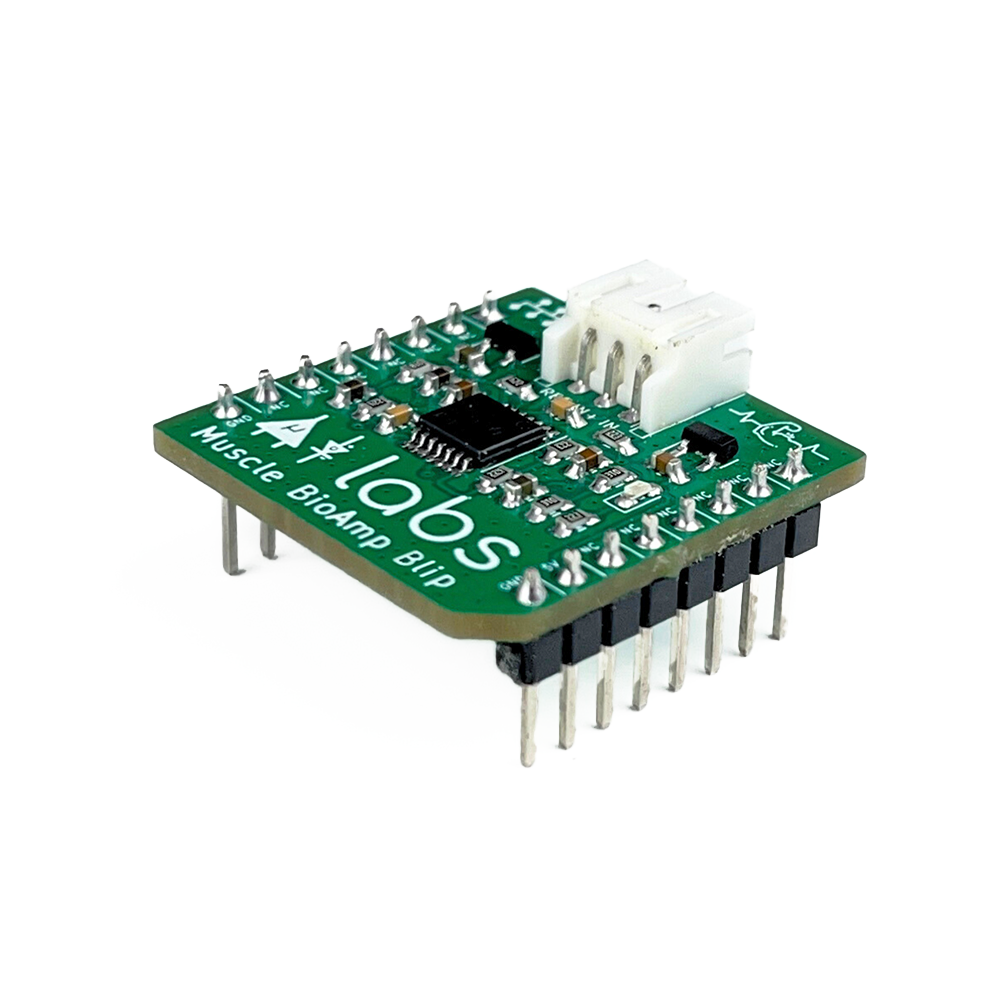
The Muscle BioAmp Blip is a single-channel, mikroBUS™-compatible electromyography (EMG) sensor module designed for precise muscle signal acquisition. It operates at 5V and is compatible with a wide range of development platforms including Arduino, Raspberry Pi Pico, STM32, and BeagleBoard Black via its standard ADC interface.

Features

  • Single-channel EMG sensor with ultra-high 10^12 Ω input impedance for accurate biopotential measurement.
  • Fixed signal gain of x2420 and a 72–720 Hz bandpass filter optimized for clean EMG signal conditioning.
  • mikroBUS™ socket standard compatibility for easy integration with hundreds of Click boards™ and development systems.
  • Complete kit includes sensor module, 1-meter BioAmp cable, six gel electrodes, and a comfortable EMG band for secure placement.
  • Open-source hardware and software, enabling full customization and integration into biomedical research, prosthetics, and human-computer interface projects.

Out of stock

Description

The Muscle BioAmp Blip is engineered for high-fidelity electromyography (EMG) signal recording. It utilizes a specialized instrumentation amplifier with an extremely high input impedance to minimize signal loading from the skin-electrode interface, ensuring the raw muscle activity signals are captured with minimal distortion. The integrated fixed-gain stage and bandpass filter condition the signal within the typical frequency range of surface EMG, providing a clean, amplified output ready for analog-to-digital conversion.

Designed around the mikroBUS™ standard, this module offers plug-and-play compatibility with a vast ecosystem of microcontroller and single-board computer carriers. Its compact form factor allows for integration into wearable devices, research setups, or educational kits. The included accessories, such as the long cable and pre-gelled electrodes, facilitate quick setup for reliable, repeatable muscle activity monitoring.

Key Features

  • Ultra-high input impedance (10^12 Ω) ensures minimal signal attenuation from electrode connections.
  • Optimized 72–720 Hz bandpass filter effectively isolates the EMG signal from low-frequency drift and high-frequency noise.
  • Fixed x2420 gain provides a robust output signal level suitable for most microcontroller ADCs without additional amplification.
  • Standard mikroBUS™ pinout offers seamless compatibility with a wide range of development boards and carrier platforms.
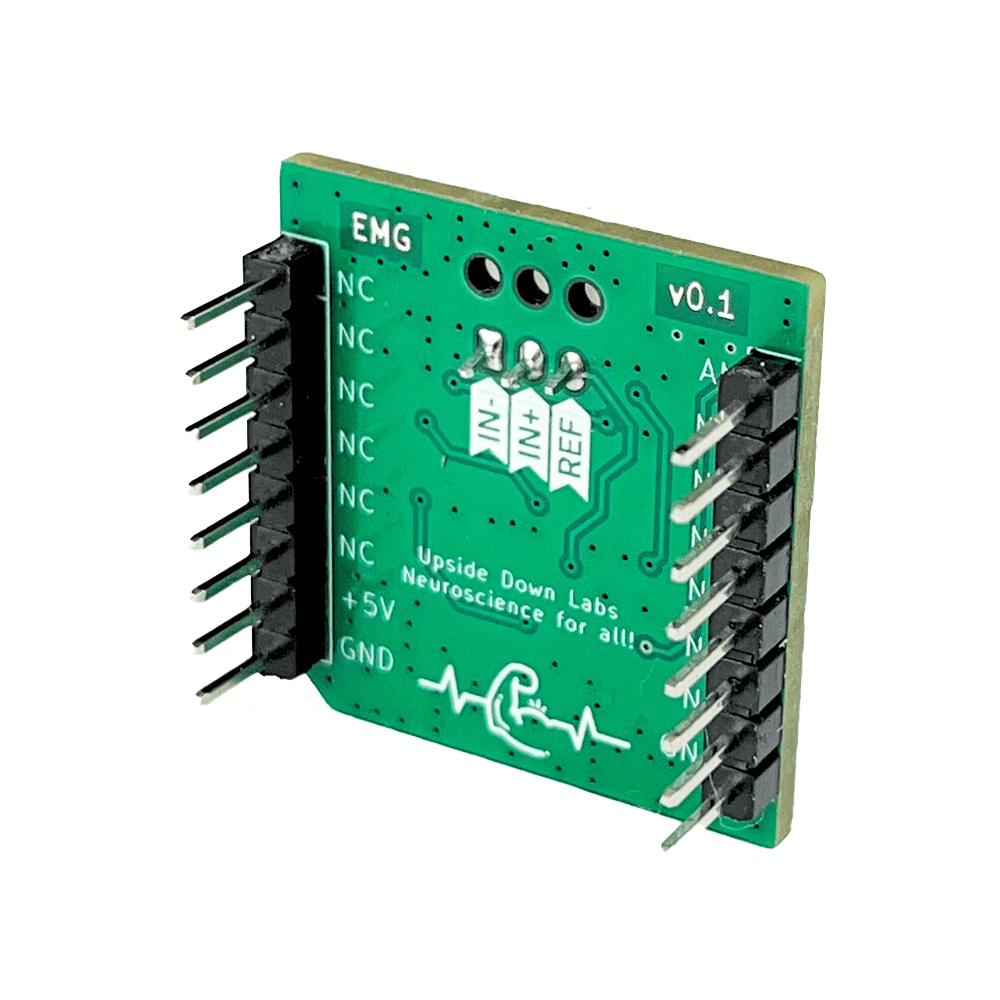
  • Supports three-electrode configuration (positive, negative, reference) for differential measurement, enhancing common-mode noise rejection.
  • Fully open-source design provides transparency and flexibility for custom firmware and hardware modifications.
  • Durable construction with a compact footprint (2.54 x 2.86 cm) suitable for embedded and wearable applications.

Applications

  • Biomedical research and education for studying muscle activation patterns and neuromuscular disorders.
  • Prosthetic limb control systems, translating muscle signals into intuitive movement commands.
  • Human-computer interaction (HCI) and gesture recognition for gaming, VR, and assistive technology.
  • Sports science and athletic training for monitoring muscle fatigue and optimizing performance.
  • Rehabilitation therapy device integration for tracking patient progress and muscle recovery.

Technical Specifications

Model / NameMuscle BioAmp Blip (Assembled)
Operating Voltage5V DC
Input Impedance10^12 Ω
Fixed Gainx2420
Bandpass Filter72 - 720 Hz
Biopotential TypeEMG (Electromyography)
Number of Channels1
Electrode Connections3 (Positive, Negative, Reference)
Interface/CompatibilitymikroBUS™, ADC-based development boards (Arduino, Raspberry Pi Pico, STM32, etc.)
Module Dimensions2.54 cm x 2.86 cm
Open SourceHardware + Software

Frequently Asked Questions

What is the operating voltage of the Muscle BioAmp Blip, and can it be used with 3.3V logic systems?

The Muscle BioAmp Blip requires a 5V power supply for its analog front-end circuitry. The output signal is an analog voltage referenced to this 5V rail. It can be safely read by a 3.3V logic ADC input on microcontrollers like the Raspberry Pi Pico or ESP32, as the output voltage swing typically remains within the 0-3.3V range after proper signal conditioning. Always ensure your ADC's input voltage range is not exceeded.

How do I connect the three electrodes (positive, negative, reference) to the sensor?

The sensor uses a differential input configuration. Connect the active muscle site to the positive input, a nearby electrically quiet location (or a second muscle site for differential measurement) to the negative input, and a neutral reference point (often a bony prominence like the elbow) to the reference pin. This setup maximizes the desired EMG signal while rejecting common-mode noise. The included BioAmp cable and snap connectors simplify these connections to standard gel electrodes.

Is this sensor compatible with Arduino Uno or Raspberry Pi Pico directly?

Yes, but the connection method differs. For an Arduino Uno, you would typically bypass the mikroBUS socket and connect the module's output pin directly to an analog input (A0-A5), and provide 5V and GND. For a Raspberry Pi Pico (3.3V logic), you can use a mikroBUS carrier board or wire it directly, ensuring the Pico's ADC pin can handle the 0-5V analog signal (often requiring a voltage divider). The sensor itself does not communicate via I2C or SPI; it provides a raw analog voltage output.

What is the purpose of the 72-720 Hz bandpass filter?

The integrated bandpass filter is crucial for EMG signal integrity. The 72 Hz high-pass cutoff removes low-frequency artifacts like baseline wander, electrode drift, and movement artifacts. The 720 Hz low-pass cutoff attenuates high-frequency noise from power lines (50/60 Hz harmonics), RF interference, and muscle tremor frequencies beyond the primary EMG spectrum. This filtered bandwidth is optimal for capturing the core energy of surface EMG signals, resulting in a cleaner, more interpretable output.

Does the kit include everything needed to start recording EMG signals?

The kit includes the core hardware: the assembled Muscle BioAmp Blip module, a 1-meter connection cable, six disposable gel electrodes, and an adjustable fabric band for electrode placement. You will need to supply a development board (e.g., Arduino, Raspberry Pi) with an ADC input for signal digitization, a USB cable for power/data, and a computer with serial monitor or data logging software. The open-source libraries and example code provided by Upside Down Labs facilitate quick software setup.

Package Includes

  • 1 x Muscle BioAmp Blip Sensor Module (Assembled)
  • 1 x BioAmp Cable v3 (100cm length)
  • 6 x Boxy Gel Electrodes
  • 1 x Muscle BioAmp Band

Additional Information

Weight 0.08 kg
Dimensions 12 × 14 × 5 cm