SKU: IOWC-1769
📋 GST Invoice Available

Seeed Studio Studio Grove LoRa Radio 433MHz Module

₹1,989.00 (Inclusive of all taxes)
Out of Stock

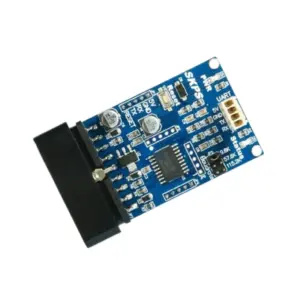
The Seeed Studio Studio Grove LoRa Radio 433MHz is a long-range wireless transceiver module based on the SX1276 LoRa modem, designed for easy integration via the Grove connector system. It operates on 3.3-5V and is ideal for Arduino and Raspberry Pi projects requiring ultra-long-range, low-power communication.

Features

  • Features the RFM95/SX1276 LoRa modem for ultra-long-range spread spectrum communication up to several kilometers.
  • Operates on the 433MHz ISM band with +20dBm (100mW) high power output capability for extended signal reach.
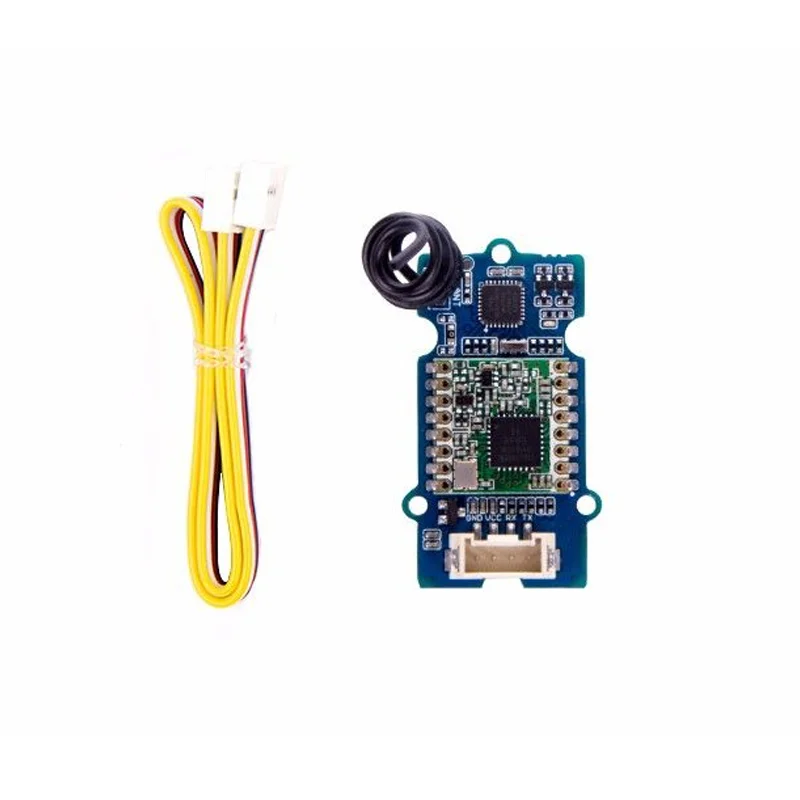
  • Includes an integrated wire antenna and an MHF connector for attaching an external high-gain antenna to boost signal strength.
  • Low power consumption with ~28mA avg. during transmit, ~20mA during receive, and ~8.4mA in standby mode.
  • Plug-and-play Grove interface (UART) simplifies wiring and accelerates prototyping with Seeed Studio Studio and Arduino-compatible platforms.

Out of stock

Description

The Grove LoRa Radio 433MHz from Seeed Studio Studio integrates the powerful RFM95 transceiver, built around the Semtech SX1276 LoRa modem, into the user-friendly Grove ecosystem. This module provides developers with a reliable, long-range wireless link characterized by high interference immunity and minimal current draw, making it perfect for battery-operated IoT sensor nodes. The onboard ATmega168 microcontroller manages the LoRa communication stack, offering a balanced blend of processing capability and energy efficiency.

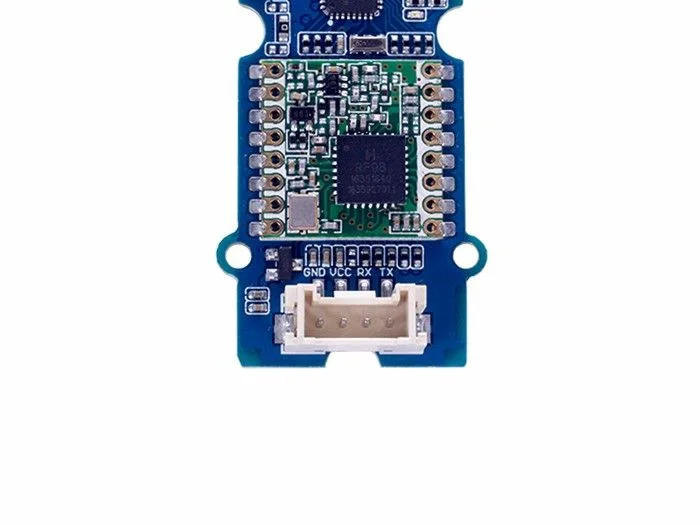
Designed for robust performance, the module includes a simple wire antenna soldered onto the board. For deployments requiring enhanced signal penetration or range, an adjacent MHF (IPEX) connector allows for the attachment of external antennas. The module communicates via a serial UART interface over its standard 4-pin Grove cable, ensuring quick integration with a vast array of Seeed Studio Studio base shields and development boards without complex soldering or pin mapping.

Key Features

  • Ultra-long-range communication enabled by Semtech SX1276 LoRa spread spectrum technology.
  • High +20dBm transmit power output for maximum signal coverage and penetration.
  • Dual antenna options: integrated wire antenna and MHF connector for external high-gain antenna.
  • Optimized for low-power operation with detailed current consumption profiles for transmit, receive, and standby modes.
  • Grove standardized connector (UART) ensures quick plug-and-play compatibility with hundreds of Seeed Studio Studio Grove sensors and boards.
  • Robust interference immunity due to the LoRa modulation scheme, suitable for noisy RF environments.
  • Powered by an ATmega168 co-processor for handling communication protocols and easing host MCU load.

Applications

  • Long-range environmental sensor networks for agriculture (soil moisture, weather stations).
  • Remote asset tracking and telemetry for industrial IoT (IIoT) applications.
  • Smart city deployments like smart parking, waste management, and streetlight monitoring.
  • Wireless sensor nodes for home automation and security systems beyond Wi-Fi range.

Technical Specifications

Wireless ProtocolLoRa (Semtech SX1276)
Frequency Range433 MHz
RF Transmit PowerUp to +20 dBm (100 mW)
Supply Voltage3.3V to 5V DC
Operating Current (Avg.)~28 mA (Transmit), ~20 mA (Receive), ~8.4 mA (Standby)
InterfaceUART via Grove 4-pin connector
Antenna ConnectorIntegrated wire & MHF (IPEX) connector
Operating Temperature-20°C to +70°C
Dimensions (LxW)40 mm x 20 mm

Frequently Asked Questions

How do I connect and communicate with this Grove LoRa module using an Arduino?

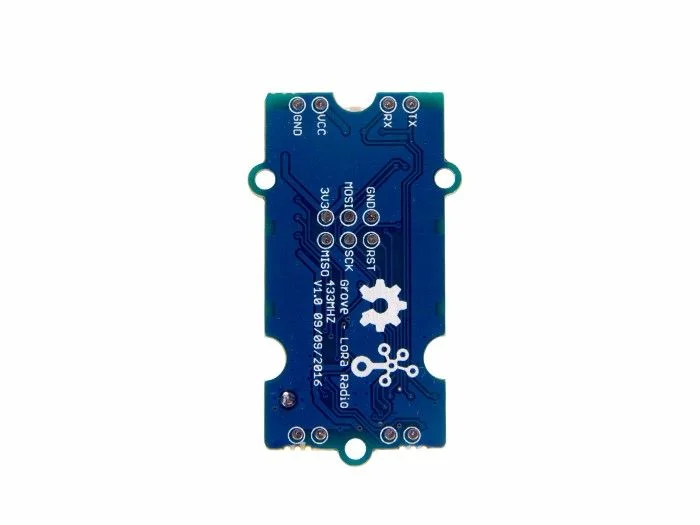
Connect the module to your Arduino via a Grove base shield using the supplied 4-pin cable. Utilize a LoRa library such as Sandeep Mistry's Arduino-LoRa. In your sketch, initialize the serial UART interface, set the frequency to 433E6, and define the CS, RST, and DIO0 pins according to the module's pinout. You can then use standard library functions like LoRa.beginPacket(), LoRa.write(), and LoRa.endPacket() to transmit data. Ensure your power supply provides a stable 3.3V or 5V as required.

Can I use an external antenna with this module, and what type should I use?

Yes, the module includes an MHF (also known as IPEX) connector next to the onboard wire antenna. You can attach a compatible 433MHz antenna with an MHF male plug. For optimal performance, select an antenna with appropriate gain (e.g., 3dBi or 5dBi) and an impedance of 50 ohms. Ensure the antenna is positioned vertically and away from large metal objects or enclosures to prevent signal shielding. The external antenna will typically provide better range and signal stability than the integrated wire.

What is the power consumption profile, and how can I implement sleep modes?

The module draws approximately 28mA average during continuous transmission at +20dBm, about 20mA in active receive mode, and around 8.4mA in standby. To minimize power for battery-operated nodes, you can leverage the LoRa modem's built-in sleep modes via library commands. After sending or receiving data, put the radio into sleep mode using LoRa.sleep(). You can also completely power down the module through a GPIO-controlled MOSFET if your host board supports it. Always measure current in your specific application, as duty cycle dramatically impacts average consumption.

Package Includes

  • 1 x Grove LoRa Radio 433MHz Module
  • 1 x Grove 4-pin Cable

Additional Information

Weight 0.011 kg
Dimensions 4 × 2 cm