SKU: IOWC-1633
📋 GST Invoice Available

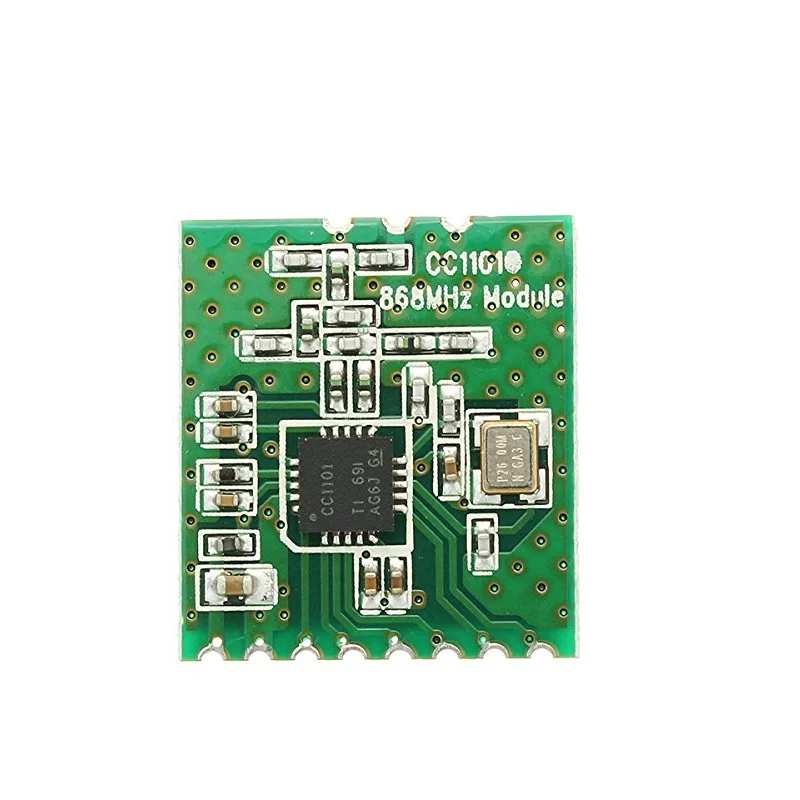
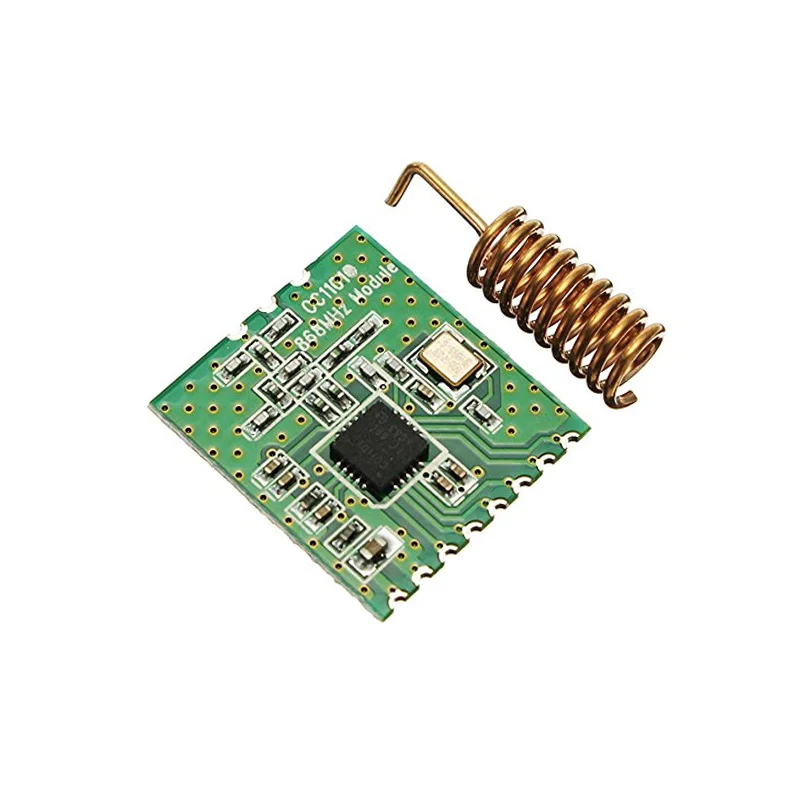
CC1101 868MHz Wireless Transceiver Module

₹229.00 (Inclusive of all taxes)
Out of Stock

The CC1101 868MHz Wireless Transceiver Module is a low-power, SPI-controlled RF module designed for ISM/SRD band applications. It operates from 1.9-3.6V and supports configurable data rates up to 500kbps, making it ideal for custom wireless sensor networks and remote control systems.

Features

  • Low-power 868MHz ISM band transceiver for battery-operated IoT nodes.
  • Supports multiple modulations including FSK, GFSK, ASK/OOK, and MSK for protocol flexibility.
  • Configurable data rate from 1.2kbps to 500kbps to optimize range vs. throughput.
  • SPI interface with 64-byte TX/RX FIFOs simplifies integration with microcontrollers like Arduino or ESP32.
  • Low voltage operation (1.9V to 3.6V) enables direct compatibility with 3.3V logic and coin-cell power sources.

Out of stock

Description

The CC1101 module is a highly integrated sub-1GHz RF transceiver built around Texas Instruments’ CC1101 core. It is engineered for very low-power wireless applications in the 868MHz ISM and SRD bands, with programmable operation across the 779-928MHz range. The module incorporates a configurable baseband modem supporting various modulation schemes, enabling developers to tailor the link for specific range, data rate, and power consumption requirements.

Hardware support for packet handling, data buffering, clear channel assessment (CCA), and wake-on-radio functionality minimizes the processing load on the host microcontroller, extending battery life in remote sensing deployments. Communication with the module is managed via a standard SPI interface, allowing for straightforward integration into embedded systems using platforms like Arduino IDE, PlatformIO, or bare-metal firmware.

Key Features

  • Low-cost, low-power transceiver for 868MHz ISM/SRD band wireless networks.
  • Flexible modulation support (FSK, GFSK, ASK/OOK, MSK) for compatibility with various protocols.
  • Programmable data rate from 1.2 kbps to 500 kbps, adjustable for range vs. speed trade-offs.
  • Integrated 64-byte transmit and receive FIFOs for efficient data buffering and burst communication.
  • Hardware support for packet handling, clear channel assessment (CCA), and link quality indication (LQI).
  • Wake-on-radio feature enables ultra-low power listening for battery-powered sensor nodes.
  • SPI interface allows easy control and configuration from any microcontroller with SPI master capability.
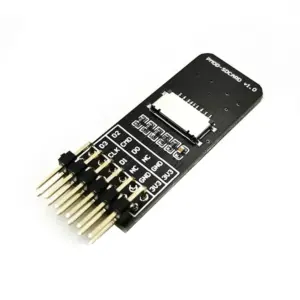
  • Compact form factor with 1.27mm pitch vertical pin headers for breadboard and PCB integration.

Applications

  • Wireless sensor networks for home automation, industrial monitoring, and smart agriculture.
  • Remote control systems for garage doors, lighting, and industrial equipment.
  • Low-power telemetry for battery-operated environmental sensors (temperature, humidity, pressure).
  • Asset tracking and inventory management within confined RF environments.
  • Custom wireless data links for hobbyist projects, robotics, and DIY IoT devices.

Technical Specifications

RF Transceiver ICCC1101
Operating Frequency868 MHz (Programmable 779-928 MHz)
Supported ModulationsFSK, GFSK, ASK/OOK, MSK
Data Rate Range1.2 kbps to 500 kbps (configurable)
Supply Voltage1.9 V to 3.6 V
Communication InterfaceSPI
Data Buffers64-byte TX FIFO, 64-byte RX FIFO
Antenna ConnectionIntegrated antenna or pad for external antenna
Package Dimensions (approx.)6 cm x 3 cm x 1 cm

Frequently Asked Questions

What microcontroller can I use to control this CC1101 module?

You can use any microcontroller with an SPI master interface, such as an Arduino (Uno, Nano, Mega), ESP32, ESP8266, STM32, or Raspberry Pi Pico. The module operates on 3.3V logic, so ensure your MCU's SPI pins are level-compatible. Libraries like 'RadioHead' or 'ELECHOUSE_CC1101' for Arduino IDE simplify initialization, packet sending, and receiving. Connect the module's SPI pins (SI, SO, SCK, CSn) to your MCU's corresponding SPI pins, provide 3.3V power, and connect an antenna.

How do I set the operating frequency and data rate for this module?

The frequency and data rate are configured via SPI registers on the CC1101 chip. Using a library like ELECHOUSE_CC1101, you call functions such as 'myDriver.setMHZ(868.0)' and 'myDriver.setDataRate(38.4)' within your Arduino sketch. The base frequency is set by programming the FREQ2, FREQ1, and FREQ0 registers, while the data rate is controlled by the MDMCFG4 and MDMCFG3 registers. Always initialize the SPI communication, reset the module, and write the full register configuration after power-up for reliable operation.

What type of antenna should I use with the 868MHz CC1101 module?

For the 868MHz band, use a quarter-wave monopole antenna (approx. 8.2cm wire) or a commercially available 868MHz antenna with an SMA or wire connection. The module typically has a pad or integrated trace antenna. For an external antenna, ensure proper impedance matching (50 ohms) and connect it directly to the designated RF pad. Keep the antenna feed line short to minimize losses. Antenna selection and placement significantly impact range; for maximum distance, use a 3dBi or 5dBi external omnidirectional antenna mounted vertically.

What is the typical current consumption during transmission and reception?

Current consumption varies with output power and data rate settings. At maximum output power (typically around +10 dBm), transmit current can reach 30-40 mA. During active reception (RX), current is typically 15-25 mA. The module supports low-power sleep modes where current drops to below 1 µA. For battery optimization, use the wake-on-radio feature and duty-cycle your transmissions. Always consult the CC1101 datasheet for precise current vs. power level graphs and configure the PA_TABLE registers appropriately for your desired output power and efficiency trade-off.

Package Includes

  • 1 x CC1101 868MHz Wireless Transceiver Module

Additional Information

Weight 0.01 kg
Dimensions 6 × 3 × 1 cm