SKU: IOWC-1505
📋 GST Invoice Available

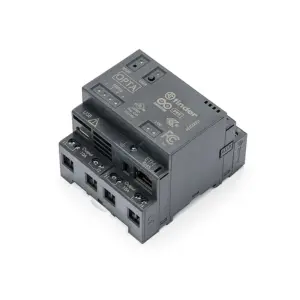
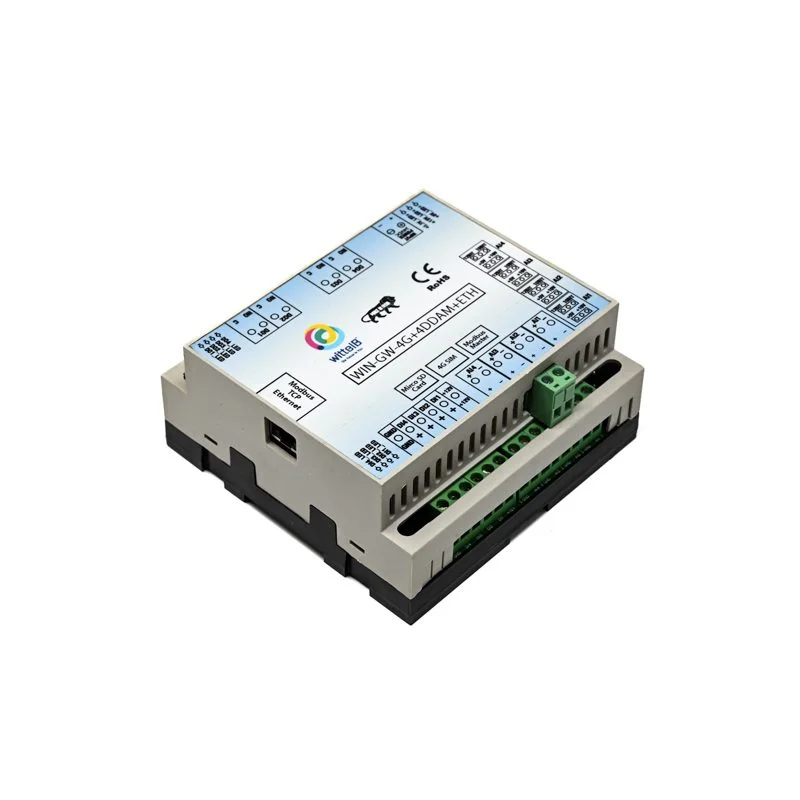
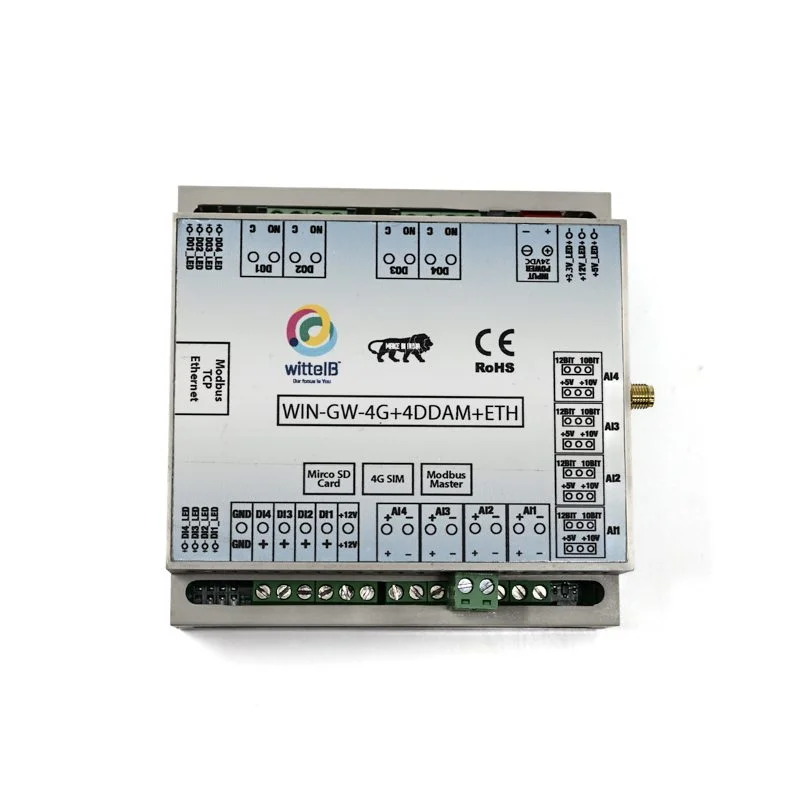
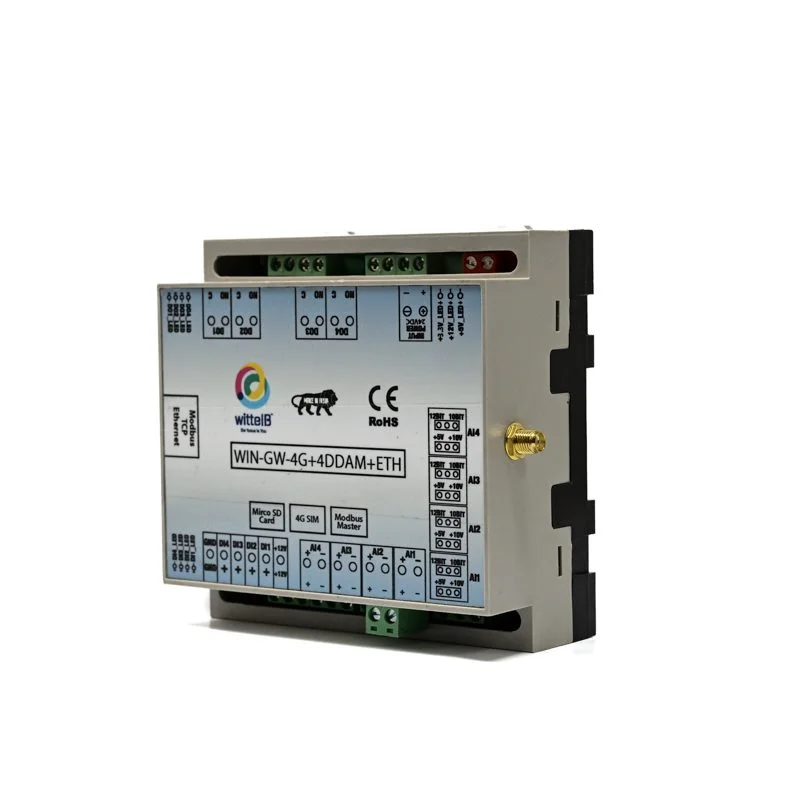
Wittelb WIN-GW-4G+IO (4DDAM)+ETH RS485 to 4G MQTT Ethernet IoT Gateway

₹10,333.00 (Inclusive of all taxes)
Out of Stock

The Wittelb WIN-GW-4G+IO (4DDAM)+ETH is an industrial IoT gateway providing robust 4G LTE and Ethernet connectivity with integrated Modbus RTU-to-TCP conversion. It enables remote monitoring and control of RS485 devices via MQTT cloud platforms and a web-based UI.

Features

  • 4G LTE cellular connectivity for high-speed, remote data transfer in the field.
  • Built-in Modbus RTU to Modbus TCP conversion bridges RS485 serial devices to Ethernet/IP networks.
  • Integrated RS485 port supports communication with Modbus slave devices up to 700 meters.
  • Cloud integration via MQTT protocol for seamless data publishing to IoT platforms.
  • Features GPS for location tracking, a web UI for configuration, and supports 4-20mA/0-10V analog inputs.

Out of stock

Description

The Wittelb WIN-GW-4G+IO (4DDAM)+ETH is a comprehensive industrial IoT gateway designed for reliable machine-to-machine (M2M) communication. It consolidates 4G LTE cellular backhaul, Ethernet connectivity, and a robust RS485 serial port into a single, hardened unit suitable for demanding environments. The gateway acts as a protocol converter, seamlessly translating Modbus RTU frames from connected field devices into Modbus TCP packets for transmission over IP networks or directly to cloud services via the integrated MQTT client.

Engineered for operational resilience, the gateway supports a wide 15-40VDC input range and operates within a 0-60°C temperature range. Its integrated analog input channels (4-20mA, 0-10V) and GPS module extend its functionality beyond simple data routing, enabling direct sensor interfacing and geolocation services. The onboard storage provides essential data buffering and logging capabilities to maintain data integrity during network outages.

Key Features

  • Dual-network gateway with 4G LTE cellular and 10/100Mbps Ethernet ports for redundant connectivity.
  • Advanced protocol conversion engine for real-time Modbus RTU to Modbus TCP translation.
  • Integrated RS485 serial interface with support for long-distance communication up to 700 meters.
  • Built-in MQTT client for secure, publish-subscribe data transfer to AWS IoT, Azure, or private brokers.
  • Onboard GPS receiver provides accurate timestamping and asset location tracking data.
  • Web-based configuration interface allows for easy setup of network parameters, Modbus mapping, and data routing rules.
  • Wide-range 15-40VDC power input compatible with standard industrial power supplies.
  • Analog and digital I/O channels (4-20mA, 0-10V) for direct connection to sensors and actuators.

Applications

  • Industrial telemetry and SCADA systems for remote monitoring of PLCs and sensors.
  • Smart agriculture for connecting soil moisture sensors, weather stations, and irrigation controllers.
  • Fleet and asset tracking by combining GPS data with vehicle sensor information over 4G.
  • Remote utility meter reading (water, gas, electricity) via Modbus RS485 interfaces.
  • Building automation for integrating legacy HVAC and lighting controls into modern IoT platforms.

Technical Specifications

Connectivity4G LTE, 10/100Mbps Ethernet
Serial ProtocolModbus RTU (via RS485), Modbus TCP
Cloud ProtocolMQTT
RS485 RangeUp to 700m (dependent on slave device)
SIM CardMicro SIM
Additional InterfacesGPS, Analog Input (4-20mA, 0-10V)
Supply Voltage15-40 VDC
Operating Temperature0 to 60 °C
Dimensions (LxWxH)110 mm (L) x 110 mm (W) x 60 mm (H)
Management InterfaceWeb-based User Interface (UI)

Frequently Asked Questions

How do I configure the Modbus RTU to TCP conversion on this gateway?

Access the gateway's web UI via its Ethernet or cellular IP address. Navigate to the 'Modbus Mapping' or 'Serial Server' section. Here, define the RS485 port parameters (baud rate, data bits, parity, stop bits) and map each Modbus RTU slave device's register addresses to a corresponding Modbus TCP unit ID and IP port. The gateway will then listen for TCP connections and translate requests to the serial bus. Typical setup involves setting a static TCP port (e.g., 502) and defining the serial baud rate to match your slave devices, commonly 9600 or 19200 bps.

What is the procedure for setting up MQTT publishing with sensor data?

In the web UI, go to the 'Cloud Services' or 'MQTT' configuration page. Enter your broker details (server address, port, username, password). Then, in the 'Data Points' or 'Topics' section, link specific Modbus register addresses or analog input channels to MQTT topics. You can set the publishing interval (e.g., every 30 seconds). The gateway will read the specified data, format it into a JSON or plain text payload, and publish it to the configured topic. Ensure your firewall allows outbound traffic to the MQTT broker's port, usually 1883 for unencrypted or 8883 for TLS.

What power supply requirements and wiring are needed for the 15-40VDC input?

The gateway requires a stable DC power source between 15 and 40 volts, such as a 24VDC industrial power supply. Connect the positive wire to the terminal marked 'V+' or 'Power In+' and the negative wire to 'GND' or 'Power In-'. Use appropriately sized wire for the expected current draw. For remote installations, consider adding surge protection on the power line. The wide input range allows compatibility with solar-charged battery systems (12V/24V) and standard industrial power rails. Always ensure the power source is adequately rated and fused according to local electrical codes for safety.

Package Includes

  • 1 x WIN-GW-4G+IO (4DDAM)+ETH - P-RS485 to 4G MQTT and Ethernet IoT Gateway

Additional Information

Weight 0.238 kg
Dimensions 11 × 11 × 6 cm