
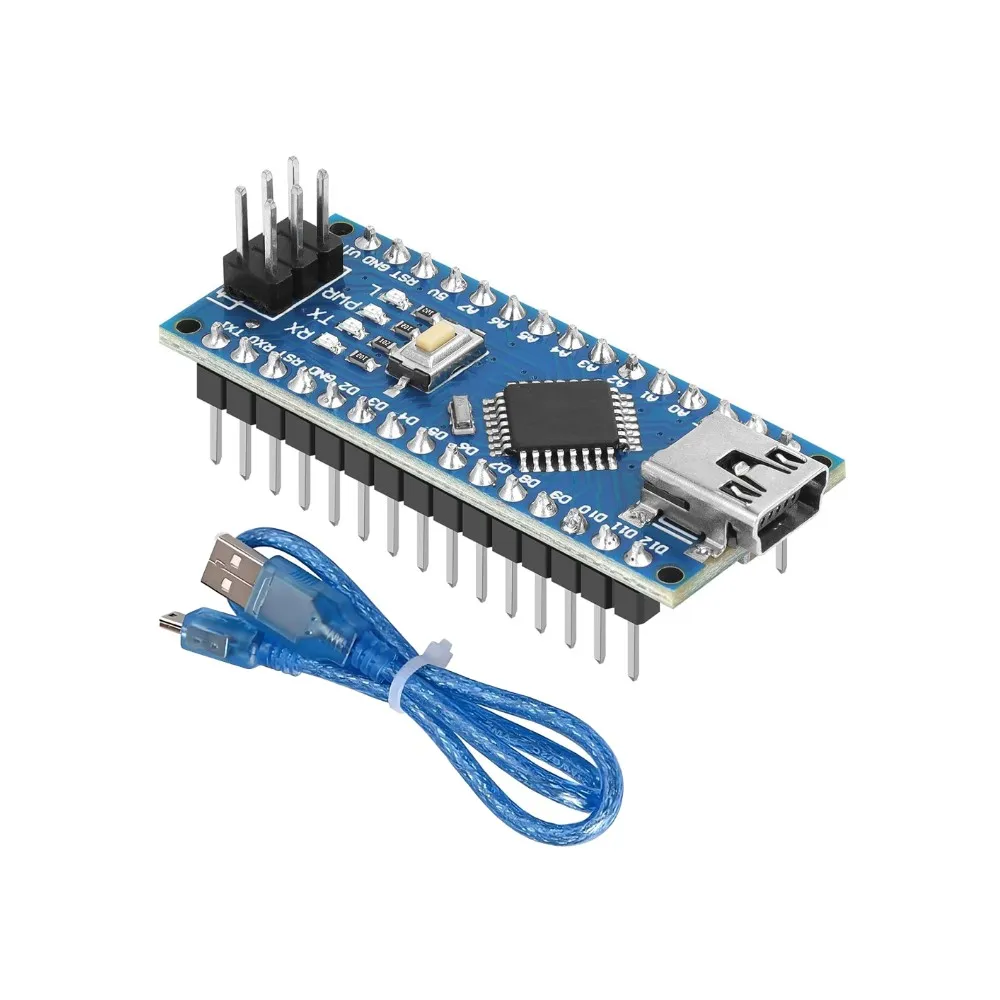
Arduino Nano V3 Development Board | ATmega328P Microcontroller | Compact Prototyping Solution
₹899.00₹1,200.00 (price_including_tax) (-25%)
Empower your compact electronics projects with the powerful Arduino Nano V3. This versatile board enables rapid prototyping and deployment of embedded systems. Engineered for reliability, it provides a stable foundation for countless innovations.
The Arduino Nano V3 delivers robust ATmega328P performance in a miniature footprint, ideal for embedded systems.
Compact size with full Arduino functionality, perfect for embedded systems and tiny robotics.
Ample digital and analog pins support diverse sensors, actuators, and communication protocols.
Reliable and widely supported microcontroller ensures stable performance for critical applications.
The Engineering Behind Arduino Nano V3
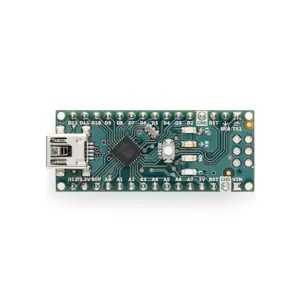
The Arduino Nano V3 is a compact, breadboard-friendly development board built around the Atmel ATmega328P microcontroller. It’s designed for rapid prototyping where space is a premium, offering the full functionality of larger Arduino boards in a significantly smaller form factor. Its architecture enables efficient execution of complex code, making it a cornerstone for embedded applications and DIY electronics.
Featuring a robust design with high-quality components, the Nano V3 ensures stable operation across various conditions. Its through-hole pin configuration makes it easy to integrate into solderless breadboards or custom PCBs, ensuring both durability and ease of use for educational and professional projects alike. The board’s consistent performance makes it a reliable choice for long-term deployments.
ATmega328P Microcontroller Core
At its heart, the Nano V3 utilizes the ATmega328P, an 8-bit AVR RISC-based microcontroller known for its efficiency and extensive ecosystem. This powerful chip provides 32KB of Flash memory for program storage, 2KB of SRAM for dynamic data, and 1KB of EEPROM for persistent data, offering ample resources for a wide range of embedded applications, from sensor data processing to motor control.
Versatile I/O and Connectivity
The board offers a comprehensive array of input/output options, including 14 digital I/O pins (6 of which support PWM) and 8 analog input pins. Communication is facilitated through UART, SPI, and I2C interfaces, alongside a Mini-B USB port for programming and power. This rich set of interfaces allows seamless integration with a multitude of sensors, actuators, and communication modules, resolving common connectivity challenges in embedded development.
Optimized for Performance & Integration
- Microcontroller: ATmega328P
- Operating Voltage: 5V
- Input Voltage (recommended): 7-12V
- Digital I/O Pins: 14 (6 PWM outputs)
- Analog Input Pins: 8
- Flash Memory: 32 KB
- SRAM: 2 KB
- Clock Speed: 16 MHz
Features & Benefits
- Compact Footprint: Enables integration into space-constrained projects without compromising functionality.
- ATmega328P Processor: Provides powerful processing for diverse embedded and IoT applications.
- Rich I/O Array: Offers 14 digital and 8 analog pins for extensive sensor and actuator interfacing.
- USB Connectivity (Mini-B): Simplifies programming and power delivery from a computer.
- Breadboard Friendly: Pin headers are perfectly spaced for solderless prototyping on standard breadboards.
- Arduino IDE Compatible: Leverages the vast Arduino ecosystem for easy code development.
Pro-Grade Advantages
- Exceptional compactness for space-constrained designs and wearables.
- Powerful ATmega328P ensures broad compatibility with existing Arduino libraries.
- Integrated USB-to-serial converter simplifies programming and debugging.
- Breadboard-friendly form factor accelerates prototyping and iterative development.
Technical Considerations
- Mini-B USB connector is less common than USB-C, requiring specific cables.
- Limited processing power for highly complex AI/ML or high-bandwidth applications.
What is the primary microcontroller used on the Arduino Nano V3?
The Arduino Nano V3 utilizes the ATmega328P, an 8-bit AVR microcontroller, renowned for its efficiency and extensive community support.
What are the power options for the Arduino Nano V3?
The Nano V3 can be powered via its Mini-B USB port, through the VIN pin (7-12V recommended), or via the 5V pin (regulated 5V supply).
How many digital and analog pins does the Nano V3 have?
It features 14 digital I/O pins, 6 of which can be used for PWM output, and 8 analog input pins (A0-A7).
Is the Arduino Nano V3 compatible with standard breadboards?
Yes, its compact design and standard 0.1-inch (2.54mm) pin spacing make it highly suitable for solderless breadboard prototyping.
What programming environment is recommended for the Arduino Nano V3?
The Arduino IDE (Integrated Development Environment) is the official and most recommended platform for programming the Nano V3, offering a vast library ecosystem.
| Specification | Value |
|---|---|
| Microcontroller | ATmega328P |
| Operating Voltage | 5V |
| Input Voltage (recommended) | 7-12V DC |
| Digital I/O Pins | 14 (6 PWM) |
| Analog Input Pins | 8 |
| DC Current per I/O Pin | 20 mA |
| Flash Memory | 32 KB (ATmega328P) |
| SRAM | 2 KB (ATmega328P) |
| EEPROM | 1 KB (ATmega328P) |
| Clock Speed | 16 MHz |
| USB Connector Type | Mini-B USB |
| Integrated USB-to-Serial | FTDI FT232RL (older) / CH340 (newer clones) |
Additional information
| Weight | 0.007 kg |
|---|---|
| Dimensions | 4.5 × 1.8 × 0.5 cm |
| Brand | Arduino |
| Processor/SoC | ATmega328P |
| Operating Voltage | 5V |
| RAM/Flash Memory | 2KB SRAM, 32KB Flash |
| Control Interface | USB (Mini-B) |
| Main Controller | ATmega328P |
Reviews
There are no reviews yet.